Come for capability, not just capacity: Why Europe is looking to India for tech partnerships
Countries around the world are investing in their own semiconductor capabilities, AI models, and critical infrastructure. But building everything independently is neither practical nor always necessary. The challenge is to balance strategic sovereignty with international collaboration.
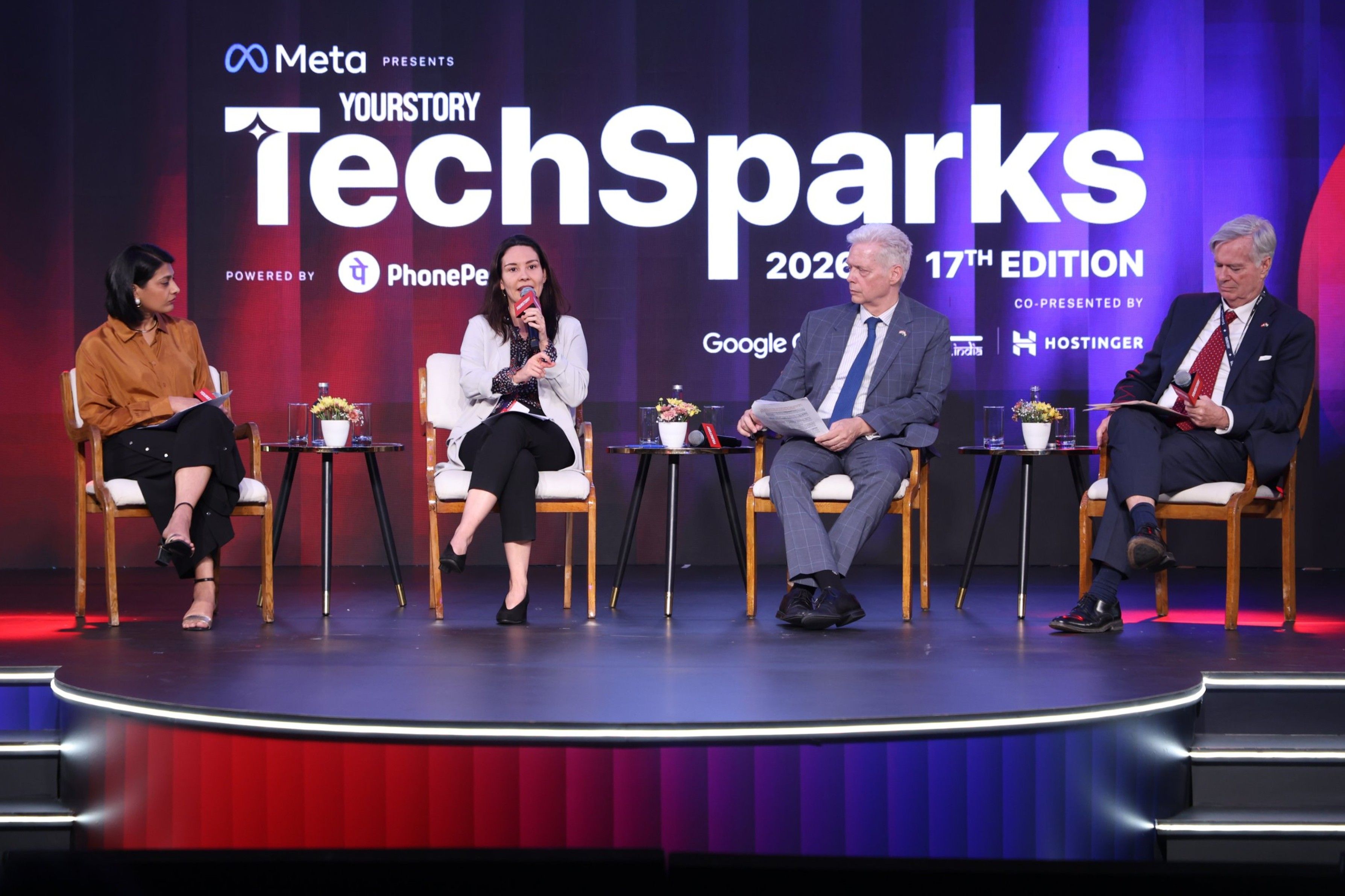
This was the focus of a panel titled 'New tech alliances: Why the world's startups need India, and India needs the world' at TechSparks 2026 in Bengaluru on October 15. The discussion explored how Indian startups could work with international technology ecosystems and how global partners could build stronger ties with India.
The panel featured Dr Angela Honegger, CEO and Consul General, Swissnex India (Switzerland); Jacobus Johannes 'Jaap' Veerman, Consul-General of the Kingdom of the Netherlands in Bangalore; and Peter Winther-Schmidt of the Consulate General of Denmark in Bangalore. The three representatives discussed programs that help startups access research, funding, markets, and partnerships across India and Europe.
Balancing sovereignty and collaboration
“We have to avoid equating strategic sovereignty with technological independence,” Winther-Schmidt said.
While defence and security require a degree of sovereignty, he argued that areas such as talent, research, and technical interoperability benefit from international cooperation.
He cited the European Union’s digital identity wallet, which he said is being built on the Indian technology stack with support from India.
Veerman agreed that countries should identify what is critical to their own ecosystems while remaining open to partnerships.
“I don't believe in isolation,” he said, emphasising the importance of finding the right partners.
Honegger also stressed the need for cooperation. “If we want a fighting chance, we have to collaborate,” she said.
Switzerland: Connecting research with startups
Honegger described Swissnex as a science consulate with six locations worldwide, including Bengaluru.
Its programs cover student and researcher exchanges, joint research funding for Swiss-Indian teams, bilateral startup exchanges, and market-validation camps. Under its startup program, 10 startups from each country visit the other to explore opportunities.
She cited Suind, a company working across AI, drones, and agriculture, as an example of cross-border collaboration.
Founded by a Swiss and an Indian entrepreneur, Suind initially opened a subsidiary in Bengaluru before switching the locations of its headquarters and subsidiary.
“Technically, they are an Indian startup with a Swiss arm,” Honegger said.
She encouraged Indian deeptech founders to consider moving part of their research and development operations to Switzerland while retaining their headquarters and manufacturing in India.
Switzerland Innovation Parks, she said, offer access to research facilities, specialized technology platforms and public funding for joint R&D with Swiss institutions. Bengaluru-based robotics startup CynLr has already opened a subsidiary in one of these parks.
Honegger also highlighted Apertus, Switzerland's open-source large language model, as an example of efforts to develop public AI infrastructure and prevent control of the technology from becoming concentrated “in the hands of a few corporates”.
The Netherlands: Partnerships across the semiconductor industry
Veerman spoke about the Netherlands’ semiconductor partnership with India, signed a couple of months earlier.
The agreement covers semiconductor design, photonics, and advanced packaging, alongside manufacturing. He also said Dutch semiconductor equipment company ASML is establishing a presence in India.
The Dutch consulate recently brought 17 startups to Semicon India as part of its efforts to strengthen technology ties between the two countries.
Veerman also highlighted Brain Bridge, a programme connecting Dutch and Indian universities with Dutch companies already operating in India.
Five Indian medtech startups have been selected for grants to explore opportunities in the Netherlands, while a cybersecurity mission is also being planned.
“We look at Bangalore as the Silicon Valley of Asia,” Veerman said.
Denmark: Supporting joint development
“The key word for us is co-development,” said Winther-Schmidt, outlining Denmark’s approach to working with Indian startups.
He highlighted the country's Water Challenge, which brings 10 selected Indian startups to Danish universities to work on AI-led water-cleaning solutions. The startups subsequently pitch their ideas to investors, with seed funding available.
Denmark’s Green Strategic Partnership with India is also being renewed and expanded to include spacetech, deeptech, and defence technology.
Winther-Schmidt pointed to a recent memorandum of understanding between DTU and IIT Madras, alongside efforts to bring venture capital and private equity investors from both countries together through a “financing bridge”.
He also mentioned the Danish Impact Fund, which primarily provides loans for solutions that have a positive environmental impact.
What Indian startups should keep in mind
The three representatives offered practical advice for Indian founders looking to enter European markets.
Winther-Schmidt urged startups to identify a specific market rather than approach Europe as a single destination.
“Don't treat Europe as a single destination,” he said.
He advised founders to validate their value proposition before entering a market, invest time in building relationships, and be willing to share their solutions with local partners rather than being overly protective of them.
Honegger called for greater willingness among Indian companies to take risks when working with international startups.
She wanted to see “more risk appetite... to become a co-creator and not just a receiver of innovation”.
Swiss startups, she explained, often find that discussions with potential Indian partners end after a free pilot project. She argued that companies should be more willing to share the financial and operational risks of developing new technologies.
The solution, she said, was to “share the risk that comes with innovation on multiple shoulders”.
During the audience interaction, an 11-year-old founder asked how smaller companies could navigate European regulations such as the General Data Protection Regulation (GDPR). The panel advised startups to prepare early, choose their target markets carefully, and seek guidance from local partners, consultants, and consulates.
India as a partner for capability
Winther-Schmidt said Danish companies had traditionally viewed India primarily as a market that offered scale. But that, he argued, was only part of the opportunity.
“You don’t come to India for capacity, you come actually to India for capability,” he said. He also emphasized that international partnerships should involve learning on both sides.
“We don't have so much we can teach India... We can learn as much from them,” he added.
Edited by Teja Lele
This content is published by YourStory and has not been created or edited by Hello Headlines. View original