Bulldozers and burden of proof: Assam’s 2021–26 eviction drives
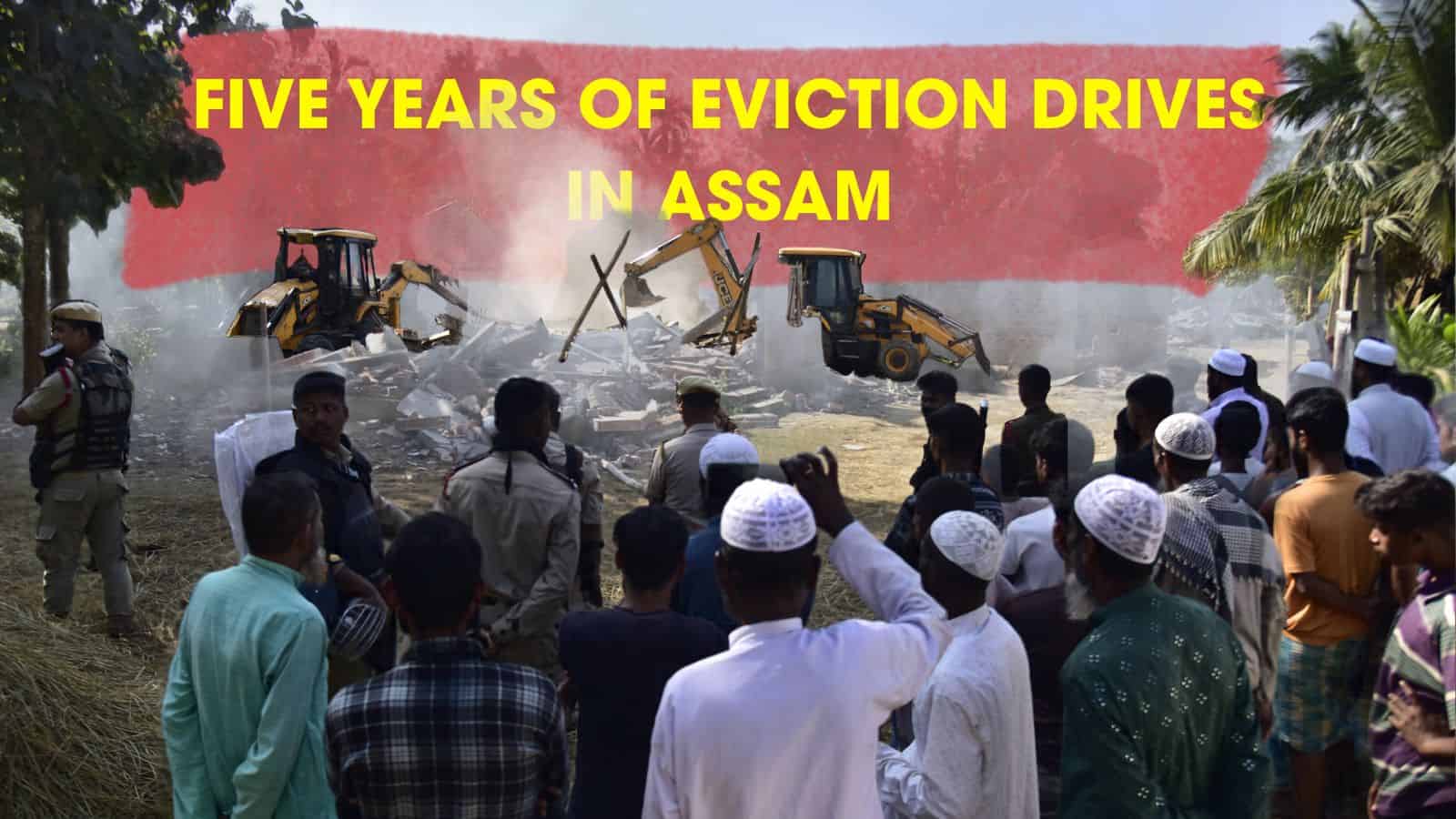
Thousands of families have lost their homes in Assam in the name of clearing encroachment. Here’s a look at what the record shows, what the state argues, and what remains unanswered.
The scale
Between May 2021 and 2026, Assam carried out at least 33 documented eviction operations, displacing 20,387 families and over one lakh people, according to a March 2026 New Humanitarian investigation. Other estimates put the number of structures demolished at over 22,000. Outlook India data puts the number at roughly 19,000 families over the past decade. Revenue department figures show that over 10,620 families, most of them Muslim, were removed from government land between 2016 and August 2024.
The pace has not slowed. On October 17 and 18, 2026, more than 1,100 families were reportedly evicted from reserved forest land across Nagaon, Hojai, and Golaghat.
The drives have spread across Lower and Upper Assam. In January 2023, 300–500 families were evicted from Pabha Reserved Forest in Lakhimpur. In July 2025, 1,080 families lost their homes at Paikan in Goalpara and about 1,400 were removed from Chapar in Dhubri. Between July and August 2025, around 2,500 families were evicted near Rengma Reserve Forest in Golaghat. In January 2026, over 700 families were evicted in Sonitpur, while evictions resumed in Dhubri.
Evictions have also claimed lives. In 2021, 2,051 families were reportedly evicted from Dhalpur and Gorukhuti in Darrang, where two villagers were killed in police firing. Two protesters were killed in police firing at Kasutoli, near Guwahati, in September 2024. In Goalpara, around 2,700 structures were reportedly demolished in July 2025.
On July 17, five days after the Paikan eviction, 19-year-old Sakuar Ali was shot dead when police opened fire on evicted people and protesters. His family has sought an FIR against the police. Goalpara’s district commissioner said forest guards and police were attacked with sticks and stones, prompting police to fire. These competing accounts warrant an independent inquiry.
The state’s case
The government maintains that these are anti-encroachment drives targeting forest, government and village grazing land. After the October operations, an official told reporters that families who approached the court had their claims rejected and that the drive resumed only after all legal requirements were met. The state has also welcomed a Gauhati High Court ruling on forest encroachment. Advocate Santanu Borthakur has argued that merely living on forest land, however long, does not confer a permanent right to settle there.
Chief Minister Himanta Biswa Sarma has repeatedly framed the issue as one of illegal immigration from Bangladesh and the protection of indigenous land. That is a legitimate policy debate. The difficulty lies in how the two arguments are joined.
Two legal questions, taken as one
Encroachment and citizenship are separate legal questions. Someone occupying government land is a matter of land law. Whether someone is a foreigner is decided through Foreigners Tribunals and the citizenship process following the NRC, not by a demolition order.
Many of those evicted held pattas (land titles issued by the state), ration cards, and voter IDs, and had settled 50 to 60 years ago after the Brahmaputra’s erosion took their earlier homes. If that is accurate for a significant share of cases, the label “Bangladeshi” is doing legal work that no tribunal has performed. Families displaced by erosion are often labelled “Bangladeshis”, “outsiders” or “encroachers”, and residents say this happens without any proof. Critics argue this deepens communal polarisation and leaves Muslim communities more vulnerable.
Land cleared, and who receives it
In Dhubri, the Assam Tribune reported in January 2026 that evictions had resumed to make way for an Adani Power thermal project, with titleholders objecting.
Activists point to large allocations to corporate projects, including 515 acres for Tata’s semiconductor facility, 3,624 bighas for Patanjali in Chirang, 3,000 bighas for a JK Lakshmi Cement subsidiary and a proposed 6,000-acre Reliance-linked solar project.
The pattern deserves scrutiny, but a careful report must establish whether the allocated plots are the same ones that were cleared. Activists argue the net result is that vulnerable families, disproportionately Muslim, lose their homes and livelihoods while corporations gain access to vast landholdings.
The selectivity question
Displaced residents have alleged that Hindu families and temples were left untouched, according to Global Voices. Muslims were reportedly the majority of those affected, and reports put their share above 90 per cent in areas such as Dhalpur, Lumding, Pabha, Hasila Beel and Kachutoli. Yet there is no public, religion-disaggregated dataset of evictions. Without one, the claim of selective enforcement cannot be proved or disproved, and the government has not published such data.
Rhetoric and timing
On January 27, 2026, Sarma said that if a rickshaw fare is Rs 5, people should pay Rs 4, and that his work was to cause hardship to “Miya” people, according to The Wire. He also said 4–5 lakh “Miya voters” would be removed from the rolls during SIR. He later described the remarks as symbolic and denied calling for a social boycott. Activist Harsh Mander filed a police complaint in Delhi. A video then circulated of a woman paying a rickshaw puller Rs 4 instead of Rs 20. A CM’s words matter when he also controls the machinery of enforcement.
Timing also invites questions. The Nagaon Lok Sabha by-election was held on October 6, 2026, and on October 9, BJP’s Devasish Sharma won by about 1.72 lakh votes over AIUDF’s Badruddin Ajmal, in a constituency reported to be roughly 61 per cent Muslim. Eviction operations followed on October 17 and 18, and an official described them as a resumption. Commentators quoted by PTI in August 2025 had argued that the drives were meant to shape a political narrative. Timing does not prove motive, and the government has given reasons for each operation, but the sequence is worth recording.
What the law and rights framework say
The Supreme Court has read Article 21 to include a right to shelter and livelihood, which makes eviction without rehabilitation constitutionally vulnerable. In November 2024, in its bulldozer judgment, the Court laid down notice and hearing safeguards for demolitions, with exceptions for unauthorised structures on public land and for court-ordered removals. The state can rely on those exceptions; critics argue that long-settled, document-holding families sit uneasily within them.
Internationally, India is a party to the ICESCR, whose General Comment 7 requires genuine consultation, adequate notice and no eviction that renders people homeless. The UDHR’s Article 25, on an adequate standard of living including housing, is a declaration and not a binding treaty.
After the bulldozers
The most consistent finding across reports is the lack of rehabilitation. Families in Lakhimpur and Golaghat reportedly received no alternative land. In Hasila Beel, the Gauhati High Court ordered basic amenities for displaced families. In Dhubri, residents said the resettlement land offered was low-lying riverbank. Many had already lost their homes to erosion, making this a second displacement.
The state can protect forests and public land, and courts have upheld some actions. But legality does not settle questions of justice: Were claims of long residence and valid documents examined before demolition? Was enforcement applied equally across communities? And why is rehabilitation still the exception?
Get the latest updates in Hyderabad City News, Technology, Entertainment, Sports, Politics and Top Stories on WhatsApp & Telegram by subscribing to our channels. You can also download our app for Android and iOS.
This content is published by The Siasat Daily and has not been created or edited by Hello Headlines. View original