1387 Vijayanagara inscription unearthed in Karkala reveals land grants
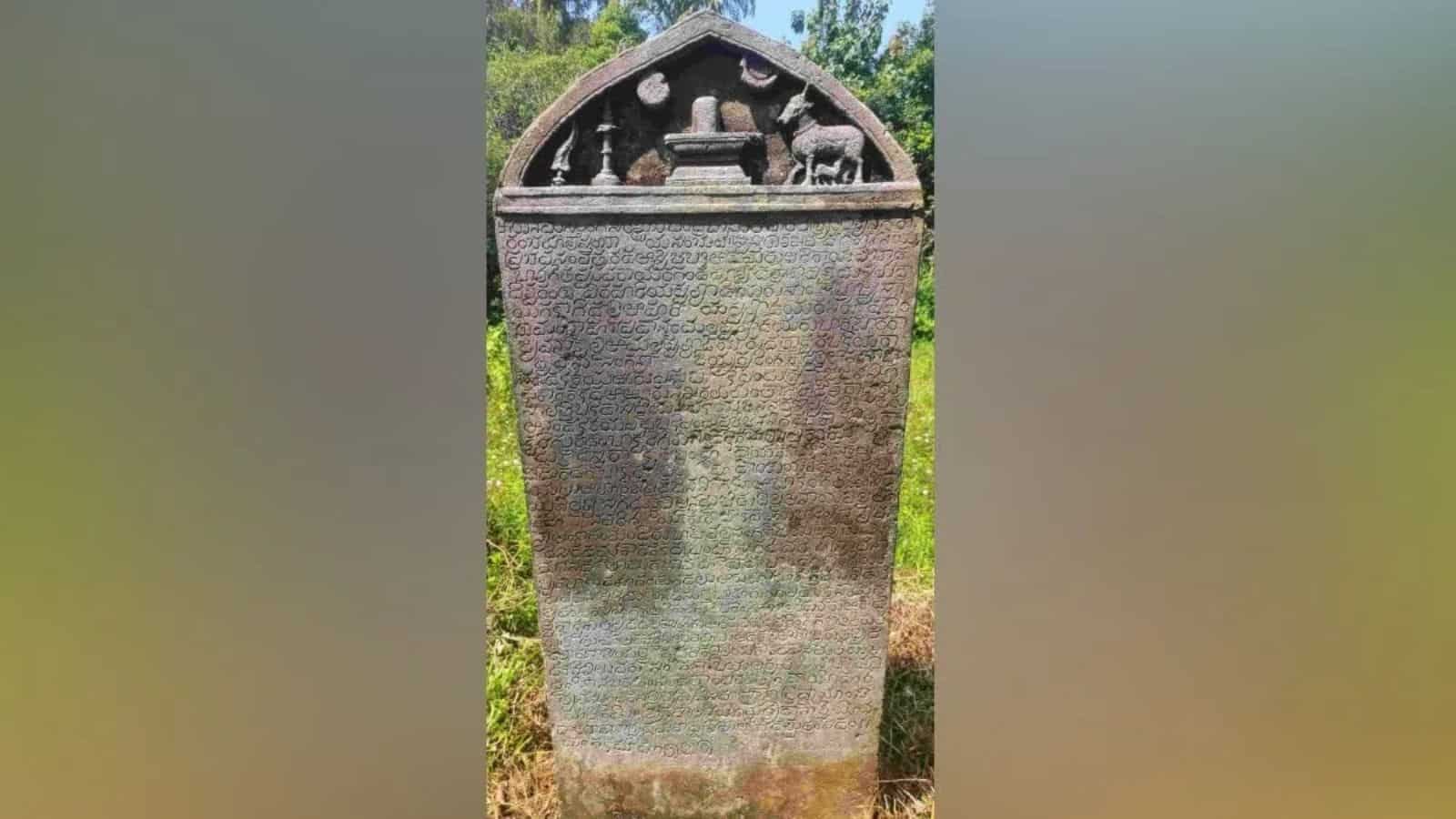
Udupi: An important stone inscription believed to date back to 1387 AD, during the Vijayanagara period, has been discovered at Dasanda Bakimaru near the Jumadi temple in the Kedinje area of Belman village in Karkala taluk.
Professor T Murugeshi, retired archaeology professor and founder trustee of Adima Kala Trust, said the discovery was significant for understanding the political, religious and cultural history of coastal Karnataka. Although the inscription is written in Kannada script and language, it contains several Tulu words, reflecting the linguistic interaction prevalent in the region during that period.
Carved on green schist, also known as soapstone, the inscription measures 46.5 cm by 23 cm. Its upper portion has an elaborate sculptural panel depicting a Shiva Linga in the centre, a cow nursing its calf on the left, and a lamp pillar and ‘Kadsale’, a sword associated with Tulu Nadu’s spirit-worship traditions, on the right.
The lower portion contains 34 lines of writing. It opens with a Swastika symbol and a prayer to Lord Shiva.
The date mentioned in the inscription is Saka 1039, Prabhava Samvatsara, Bahula 3. However, Professor Murugeshi said this date was inconsistent with the chronology of the Vijayanagara rulers. Based on historical calculations, the inscription should be dated to Saka 1309, corresponding to 1387 AD.
The record refers to Vijayanagara ruler Immadi Harihara Raya and praises him as the sovereign of the eastern, southern and western seas.
It also provides information about the administration of the Barkur region. According to the inscription, Mahapradhana Mallappa Odeya governed Barkur under the orders of Hariyappa Odeya. Mallappa Odeya later transferred the Dattaluva kingdom to Sanganna Jaya Arasa.
One of the significant aspects of the inscription is its account of a land grant at Nandalike. Sanganna Jaya Arasa donated two parcels of land, described as ‘Balike’, to two brothers, Kotishwaralva and Kadambalva. The grant was made as Brahmadaya and carried exemption from all taxes.
The beneficiaries were required to provide six mudis of paddy annually to a Brahmin engaged in reciting or teaching the Puranas. The obligation was to be fulfilled regularly and without any interruption.
The inscription imposed financial penalties for violations of the endowment. A violator, including the state, would be required to pay 250 Gadyanas to the king and 150 Gadyanas to the deity. Such provisions underline the importance attached to protecting religious grants.
The inscription was authored by Vittanna, the Senabova of Jaya Arasa. It ends with customary warning verses against anyone who might violate its terms.
The inscription was brought to the notice of Professor Murugeshi by Sinchith M. and Shodhan B., first-year BA archaeology students of Shirva MSRS College, who identified the historical stone.
Professor Murugeshi congratulated the students and acknowledged the assistance of Suhas Hegde of Nandalike Palace, his mother Sarala S Hegde, Dr Suresh Chitrapu of the Mulki Gazani Foundation and Dr Raghuram Shetty of the Gulladi Rani Chikkayi Thayi Charitable Trust in facilitating the study.
Get the latest updates in Hyderabad City News, Technology, Entertainment, Sports, Politics and Top Stories on WhatsApp & Telegram by subscribing to our channels. You can also download our app for Android and iOS.
This content is published by The Siasat Daily and has not been created or edited by Hello Headlines. View original