What Makes A Bond Worth Buying? A Framework For Comparing India’s Top Corporate Bond Opportunities
In recent years, Indian fixed income markets have seen increased participation from different investor groups as access to corporate bonds has become more structured. Earlier, these instruments were primarily accessed through institutional channels, but digital systems have gradually introduced more structured and transparent access to bond information. This shift has also increased the need for clear comparison methods when reviewing multiple issuers and structures. As information availability has improved, key factors such as credit quality, issuer profile, tenure, and structure are increasingly considered when assessing corporate bond instruments.
Why Investors Can Consider Bonds
No single factor determines whether a corporate bond is suitable for an investor. In the context of corporate bonds, investors often review a combination of characteristics, including the bond interest structure, credit profile, maturity, and potential role within a broader investment portfolio. Together, these characteristics explain why corporate bonds are often considered alongside other fixed-income instruments.
Wider Access Through Digital Platforms
Digital investment platforms have made corporate bond information more organised by presenting issuer details, credit ratings, coupon rates, maturities, and disclosures in a structured format. This has made it easier to review and compare various bonds to invest in through a single interface.
Regular Income Potential
Many corporate bonds provide coupon payments at predetermined intervals, subject to the bond terms and the issuer's ability to meet its obligations. This defined payment structure is one of the characteristics that investors may consider when evaluating fixed-income instruments.
Defined Repayment Timeline
Unlike perpetual bonds, most corporate bonds have a specified maturity date on which the principal amount is generally repaid, subject to the bond terms. This defined investment horizon may be relevant for investors planning around specific financial timelines.
Portfolio Diversification
Corporate bonds are often considered alongside equities, fixed deposits, and other fixed-income instruments as part of a diversified investment portfolio. Because they have different structural characteristics from other asset classes, they may provide additional diversification within an overall investment strategy.
Range of Investment Options
The corporate bond market includes issuances across different sectors, credit ratings, coupon structures, and maturities. This variety allows investors to review instruments with different characteristics based on their investment objectives and risk preferences.
Regulated Market Framework
Publicly issued and listed corporate bonds in India are regulated by SEBI, while issuance and settlement follow applicable regulatory frameworks. Standardised disclosures, credit ratings, and offer documents provide information that supports comparison across different issuers and bond issuances.
Framework for Comparing Bond Opportunities
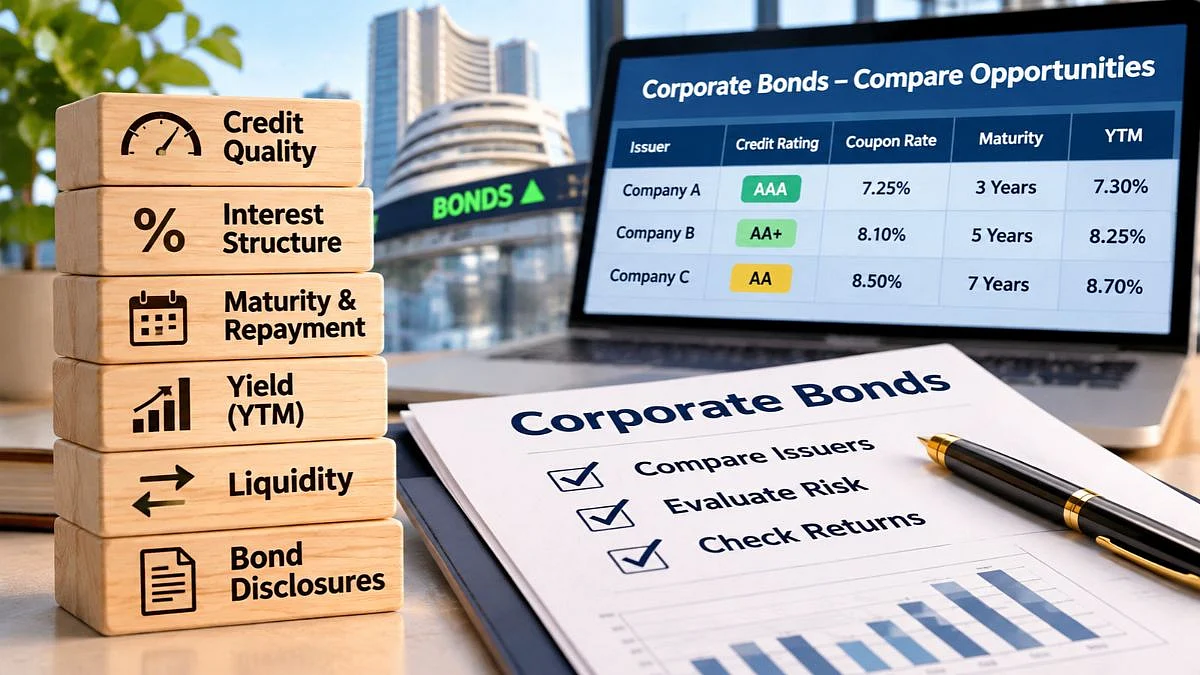
Once the characteristics of individual corporate bonds are understood, they may be compared using a structured evaluation framework. Reviewing similar parameters across issuers may help create a more consistent basis for comparing top corporate bond investments.
Compare the Issuer's Credit Profile
Comparing the credit profiles of different issuers provides insight into their relative financial strength. Investors often review credit ratings alongside the issuer's financial position, business performance, and repayment history when available.
Compare Interest Structure
Coupon rates should be evaluated together with the coupon structure. Bonds offering similar coupon rates may still differ depending on whether interest is fixed or benchmark-linked, as well as the frequency of coupon payments.
Compare Maturity and Repayment Structure
Corporate bonds may have different tenures and repayment arrangements. Comparing bonds with similar maturities generally provides a more meaningful basis for evaluating their characteristics.
Compare Yield Alongside Credit Quality
Yield to Maturity should not be assessed in isolation. A higher yield may reflect differences in credit profile, maturity, liquidity, or market conditions. Comparing yields among bonds with broadly similar characteristics often provides a clearer context.
Compare Liquidity
Liquidity may influence how easily a bond may be traded before maturity. Comparing trading activity and market availability may help differentiate bonds with otherwise similar features.
Review Bond Disclosures
Offer documents, credit rating reports, and issuer disclosures to provide detailed information about the bond terms and conditions. Reviewing these documents may help clarify coupon structure, repayment provisions, and other important features before making comparisons.
Using Digital Platforms for Bond Comparison
Digital platforms have made corporate bond information more organised by presenting issuer details, credit ratings, coupon rates, YTM, maturity dates, and disclosures in a structured format. Instead of gathering information from multiple sources, investors may review different corporate bond issuances through a single interface, making comparisons more systematic.
Conclusion
Comparing corporate bond opportunities involves reviewing multiple characteristics rather than relying on a single measure such as yield or credit rating. Factors including the issuer's credit profile, interest structure, maturity, liquidity, and bond disclosures together provide a more comprehensive basis for evaluation. As corporate bond information has become more organised through regulated digital infrastructure, comparing instruments across different issuers has also become more structured. Within this ecosystem, platforms such as Altifi present corporate bond information in a standardised format, supporting the review and comparison of instruments within India's fixed income market.
This content is published by Free Press Journal and has not been created or edited by Hello Headlines. View original