From code to content: How AI could make India the world’s next story exporter
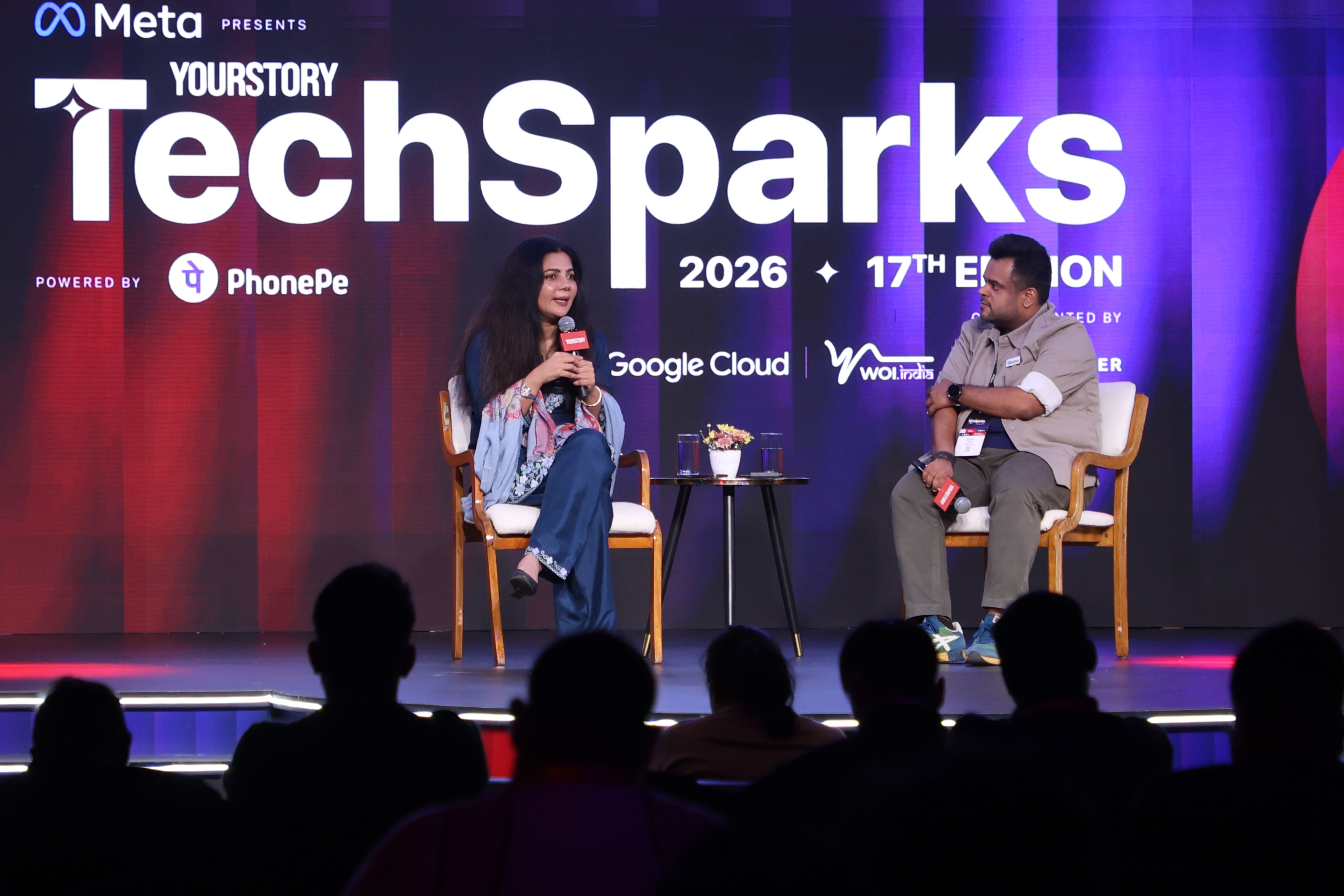
India spent the 1990s and 2000s becoming the back office of the world for code. At TechSparks 2026, a flagship event of YourStory, one founder asked whether the country can now do the same for stories. As AI makes video production more efficient and economical, his answer was a confident yes.
The session, titled ‘Can AI turn India into a global content export hub?’, began with the product showcase of Dolphin AI by Saurabh Pandey, Founder and CEO of Eloelo Group, and then moved into a fireside chat with Shradha Sharma, Founder and CEO of YourStory and The Bharat Project.
Why India has not yet exported its stories
Pandey noted that India has long produced standout IPs such as Baahubali, Kantara, and RRR, but has rarely been an exporter. Japan did it with anime, South Korea with K-dramas, China with micro dramas, and the US with Hollywood. Each, he said, used content to build soft power.
AI, in his view, changes the equation because the tools once available only to a few markets are now open to everyone. The opportunity also goes beyond films, to localized advertisements, commerce videos, and social media content for overseas customers.
Dolphin AI: One suite from idea to final cut
To make that case concrete, Pandey introduced Dolphin AI, Eloelo’s newest launch. The company began with live entertainment, moved into micro dramas with its Story TV app, and recently added a micro learning app called Master.
Dolphin AI targets a familiar creator hurdle: making one AI video often means stitching together clips and edits from around 20 tools. Dolphin AI replaces that with an agentic chat and a set of templates. A simple prompt can produce a full video, with the suite handling context and continuity. It also integrates with Claude and ChatGPT through MCP, helping creators build longer AI videos. A short demo reel closed the showcase.
Fireside chat: Removing the gatekeepers
When Sharma joined Pandey on stage, she reacted to the demo with pride. “This is remarkable. This is real, and this is happening in India,” she said.
The conversation first turned to adoption. Pandey said roughly 15,000 videos were created on Dolphin AI in eight days in its early access phase, entirely through organic discovery.
He then explained why this matters for storytellers. High-end visual effects once meant massive budgets, and those budgets acted as a filter on who could tell ambitious stories.
“With AI, with tools such as Dolphin AI, what we are trying to build is that you can ship content without any gatekeepers,” he said. He clarified that AI is not replacing actors but expensive locations, so a period drama no longer needs a real palace. With distribution now largely algorithmic, a storyteller in India can reach audiences in the US or Europe.
Asked why India has lagged, Pandey did not blame creativity. He compared South Korea, with 52 million people and a content export economy of about $15 billion, to India’s 1.4 billion.
“I would refuse to believe that we don’t have the creativity,” he said. In his view, technology, aspiration, distribution and capital must come together, and Indian builders have too often treated the local market as the only one that matters.
The micro drama moment
On whether micro dramas can finally work as a business in India, Pandey cited China, where the category reached roughly $8 billion in revenue last year and is now at a run rate of $10 billion to $11 billion, with a single platform earning more than China’s entire box office. In India, he said, the combined run rate of the top four or five players is north of Rs 5,000 crore, reached in about 18 months.
Production costs have been the stumbling block, historically eating up 50-60% of revenue. AI, he argued, finally fixes the supply side. “This is that quick commerce moment of entertainment,” he said.
Where the opportunity sits
Pandey expects platforms to consolidate around two or three players, as food delivery and ecommerce did. Supply, however, will stay open. Eloelo launched 200 new micro dramas last month for its microdrama platform Story TV and works with about 90 production houses, a number he sees doubling.
His advice for new entrants was to build on the supply side. Small, nimble AI studios of a few editors, promo producers and a line producer could supply platforms with micro dramas and OTT content. He urged writers and producers to treat AI as a brainstorming partner, and floated the idea of an AI-made Mahabharat.
“The next Disney or the next big IP can be built now if the right supply engine comes in because the demand is very clear,” he said.
The window to build
Pandey said Eloelo, which has grown from one platform to five, is not eyeing an IPO soon and is focused on sustainable growth while it builds for India’s global ambitions.
Sharma called his journey from a Flipkart employee to founder building for the world a reminder of what Indian aspiration can achieve. She urged the audience to tell their teams and networks that the window to build in this space is open. If India turned code into a global export, the session suggested, stories could be next.
This content is published by YourStory and has not been created or edited by Hello Headlines. View original