Rare cream-yellow Coppersmith Barbet spotted at Kodakanchi Lake in Sangareddy
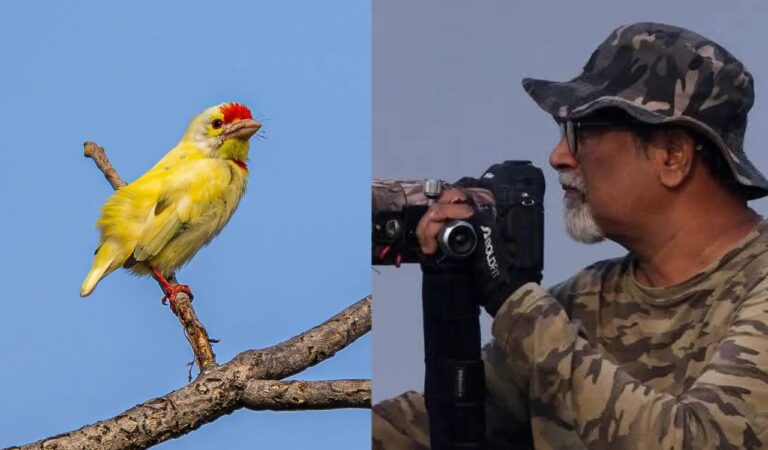
Hyderabad: For the birding community, all roads seem to lead to Kodakanchi Lake in Sangareddy what started as a routine morning birding trip for local enthusiasts Raj, Jags, and Syam (the Birding Trio) quickly transformed into an unforgettable scientific spectacle when the trio stumbled upon a extraordinarily rare, sun-drenched marvel hiding in plain sight. “Perched among a flock of standard crimson-and-green Coppersmith Barbets (Psilopogon haemacephalus) was a dazzling, bright cream-yellow bird,” says Syam Sundar Potturi, an avid birder from the City and an acknowledged authority on birds. “At first, our euphoria was driven by the thought that we had discovered an entirely new species,” the trio recalled. “That initial excitement soon turned into pure joy when we realized what we were actually looking at: a stunning, one-of-a-kind genetic mutation within a familiar species,” he informed ‘Telangana Today’. “While color variations like leucism (a deficit of melanin causing pale patches) and melanism (an overabundance of dark pigment) are occasionally documented in the animal kingdom, vibrant color shifts remain exceptionally rare in the wild,” he said.
So, how does a naturally emerald-green bird turn brilliant gold? “Normally, a Coppersmith Barbet’s iconic green plumage is an optical illusion created by a complex mix: dark melanin pigments combined with microscopic light-scattering structures in the feathers, layered over naturally occurring yellow and red pigments (carotenoids),” Syam Sundar Potturi explained. “When a rare genetic or metabolic disruption halts melanin production, the structural green effect completely collapses. Without dark melanin to create the green hue, the underlying yellow carotenoids take center stage—transforming the bird into a glowing golden variant,” he said.
“What is Xanthochroism? Experts categorize this phenomenon as a form of leucism leading to xanthochroism (often referred to broadly as a lutino or yellow mutation). It occurs when melanin is entirely missing, allowing yellow and red pigments to visually dominate the bird’s plumage,” he reasoned out. “Definitely while a tiny handful of cream-yellow Coppersmith Barbets have been recorded by birdwatchers and ornithologists over the years, wild sightings remain a once-in-a-lifetime occurrence. For Raj, Jags, and me, an ordinary morning outing turned into an extraordinary reminder of the endless surprises nature holds right in our backyard,” signed off a visibly delighted Syam Sundar Potturi.
This content is published by Telangana Today and has not been created or edited by Hello Headlines. View original