From scrap to stories: Ashoke Lyngdoh’s passion for vintage cars gives shape to heritage museum
By Our Reporter
SHILLONG, Nov 4: What began as a childhood fascination with old vehicles has taken shape as a carefully tended collection of vintage cars, motorcycles, antiques and art.
On Wednesday, Ashoke Lyngdoh, owner of Rock Cliff Homestay in Shillong, opened the doors of his heritage museum, bringing years of quiet passion and patient restoration into the public view.
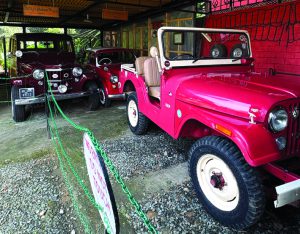
For Lyngdoh the museum is not simply a display of automobiles. It is a personal journey through history, memory and objects that have outlasted their original purpose. Many of the vehicles were rescued from scrapyards at a time when their owners saw little remaining value in them.
“These cars and motorcycles are basically all from the scrapyard, mostly,” he said. “In those days, it was very affordable to buy these cars because people didn’t want them. So basically, we took dead vehicles and gave them life.”
The idea of a museum had stayed with him for years, repeatedly set aside by work and other demands. This year he fixed November 4 as the date and worked against a tight schedule to bring the pieces together. The result is a space that reaches beyond the vehicles themselves. Visitors can walk through the house, its distinctive décor, the antiques, the landscaped gardens and several forms of art—installation pieces, restoration work, 3D forms and traditional pieces.
Lyngdoh speaks of the entire property as his personal canvas, one that continues to change with every new addition. “I consider this property my landscape. It’s my canvas, actually. I don’t paint with a brush, but with objects and colours,” he said.
He does not intend the work to reach a finished state. New objects and installations will keep arriving. “Every week you come, every two weeks you come, something new is going to be there. I consider it to be an organic canvas. It’s alive and vibrant.”
Lyngdoh’s interest in old machines began early. At the age of four he developed a particular fondness for jeeps. Around 1971 he saw two CJ5 Willys jeeps that had arrived in Shillong. At a time when the more common CJ3B models filled the roads, the rounded fenders of the CJ5s stood out. The sight stayed with him. Some of his earliest photographs show a small boy sitting in a jeep, wearing a hat. That early admiration grew into a lifelong practice of finding, acquiring and restoring vintage vehicles.
The collection has drawn vehicles from beyond Shillong. One car came from Tinsukia in Assam with neither engine nor gearbox. Friends advised against the purchase, calling the project impossible. Lyngdoh went ahead. The restoration took nearly two years. For him every vehicle carries its own history and its own labour.
One of the most meaningful cars in the group is a blue vintage vehicle that once belonged to his father, who served as Deputy Commissioner of Nagaon in the undivided state of Assam in 1963-64. After the family left Nagaon the car disappeared from their knowledge. In 2010 Lyngdoh learned it was still at the circuit house there. He travelled to Nagaon and began the long process of recovering it. Officials at the Deputy Commissioner’s office helped clear the bureaucratic path. Within ten months the car was back in his hands and the restoration began.
The vehicle holds a particular place because his parents and sisters used it for journeys between Nagaon and Shillong and for everyday travel, including the school run. Although Lyngdoh was born in 1968, years after the car had been part of daily family life, the stories his parents told gave it lasting weight. “I don’t have a car that my father owned, but I have a car that my father drove. So, something is better than nothing,” he said.
Some of his other vehicles have appeared in films. One was used in the adaptation of Rabindranath Tagore’s Shesher Kabita. He is careful to note that the car seen in Richard Attenborough’s Gandhi belonged to the late Hansen Lyngdoh and is not part of his collection.
Space remains limited. While several vehicles now stand at the museum, about seven others stay at his residence. He hopes eventually to expand the display area. With a light touch of humour he calls the cars at the museum “the boys” and those kept at home “the girls.”
The collection is not meant to sit motionless. On Sundays when the weather allows, Lyngdoh and his team take the vehicles out for drives. The pleasure, he says, is not only in the driving. The sight of the old cars often draws smiles from people along the road. “When people see these cars, they break into a smile. And for me, if I can make someone smile, that is my worship.”
The museum also offers a quieter corner in a city that has grown crowded and hurried. The gardens and the measured pace of the place are meant to let visitors slow down. Opening hours are 11 am to 4 pm, and prior online booking is required. Visitors scan a QR code on arrival. Daily numbers are kept to roughly fifty or sixty people so that the character of the property and the condition of the collection can be preserved. “I don’t want it to become a commercial space. The sanctity of the place has to be maintained,” Lyngdoh said.
At the inauguration, family members recalled how deep the interest ran. His uncle Deepak remembered the young Lyngdoh carefully cleaning and protecting his miniature Dinky cars. Having an interest is one thing, the speaker observed; sustaining it with steady attention over decades is another.
Beyond the vehicles, Lyngdoh’s work in education is also of particular note. He founded Springfield School in 1999, an effort that has reached hundreds of children. He has also supported other schools, including one at Thangsning, stepping in where he felt help was needed.
For Lyngdoh the opening marks the realisation of a long-held plan, yet he does not treat it as a completed project. The museum, in his view, will keep growing and shifting.
In a city where new buildings and faster traffic have altered the older landscape, the space offers a quiet argument for keeping what remains of the past.
Through vehicles pulled from scrapyards, family heirlooms, antiques and objects once set aside, he has made a place where history can be walked through rather than merely observed.
The museum stands as the work of a man who saw worth in what others had discarded and chose to give those things another stretch of life, turning a childhood attachment into a lasting act of care.
This content is published by The Shillong Times and has not been created or edited by Hello Headlines. View original