'Advanced Surgical Technologies Should Not Be Limited to Metro Cities': How These Founders Built a Homegrown Surgical GPS
The GPS on your phone helps you find your way to a favourite restaurant, avoid traffic jams and take an unfamiliar road with confidence. It tells you where you are and helps you figure out where to go next.
Now, imagine a similar guiding system inside an operating theatre, helping a surgeon navigate the delicate structures of the human brain or spine.
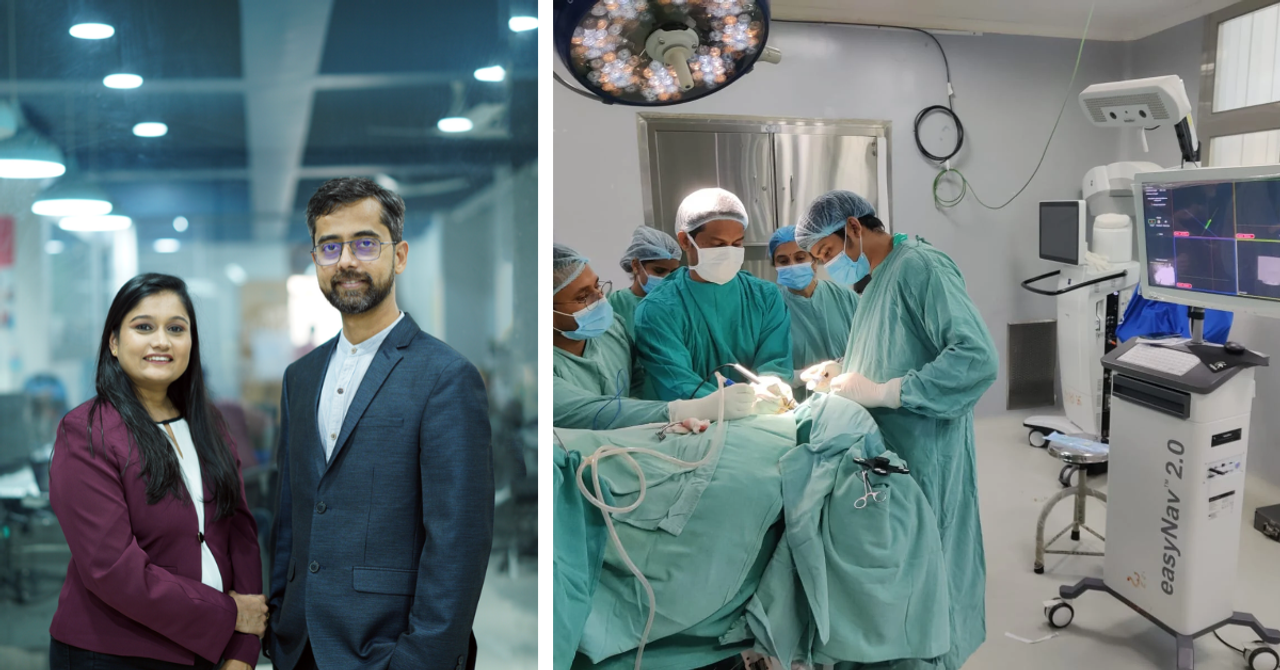
That is the idea behind easyNav™, an image-guided surgical navigation system developed by Bengaluru-based health-tech company HRS Navigation. Using medical images to map a patient’s anatomy and track surgical instruments in real time, the technology helps surgeons understand where they are operating, particularly when working around sensitive nerves, blood vessels, and other critical structures.
Founded in 2015 by Arpit Paliwal and Shweta Paliwal, HRS Navigation has developed an indigenous alternative to imported surgical navigation platforms. Its systems are now installed in more than 200 hospitals and have supported over 20,000 surgeries, according to the company.

But the motivation behind the startup was not simply to build sophisticated medical technology. It was to address a question that Arpit encountered repeatedly: why should access to advanced surgical care depend so heavily on where a patient lives or how much they can afford?
Why surgical precision needed to reach beyond metros
An electronics engineer who also completed an executive programme at IIM Calcutta, Arpit spent around 11 years in an international role before deciding to build a medical technology company in India.
His experience had given him an understanding of surgical navigation and the standards these systems needed to meet. It had also helped him recognise a gap in the market.
Surgical navigation technology was already available internationally, but its adoption in India was constrained by more than the cost of purchasing a machine. Some imported systems required hospitals to buy recurring consumables for every procedure or upgrade their operating theatres to meet specific infrastructure requirements.
For hospitals working with limited budgets, these expenses could make the technology difficult to sustain, particularly when treating patients who could not afford to pay much for surgery.
Arpit recalls meeting families who were struggling to afford treatment. One interaction that stayed with him was that of a father who told him to proceed with his child’s operation, saying he would sell his house to arrange the money.

“I have seen that kind of reality,” he says, describing the experiences that motivated him to build something for India.
For him, the problem was not a lack of medical expertise. It was that the tools available to support complex procedures were not always accessible to the hospitals and patients who needed them.
Simply reducing the price of an imported system would not necessarily solve this problem. The technology also had to work within the realities of Indian hospitals.
“You need to adapt your system to work with the requirements of Indian infrastructure,” Arpit explains.
That became a guiding principle for HRS Navigation. Starting with a small office and building its technology from the ground up, the founders set out to develop a system that could work with the equipment hospitals already had, without compromising on accuracy.
It was a demanding undertaking in a field requiring extensive research, engineering, testing and regulatory compliance. Arpit says developing the technology from the prototype stage took years of work, including studying research papers and building the team’s technical expertise at a time when many of today’s AI tools were not available.
The effort eventually led to easyNav™, designed around two priorities: precision that meets demanding clinical requirements and adaptability that makes the system practical for Indian hospitals.
How does a GPS for surgeons work?
To understand the technology, consider what happens when someone drives through an unfamiliar city without navigation. They must rely on signboards, landmarks and their own judgement to decide which road to take.
A GPS adds another layer of information, showing their position in relation to the route and helping them correct their direction as they move.
Surgical navigation applies a comparable principle inside the operating theatre, using medical imaging rather than road maps.
Before surgery, CT scans provide detailed images of the patient’s anatomy. These images are used to create a reference for the procedure. During the operation, the navigation system tracks the position of surgical instruments and displays where they are in relation to that anatomy.

This gives the surgeon an additional way to check the instrument’s position and trajectory, particularly when the target lies deep inside the body or close to structures that must be preserved.
In brain surgery, for instance, the system can help a surgeon plan the route to a tumour and understand its relationship with important structures. In spine procedures, it can help determine the entry point and trajectory for placing screws.
Dr Ranjit Deshmukh, consultant neurosurgeon at Sahyadri Hospital, Pune, explains that complex procedures have traditionally relied on anatomical landmarks, surgical experience and imaging during the operation to establish orientation.
“Navigation provides an additional layer of anatomical guidance, helping the surgeon plan and execute these procedures with greater confidence,” he says.
With easyNav™, Dr Deshmukh says he can understand where his instruments are in relation to the patient’s anatomy in real time. He particularly values this in complex brain surgeries involving deep-seated tumours, lesions near major blood vessels and procedures around the skull base.
The technology can also support planning when a tumour lies close to functional areas of the brain. Information from techniques such as functional MRI and tractography can help surgeons understand these relationships and plan an approach that aims to remove as much of the tumour as safely possible while preserving critical functions.
Importantly, navigation does not replace a surgeon’s judgement or experience. Instead, it provides additional information to support decisions during critical stages of an operation.
Dr Deshmukh says he has used international navigation platforms for around 15 years and finds easyNav™ comparable in ease of use and overall workflow. "Once a surgical team becomes familiar with the system, it integrates into the procedure without adding unnecessary complexity," he adds.

He has also noticed a reduction in uncertainty during many complex cases, although he cautions that complications and revision rates depend on several factors and cannot be attributed to a single technology.
For Arpit, maintaining this precision while making the system affordable required extensive research into components, performance, and design. The team worked to meet international quality and regulatory parameters while developing a system suited to the infrastructure and needs of its intended users.
From a small-town hospital to a mother’s second chance
The value of this approach becomes clearer when the technology reaches hospitals beyond major metropolitan centres.
Arpit recalls a surgeon in a small town in Maharashtra who used the system to operate on a young child from a farming family. The family had limited financial resources, and the surgeon operated for around Rs 10,000.
When the surgeon shared the outcome with colleagues, they were surprised that such a procedure had been performed at a small centre.
For Arpit, this was precisely the kind of change HRS Navigation had hoped to enable: helping skilled doctors access tools that can support complex surgery, even outside the largest hospitals.
Another example comes from a trust hospital in Siddhagiri, Maharashtra, where the system has been in use for several years. According to Arpit, patients travel there from Maharashtra and neighbouring Karnataka because the hospital offers treatment at affordable rates.
He recalls the case of a mother of three who had a brain tumour in a particularly difficult location. After approaching several larger hospitals, she eventually underwent surgery at the trust hospital.
The procedure was successful, and she survived with her neurological functions preserved, Arpit says.
Stories such as these illustrate why surgical navigation can matter beyond the operating theatre. When a hospital can offer complex procedures at an affordable cost, patients may have another option closer to home instead of having to travel to a major city.

The impact is not limited to patients, either. Surgeons can gain confidence from being able to verify their instruments’ positions during difficult procedures. Arpit recalls how some senior surgeons initially questioned the system when its guidance differed from their expectations. After repeatedly checking its accuracy during operations, he says many began relying on it as an important part of their workflow.
The company also points to a memorable procedure in Guntur in which a patient undergoing brain surgery remained awake and watched the film Baahubali. Unlike most brain surgeries, which are performed under general anaesthesia, an awake craniotomy requires the patient to remain conscious so doctors can monitor essential brain functions in real time. In this case, the patient was comfortable enough to watch a film while the surgical team monitored his responses using HRS Navigation's technology. "The case attracted widespread media attention," Arpit says. For the team, the procedure was a memorable demonstration of how image-guided technology can support surgeons in carefully selected operations where monitoring a patient's core functions is essential.
HRS Navigation’s systems are now used across a wide range of hospitals, from smaller centres in places such as Guntur and Gorakhpur to larger institutions, including Apollo hospitals and AIIMS facilities.
Dr Deshmukh believes such technologies can help narrow the gap between metro and non-metro healthcare facilities, provided hospitals also have the clinical expertise, training and technical support needed to use them effectively.
“Advanced surgical technologies should not be limited to a few tertiary centres in major cities,” he says.
Building medical technology in India, for the world
Making precision technology accessible also means rethinking the business model behind it.
Arpit says HRS Navigation has avoided recurring consumable costs for every procedure, a model he believes can help hospitals use the system without having to weigh the expense of additional supplies against a patient’s ability to pay.
The company has also designed easyNav™ to work with existing operating theatre infrastructure, reducing the need for hospitals to make extensive changes before adopting the technology.
These decisions are part of a larger ambition: to demonstrate that sophisticated medical devices can be designed and built in India without compromising on performance.
Arpit says HRS Navigation has received international recognition for its product design, including an iF Design Award from Germany and an A’ Design Award from Italy. The company has also been selected by India’s Department of Science and Technology for recognition linked to the country’s 75 years of independence.
For him, these milestones matter because medical technology made in India should be judged on what it can achieve, rather than assumptions about where it comes from.
“We have taken a long path of doing it from India,” he says, describing the company’s ambition to become globally respected.
That ambition is closely tied to the reason he started the company in the first place. The goal is not only to compete with established international manufacturers but also to make precision healthcare more accessible to people who might otherwise struggle to reach it.

Surgical navigation cannot, on its own, solve every challenge in healthcare. The right equipment must work alongside skilled surgeons, trained teams, reliable support and hospitals that patients can afford to access.
"But when those pieces come together, technology can expand what a hospital is equipped to offer and give surgeons another tool to make informed decisions," adds Arpit.
For the family trying to afford an operation, the surgeon working in a smaller town, or the patient who needs a complex procedure without travelling hundreds of kilometres, that difference can be deeply personal.
And that is the promise behind HRS Navigation’s homegrown GPS for surgeons: not simply helping doctors find their way through the human body, but helping more patients find their way to advanced surgical care.
All images courtesy of HRS Navigation team
This content is published by The Better India and has not been created or edited by Hello Headlines. View original