MDR And AI: Inside The Two Acronyms That Could Shape Razorpay’s ₹6,000 Cr IPO
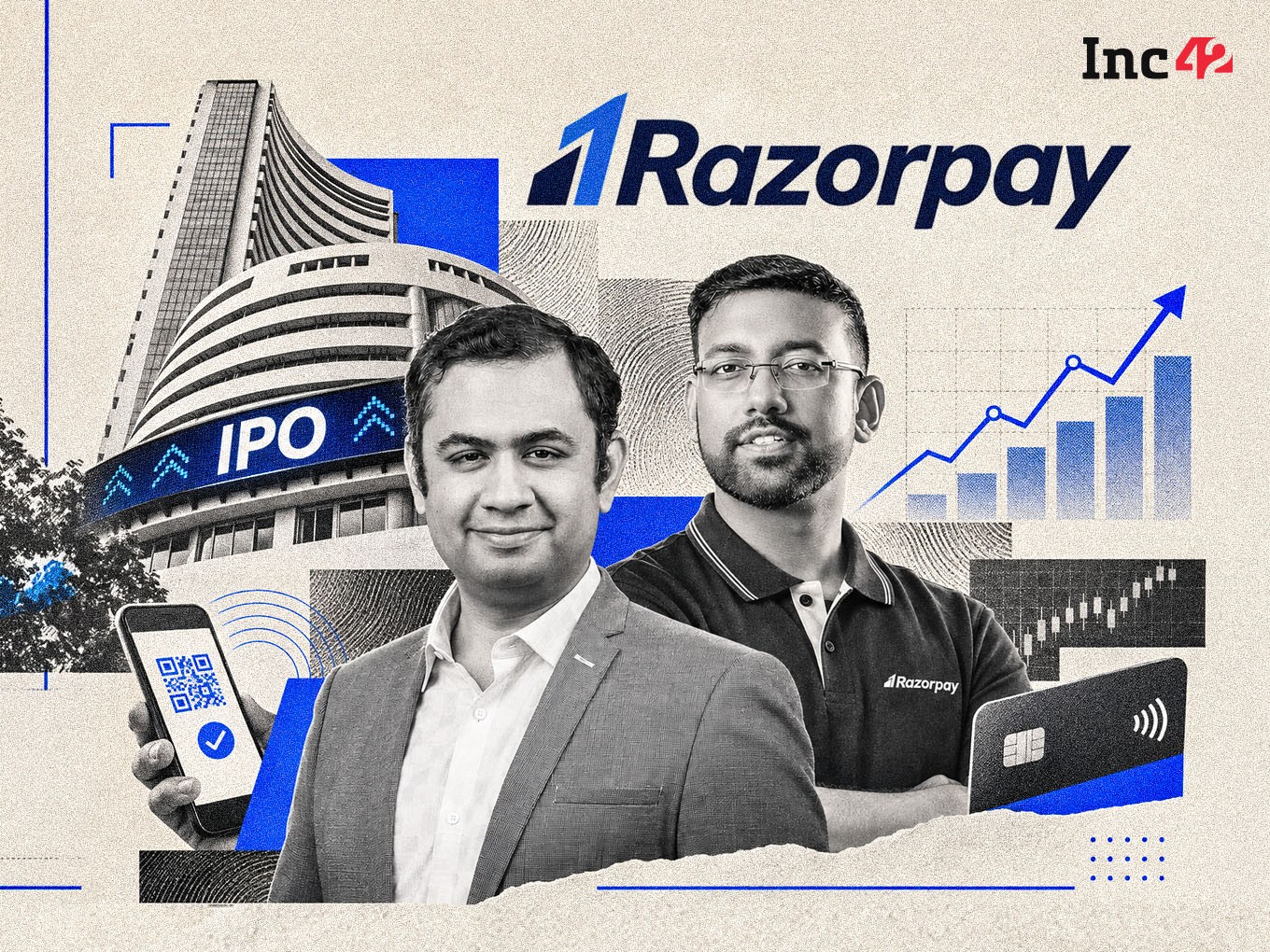
In March this year, on the sidelines of Razorpay’s annual flagship event FTX, CEO Harshil Mathur told Inc42 that what mattered most to him was how Razorpay stands in the public markets, and not the fact that it went public.
Eight months on, that test now has a rough date as the company sets off on the last leg of its IPO journey.
Razorpay has received SEBI’s approval for its proposed IPO. The fintech major is looking to raise ₹5,000-6,000 Cr through a mix of fresh issue and offer for sale at a valuation of around $5 Bn, with a listing likely between January and March 2027. Axis Capital, Kotak Mahindra Capital, JP Morgan and Citi are the reported bankers.
The headline number when it comes to Razorpay’s listing, or for that matter any listing within fintech circles, has been that of valuation.Sources suggest that Razorpay may be looking to list at a $5 Bn valuation, a markdown from the $7.5 Bn valuation that the company commanded in December 2021.
But back in 2021, fintech valuations were sky high amidst a pandemic led funding boom that witnessed sharp corrections years down the line.
Another fintech major, PhonePe, paused its mega listing in March 2026, with reports suggesting that volatile geopolitical tensions and valuation concerns led the payments company to put its IPO plans on hold. It has since revived them on the back of MDR. Sources told Inc42 in September that PhonePe is targeting a listing between February and March 2027 at a valuation of about $10 Bn.
But Razorpay has a different story to tell the public investors as it seeks ₹5,000-6,000 Cr from them.
The first part of that story is profit. “When you take out that one-time cost of the reverse flip, Razorpay was profitable — that profitability streak is maintained throughout. We hope the financials will continue to improve from here as a company that’s continuously growing,” Mathur had told Inc42 earlier.
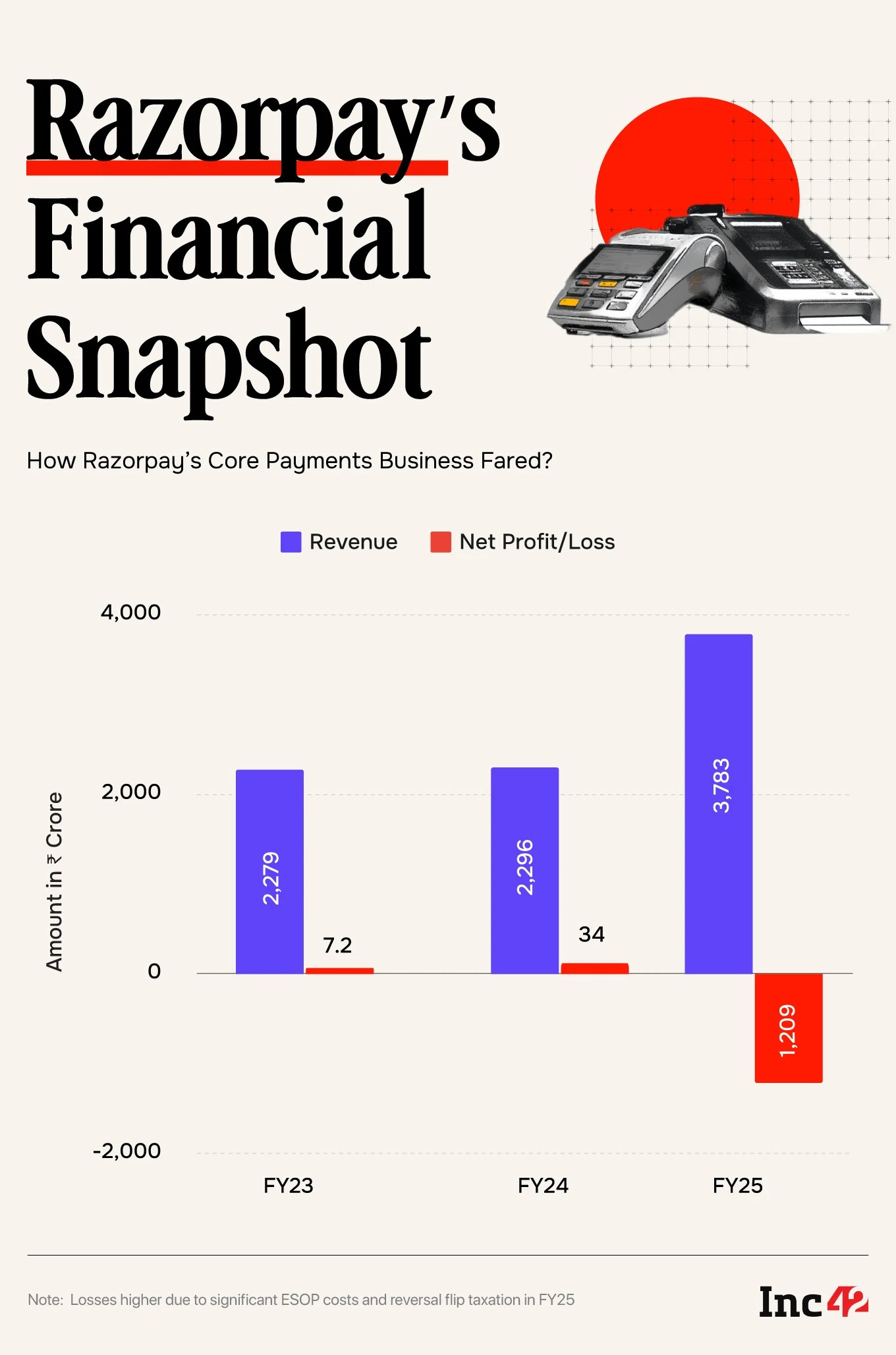
In FY25, Razorpay slipped into the red, weighed down by ₹1,209 Cr in ESOP expenses and one-time restructuring and tax costs from moving its domicile to India. It did not disclose the size of the loss. The reverse flip tax bill has been reported at about ₹1,245 Cr, or about $150 Mn. A year earlier, in FY24, its payments business had reported a ₹34 Cr profit against a total revenue of ₹2,068 Cr or a net margin of 1.6%.
The company claims to lead India’s digital payments processing market in terms of total payments volume and is expanding across Southeast Asia and other geographies, but monetising this scale has always been a problem when it comes to payments companies.
The 0.4% merchant discount rate (MDR) on large UPI payments, due after Diwali, would be the first fee on a bulk of these payments, and it would arrive just ahead of the listing window.
How much reaches Razorpay’s bottom line depends on two things: how it negotiates with the banks that receive the fee and the large merchants that pay the MDR.
Sources we spoke to suggest that much of the revenue bump that companies like Razorpay will get out of MDR would not boost their topline significantly, but could feed profits strongly because it is a fee on rails that companies have already built. For Razorpay, it’s a boost to its search for the right valuation just in time.
MDR on UPI would likely narrow the gap between the company’s sought valuation and its bottomline. It also gives Razorpay a growth story to take to public investors as it heads into the IPO.
A Profitable Core
Unlike many of its contemporaries eyeing a listing at the scale of Razorpay, the fintech has no major debt overhang and nearly half of the IPO proceeds are expected to be allocated for OFS.
Company sources told us that the core online payments business is EBITDA profitable and generating strong cash flows, which is why the company is making bold investments in allied businesses and AI.
Sources pointed towards capital allocations “between mature, cash-generating units and high-potential growth bets”, with AI-first products, financial infrastructure and new verticals taking the investment.
The company has also given a timeline on profitability. “By the end of FY26, our India business should be solidly profitable. At the consolidated level, we’ll reach profitability about two to three quarters after that,” the company’s CFO, Arpit Chug, told Inc42 in October 2025.
But FY26 has since closed, and Razorpay is yet to make those numbers public. The biggest factor in Razorpay’s IPO will be the profitability and the margins earned by its core business.
In lieu of actual profit figures, Razorpay’s pitch to public investors rests on scale. It described itself in 2024 as India’s market leader in digital payments processing, with a majority share, and said in 2025 that it served 105 of India’s 119 unicorns. It claims to be processing a total payments volume (TPV) of over $180 Bn (as of 2024 end).
When compared against its primary competitors Cashfree and PayU, Razorpay stands out for its scale and its focus on small and medium businesses.
Razorpay claims to lead on overall volumes, enterprise accounts drive the bulk of volumes at Cashfree, Inc42 reported earlier. Razorpay, on the other hand, claims that 80% of its client base comprises SMBs and startups.
Among the three, PayU India leads in terms of the topline. Its payments business alone earned $523 Mn (about ₹4,420 Cr) in FY25. It pulled ahead of Razorpay which reported ₹3,783 Cr in FY25, while Cashfree stood at ₹640.1 Cr. PayU owner Prosus claims the company has a 25% share of the Indian online payments, while processing $90 Bn in TPV in FY26.
In a bid to race past the competition, Razorpay has been eyeing overseas markets by strategic tie-ups and acquisitions. Mathur earlier said that international was its fastest-growing business, with payments growing about 40% and newer segments at 70-90%.
Outside India, Razorpay currently operates in Malaysia and Singapore and is eyeing expansion into the Philippines, Thailand and Vietnam as its next Southeast Asian targets.
The company, according to sources, is expanding majorly within Southeast Asia and expects the revenue from these countries to contribute 15% of its overall topline by 2030.
Razorpay entered Malaysia by buying a majority stake in Curlec in 2022, launched its gateway there in 2023 and entered Singapore in March 2025.
Closer to home, the biggest expected lever is UPI and the introduction of MDR soon after the festive season. About half of the payments flowing through Razorpay are on UPI, and that rail is about to start earning the fee that can feed the company’s bottomline.
The Two Negotiations Behind Razorpay’s MDR Upside
The first critical negotiation for Razorpay will be with banks. Payment aggregators such as Razorpay get no fixed share under NPCI’s stated framework, because they are not direct members of the UPI network and are part of it only through sponsor banks.
So the aggregator’s cut has to come out of the acquirer bank’s share in the MDR, under a private contract between the two.
Reports suggest that the talks have centred on aggregators keeping 50-80% of the acquiring bank’s MDR share. But there is also a flip side to it.
Payment aggregators and gateways already earn technology, checkout and reconciliation fees from merchants, and with MDR coming into effect, the merchants can move to the aggregators and gateways that offer more reasonable take rates.
Pine Labs CEO Amrish Rau has already flagged that talks with merchants have yielded this view among the primary customer base for payments aggregators. “From a commercial standpoint, I absolutely do believe when it comes to the largest of large merchants that we have with us, there will be a commercial conversation to be had, for sure,” Rau said in October 2026 after the Q2 results.
Notwithstanding the restructured commercial agreements that the payment aggregators and gateways will sign with banks and merchants for the MDR regime, sources say that the fee could support higher valuations for IPO-bound companies such as Razorpay and PhonePe.
“The headline MDR pool is not the same as revenue accruing to an individual participant. It depends on eligible transaction volumes, merchant mix and the prescribed distribution across the ecosystem,” PhiCommerce CEO Rajesh Londhe told Inc42.
Listed peer Paytm has already put a number on what MDR will bring to the table. With its Q2 results, Paytm said it expects an uplift of about 2.5 bps in its overall payments processing margin, and that the actual outcome may stabilise in 2-3 quarters after implementation.
As per sources, MDR could bring Razorpay ₹192-461 Cr of revenue a year once implemented, which would be about 5-12% of its FY25 revenue and 15-36% of its FY25 gross profit.
As a result, analysts believe that Razorpay could see a valuation bump of $300 Mn-$1 Bn from the existing ask. That’s what the MDR effect can actually unlock, though much would also depend on the commercial agreements with banks and merchant talks.
Razorpay’s technology prowess and merchant scale could be a huge lever in any talks with banks and merchants.
However, what matters more than the scale will be the value of transactions and the scale of the clients themselves, which would directly boost revenue and improve margins. Nearly 80% of Razorpay’s customers are small businesses, digital-first brands and startups, and it has not disclosed how many of their tickets cross the ₹2,000 threshold required for the MDR boost.
There is also no certainty as yet on the timeline by which fintech companies can expect the MDR outcome to start showing up on their P&L.
Analysts tracking the industry, however, say that the companies would need a few quarters of data to give investors a credible outlook. For Paytm, that could be 2-3 quarters, and with Razorpay coming to the IPO table, investors would want to hear a number for the company. Will a listing between January and March of 2027 be enough to give investors a clear answer?
The AI Story Needs Numbers
Then there’s the AI story, which we had written about extensively earlier this year.
According to Mathur, Razorpay is building a long-term business bet on AI and this is not related to the IPO and its outcome. The fintech sector has been one of the earliest adopters and partners of frontier AI models such as ChatGPT and Claude, experimenting with AI use cases for the millions of merchants on its platform.
Razorpay’s Agent Studio, built on Anthropic’s Claude, offers small businesses task-specific agents for abandoned carts, disputes, subscription recovery and cash flow forecasting. Mathur wants Razorpay to be known as “an operating system for businesses” which is run on AI.
That story gives investors a reason to look past the thin margins in the payments business, but the AI theme is not strong enough in the case of Razorpay yet. It has to make a bigger splash in terms of the outcomes it is seeing. .
Rivals Cashfree, PayU and Pine Labs are also accelerating their AI led partnerships to offer new products to their existing merchant base. All these AI offerings have been particularly concentrated towards agentic workflows and ecommerce enablement.
However, there is still little public evidence of what these agents earn. Mathur earlier told us that it will take a few years to assess the real term monetisation value that these AI capabilities can unlock for any fintech.
Hence for an IPO-bound Razorpay, its core payments business is the only true and measurable metric for the public investors. The future bets may fructify but for now, they are unlikely to be a factor for investors.
Even at a reported $5 Bn valuation, Razorpay goes to market with some real strengths such as 65% YoY revenue growth in FY25, about $180 Bn in annualised TPV, and a profitable core. While it is banking on the MDR regime to solve a lot of headaches, investors will want to see a lot more to justify the valuation ask.
Whether the price holds depends on disclosures still to come, including its FY26 and subsequent financial performance and the results of its MDR negotiations with banks. And only then will Razorpay find out how much of its story the public market is willing to pay for.
[Edited By Nikhil Subramaniam]
The post MDR And AI: Inside The Two Acronyms That Could Shape Razorpay’s ₹6,000 Cr IPO appeared first on Inc42 Media.
This content is published by Inc42 and has not been created or edited by Hello Headlines. View original