
Profits Are Just Half The Story This Earnings Season

The 2026 festive season began in muted fashion, but the performance of some of the key new-age tech stocks in the pre-festive quarter (Q2 FY27) shows that even in this environment businesses are able to extract and expand profits, and grow their topline.
When we see the financial performance of ecommerce, fintech and logistics stocks, it’s clear companies entered this period with a lot more confidence and absorbed some of these headwinds. Pretty much each one of them improved on their profitability metrics and their topline.
As Inc42 reported in October, early data from the festive season sales indicated that Indian consumers kept shopping, but with more abandon.
Online sales slipped from last year, card spending and smartphone sales weakened, and surveys suggest urban households are trimming discretionary budgets too. Rising household costs, uncertainty over jobs and incomes, and discounts that no longer feel compelling have made shoppers wary of big-ticket purchases.
Consumers are still browsing for products, but in the current climate, conversion rates have fallen for premium products, which usually see a big uptick.
A lot of this has to do with the macroeconomic factors, rising energy prices and logistics costs, and lingering grave geopolitical concerns that have dented consumer confidence and spending.
In Q2, logistics tech players expanded capacity ahead of the festive shopping rush, with higher volumes offering an opportunity to improve operating leverage. Ecommerce companies capitalised on seasonal demand, even as the pressure to balance growth with profitability persisted.
Meanwhile, fintech companies, particularly those with a big UPI focus, faced a different equation: the prospect of merchant discount rates (MDR) on select UPI transactions. While MDR itself is yet to come into effect, the fintech ecosystem’s quarter was defined by swelling toplines, which bodes well for the next quarter where MDR is likely to become a real factor.
Profitability broadened across the listed new-age tech universe, with nine of the 11 large tech stocks (with a market cap of over ₹10,000 Cr) across these key sectors reporting a net profit in Q2 FY27.
The combined bottomline of these companies improved by around ₹1,100–1,400 Cr year-on-year (YoY), depending on how exceptional items in the base quarter are treated, according to market data.
More importantly, EBITDA grew faster than revenue at all nine profitable companies, suggesting that operating leverage is beginning to show up in reported performance.
But a significant profit pool remained concentrated in a handful of companies, while businesses such as Swiggy and Meesho continue to report losses despite improving operating metrics.
Atul Thakkar, executive director at Anand Rathi Investment Banking, believes the market is moving towards rewarding earnings delivery rather than growth narratives. “Over the next 12–18 months, we expect earnings delivery, rather than growth narratives, to be the main driver of returns in this space,” he said,
This distinction is particularly relevant when the three major segments, fintech, logistics and ecommerce are assessed separately.
Fintech has delivered the strongest operating performance, logistics has shown some of the clearest margin improvement, and ecommerce has produced a wide range of outcomes. But how did the profitability story unfolded across these three sectors?
Logistics Tech Shifts Into High Gear
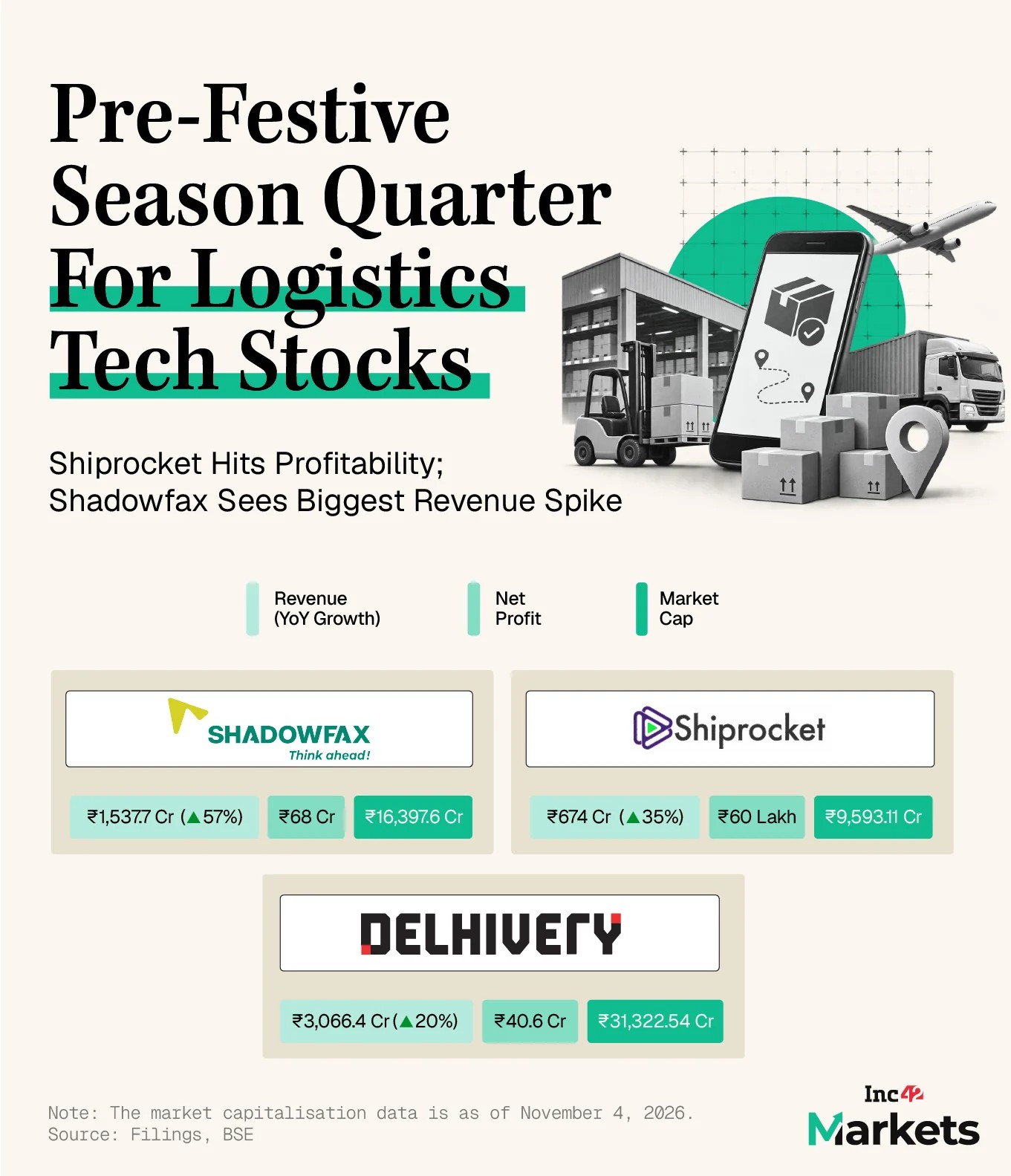
It was largely a capacity-building quarter for logistics companies, with the full benefit of festive demand expected to play out in Q3. Yet, the results already point to improving operating leverage, as shipment volumes grew faster than revenue at the larger third-party logistics (3PL) players.
Shadowfax’s revenue rose 57%, while express and hyperlocal orders grew nearly 70%. Adjusted EBITDA increased sharply, with margins expanding to 5%. Delhivery reported a similar divergence: express shipments grew 32%, against 22% growth in express revenue. Its adjusted EBITDA margin also improved, while first-half operating cash flow more than doubled.
The gap between volume and revenue growth suggests that incremental shipments are not translating into proportionate revenue. Profitability, therefore, will depend on whether higher volumes can offset pricing pressure and rising costs across fuel, wages and last-mile delivery.
Delhivery’s return to profitability also needs context: the year-ago quarter included acquisition-related integration costs linked to Ecom Express. Its adjusted EBITDA and cash generation offer a more useful measure of underlying progress.
Shiprocket, meanwhile, turned profitable, reporting a net profit of ₹60 Lakh against a loss of ₹20.3 Cr a year ago. Revenue grew 35%, while adjusted EBITDA more than tripled. Its core business continued to expand, with transactions growing 31% and adjusted EBITDA margin improving to 12.8%. The results point to improving economics, although the reported profit remains modest.
Across the sector, technology and network utilisation are central to the margin story.
Shadowfax is deploying AI-led route optimisation and expanding its seller platform, while Delhivery is investing in automation and autonomous material-handling systems. These initiatives could improve productivity, but their returns will depend on execution and the ability to absorb peak-season volumes without adding costs at the same pace.
The festive quarter will be the real test. Stronger volumes should support operating leverage, but sustained margin expansion will require better network utilisation, disciplined pricing and control over fulfilment costs. Logistics is showing clearer signs of improving economics, though the gap between shipment growth and revenue realisation remains a key risk.
Fintech’s Profit Engines Roar
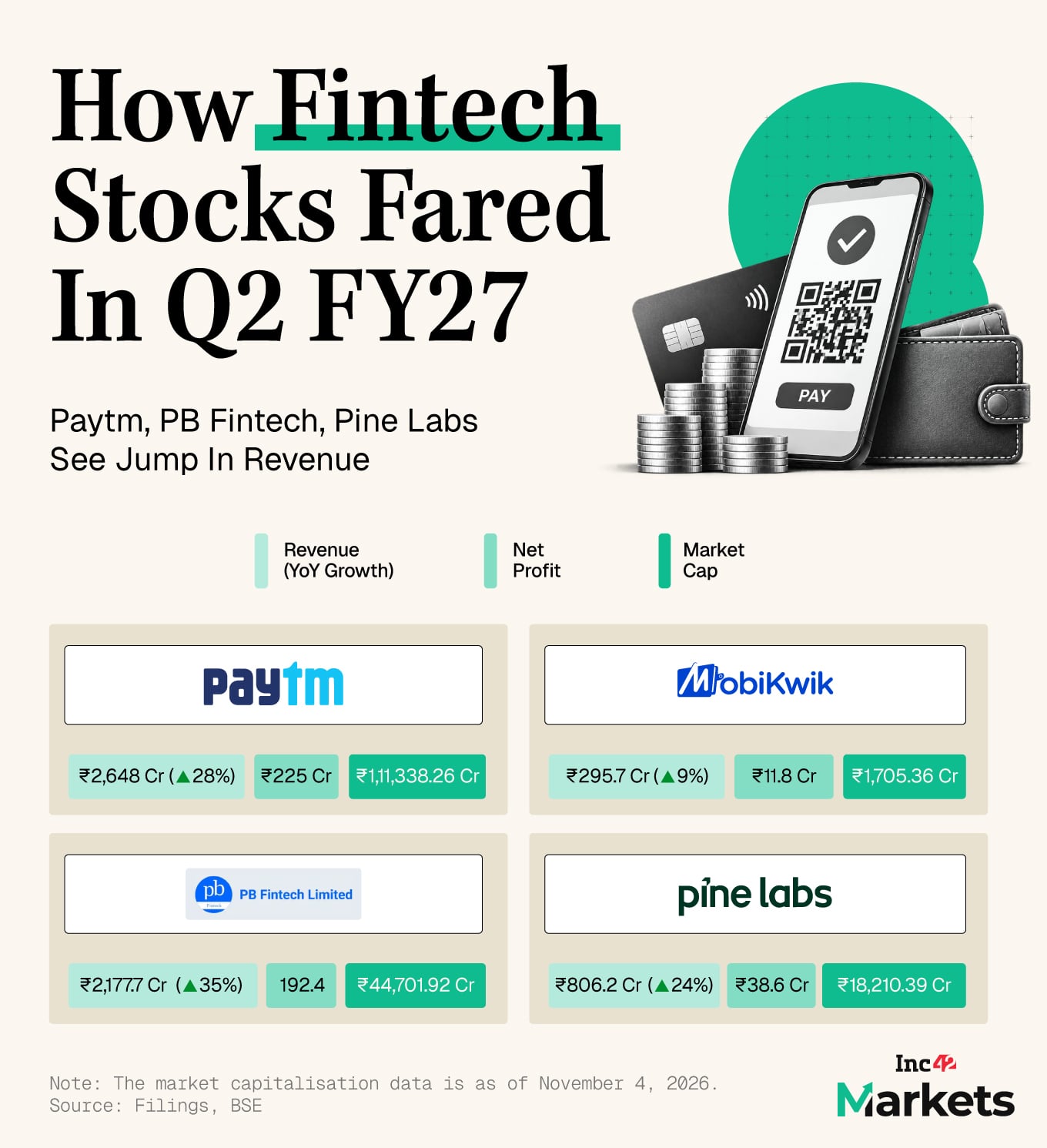
Fintech was the strongest performer in Q2 FY27, with all the major companies in the segment reporting profits. Moreover, EBITDA growth outpaced revenue growth at each, pointing to improving operating leverage. The gains, however, are coming from deeper monetisation of existing customers rather than payment volumes alone.
Paytm is increasingly diversifying beyond payments, with financial services distribution contributing about a third of its revenue. Its merchant subscription base and financial services business continue to expand, reducing its dependence on payment processing.
Meanwhile, Pine Labs is extracting more value from its merchant network through subscriptions, affordability products and transaction-linked services. PB Fintech’s growing renewal book offers a similar advantage: recurring insurance revenue is expanding faster than its core insurance business, making growth less dependent on fresh policy acquisition.
The bigger question for fintech is whether these operating gains can withstand regulatory changes. The proposed UPI MDR framework could create an additional revenue stream, but the benefit to payment companies will depend on how the pool is shared between banks and other ecosystem participants. With implementation postponed beyond the festive period, it remains an opportunity rather than an earnings driver for now.
Insurance distribution faces a more direct overhang. The proposed changes to commission structures and expense limits could alter the economics of online intermediaries such as PB Fintech. Its growing renewal revenue offers some cushion, but the impact on new-policy distribution remains uncertain.
“While fintech companies have demonstrated an ability to improve monetisation and operating leverage, the regulatory environment remains a key determinant of how sustainable these gains will be. For this segment, regulation is a bigger variable than execution,” said Thakkar.
Ecommerce’s Profitability Divide Widens
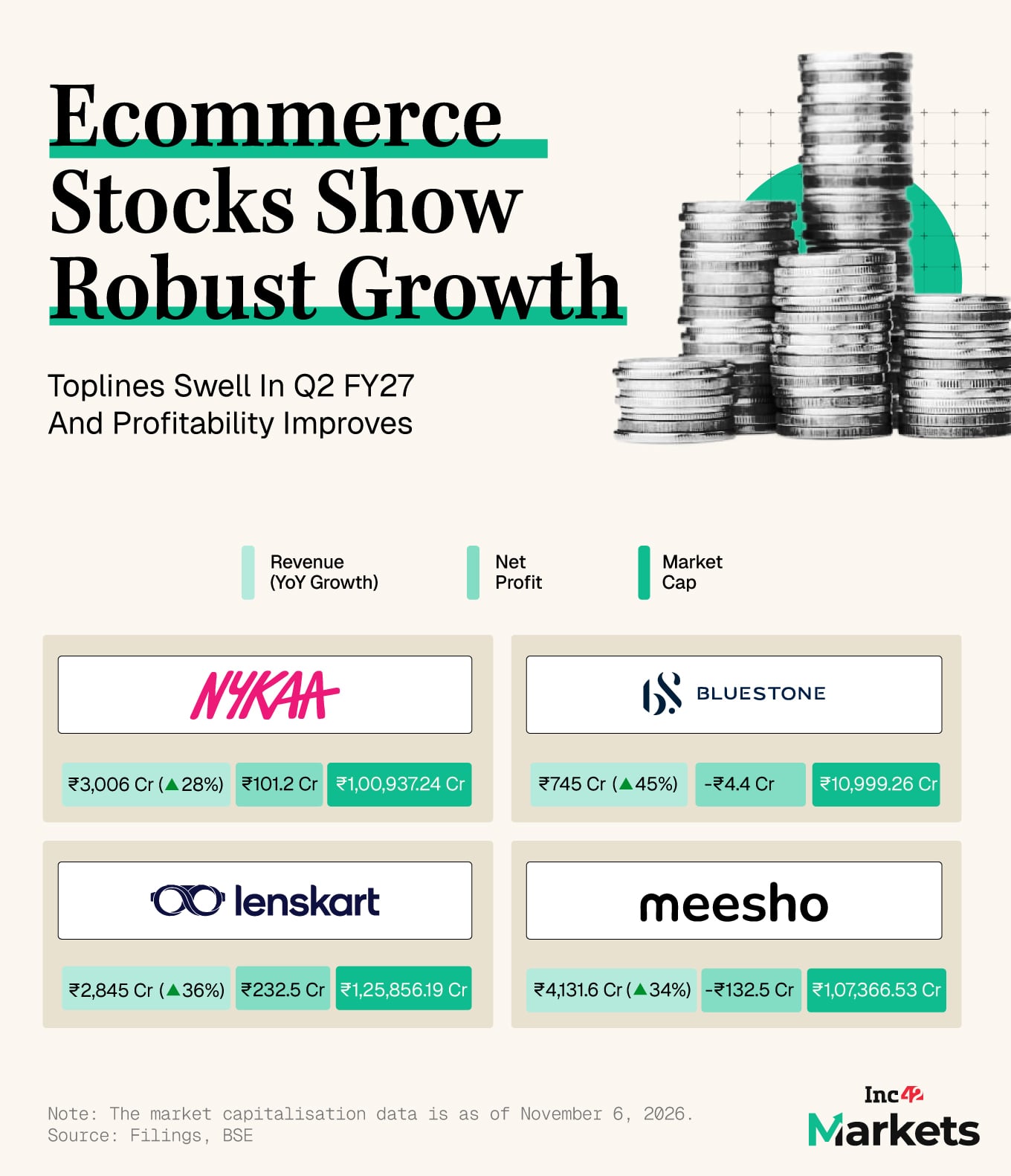
Ecommerce delivered the widest divergence in Q2 FY27. While revenue growth remained strong across quick commerce, ecommerce and consumer brands, profitability varied sharply, reflecting differences in scale, cost structures and monetisation.
For example, Meesho saw its net loss narrow to 68%, while marketplace contribution margin improved to 6% of NMV from 3.3% a year ago. However, newer initiatives remain loss-making and are yet to establish meaningful scale.
Consumer brands delivered a more consistent earnings performance. Nykaa’s profit more than tripled, supported by margin expansion and growth across beauty and fashion. Lenskart also reported strong profit growth, with expansion across its India and international businesses. Higher store productivity, rising volumes and operating cash flow suggest that growth is being supported by better utilisation of the existing network, alongside store additions.
Input-cost inflation remains another pressure point for consumer brands. Passing on higher costs through pricing could protect margins but risks weighing on demand and average order values. Gross margins, customer retention and acquisition costs will be as important as revenue growth in assessing the durability of earnings.
Why Profits Are Just Half The Story
As these sectors continue to mature, operating leverage is becoming more important than headline growth. However, profitability remains concentrated, with a handful of companies accounting for a substantial share of the sector’s earnings.
The ownership shift is also worth watching.
Foreign investors have reduced exposure to several listed new-age tech companies, while domestic institutions have increased participation. But domestic ownership is no guarantee against corrections when earnings or regulatory developments disappoint.
According to market analysts, retail investors are likely to increasingly favour companies that are not only profitable but also generate revenue from multiple products within their existing customer base and use operating cash flow to fund expansion.
We can see this in the aggressive diversification across the industry, particularly in fintech and logistics tech.
This wave favours established fintech businesses, asset-light logistics networks and ecommerce companies where the seller-customer flywheel is up and running.
Post the festive season spike, even if it may be a relatively smaller spike compared to previous years, the cash generation and regulatory resilience of these companies will be worth watching. That could very well mark the next phase of maturity.
MARKETS WATCH: NEW ISSUES, POST-IPO JOURNEY & MORE
Inside Razorpay’s ₹6,000 Cr IPO: As Razorpay gears up for its ₹6,000 Cr IPO, the proposed UPI merchant discount rate and its AI ambitions could shape its valuation. But can these growth levers convince public market investors to look beyond its thin margins?
Honasa’s Profit Up 87%: The Mamaearth parent reported an 87% YoY jump in Q2 FY27 net profit to ₹73.2 Cr, while revenue rose 36% to ₹731.2 Cr. Growth across focus categories, offline channels and younger brands helped drive the company’s quarterly performance.
Go Digit PAT Dips: Go Digit’s net profit declined 31.1% YoY to ₹142.4 Cr in Q2 FY27 despite a marginal 1.7% rise in insurance revenue to ₹2,720.5 Cr. Higher insurance service expenses and claims weighed on profitability, even as motor insurance revenue grew.
RateGain Profit Rises 47%:The travel-focused SaaS company’s profit rose 46.5% YoY to ₹74.7 Cr in Q2 FY27, driven by operating revenue zooming 152.6% YoY to ₹745.4 Cr. This came on the back of the consolidation of travel marketing platform Sojern, which RateGain acquired for $250 Mn last year.
Moneyview Revenue Grows 41%: The fintech company’s consolidated net profit surged 417.6% YoY to ₹200.7 Cr in Q2 FY27, while operating revenue grew 41% to ₹1,120.2 Cr. The fintech reported a managed AUM of ₹23,892 Cr, with its shares gaining 5.7% following the earnings announcement.
[Edited by Shishir Parasher]
The post Profits Are Just Half The Story This Earnings Season appeared first on Inc42 Media.
This content is published by Inc42 and has not been created or edited by Hello Headlines. View original