Beauty Brands Go Quick Commerce-First
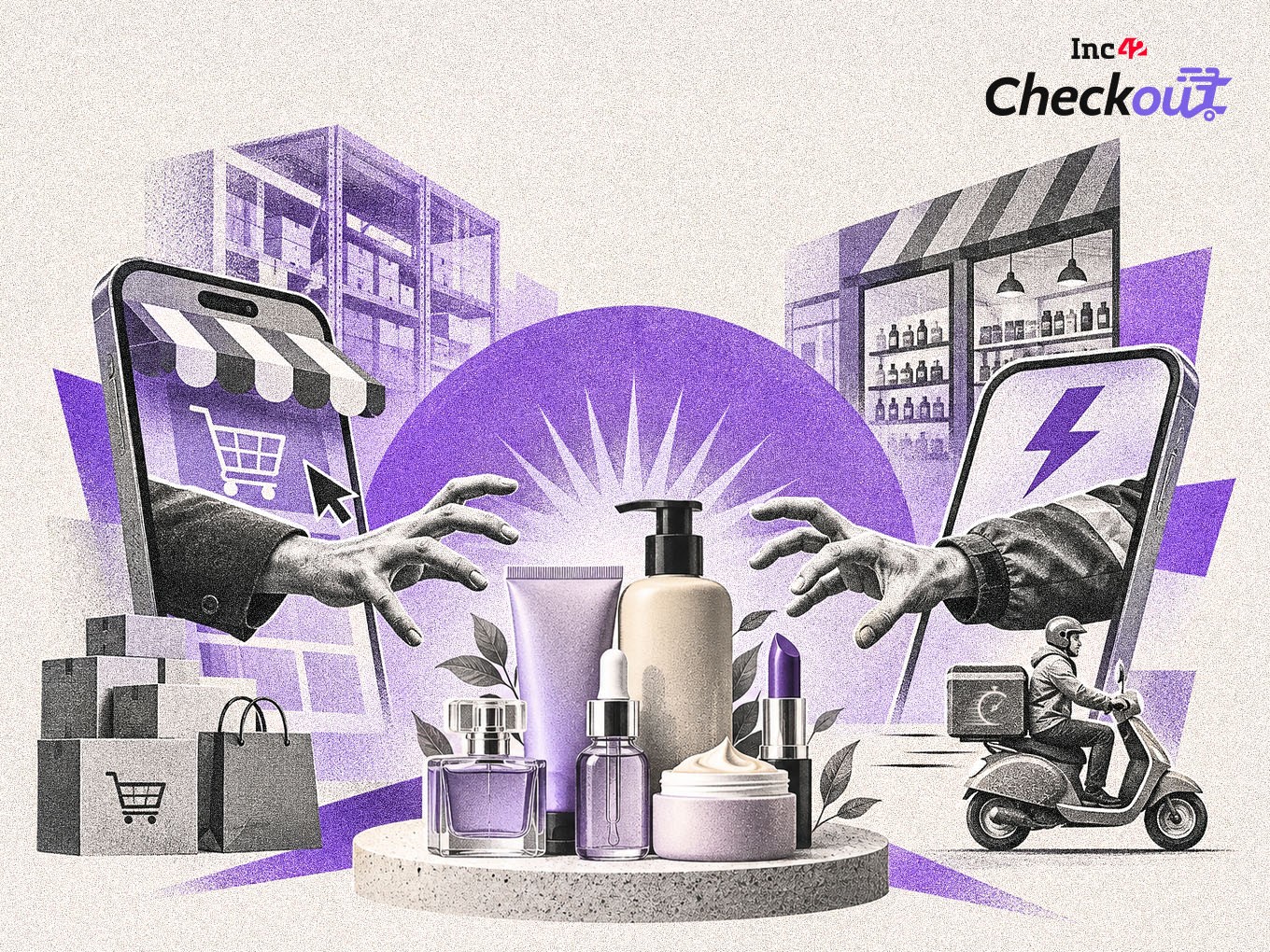
Quick commerce has tilted the balance for India’s beauty and personal care (BPC) brands. So much so, that some brands are now entirely reliant on quick commerce for growth and reevaluating how much they should invest in horizontal marketplaces.
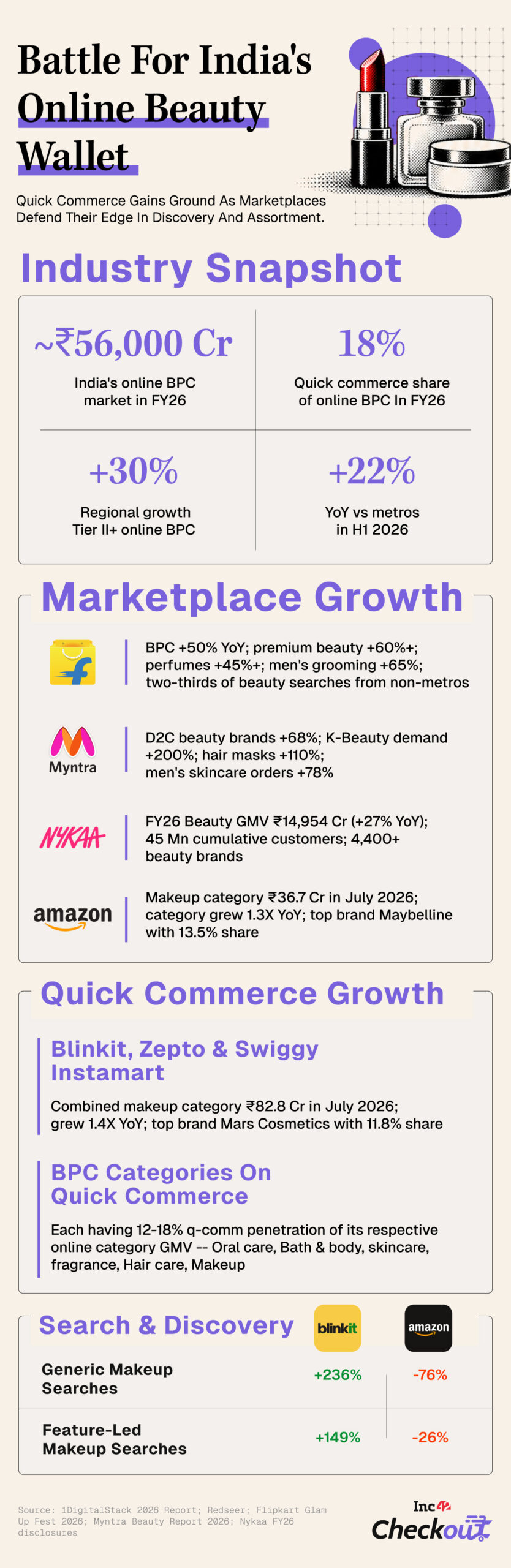
At roughly $1 Bn in annualised gross merchandise value (GMV), sales of beauty products on quick commerce is growing by about 90% a year, according to Redseer. Separately, Elara Securities estimates the channel will grow to 25-30% of online BPC sales by FY30.
Karan Taurani, executive vice president at Elara Capital, says that BPC as a category was a natural progression for quick commerce platforms after they had figured out the grocery supply chain. “Beauty has got a very premium gross margin, and higher EBITDA margin as compared to other categories.That is why quick commerce is also getting on this aggressively,” Taurani said.
But while the balance is shifting, the contest between quick commerce and ecommerce marketplaces is far from settled.
Marketplaces are still the biggest destinations for shoppers to compare, read reviews and discover new products, especially those with a premium price tag. But the likes of Nykaa, Myntra, Amazon and Flipkart are having to play the game started by Blinkit, Instamart and Zepto to catch up.
For D2C brands, this is the time to recalibrate and optimise for both channels. From sizing their SKUs and dividing their marketing budgets to rethinking how shoppers find them, the brands Inc42 spoke to, are adapting to what they call a “tectonic shift” in consumer behaviour.
And it all started after the sales on quick commerce channels zoomed over the last couple of years.
How Brands Are Recalibrating
It’s not that long ago that marketplaces ruled the market.
“A year ago, they (quick commerce as a channel) didn’t even exist for us. So it’s growing very fast. Our largest channel used to be marketplaces, but that’s not the number one any more,” skincare brand Asaya cofounder and CEO Neeraj Biyani.
Others are reporting a similar boost from quick commerce as consumers splurged during the festive season. At haircare brand Moxie Beauty, whose annualised revenue had crossed ₹100 Cr last December, quick commerce is now the largest channel accounting for more than 30% of sales, cofounder Nikita Khanna told us.
Renee Cosmetics, which reported ₹440 Cr in FY26 revenue, has seen quick commerce’s share of sales grow from about 3% to over 13% in two years.
Typsy Beauty, which raised ₹20 Cr in August to double down on quick commerce and offline retail, is also keeping up with the fast paced trend.
“The biggest change has been quick commerce. A year ago it was a single-digit share of our revenue. Today, it has grown about 5x in absolute terms, faster than any other channel,” Typsy cofounder and CEO Kairavi Bharat Ram said.
That growth has pushed brands to rethink how much they spend on marketplaces vs quick commerce, when it comes to ads as well as in product development.
Quick Commerce Gets The Ad Money
As sales on quick commerce rose, brands have followed up by allocating more budget for visibility. The likes of Blinkit, Zepto and Instamart have reimagined placement of ads in a bid to grow their average order value and this means brands have more real estate to get that all-important click.
“We are spending more on quick commerce since we are selling more on quick commerce. It’s not that we spend more on ads and therefore that channel grows, it’s that people are choosing to buy there. And so then you want to be easily found on the platform where they’re going to be buying their hair care,” added Moxie Beauty’s Khanna.
Social media spending is still the largest part of ad spends, but At Typsy Beauty founder Bharat Ram believes the share going to quick commerce ads has risen through the year, following the shift in sales.
The data also points to a change in how shoppers search. Volumes for 10 generic makeup keywords rose 236% on Blinkit between Q1 2025 and Q2 2026 and fell 76% on Amazon, though Amazon’s volume still appears larger, according to a report by 1DigitalStack (1DS), which was accessed by Inc42.
Quick commerce has not suddenly eliminated marketplace or social media ad costs, but it is becoming a dedicated channel by itself. Awareness is still built elsewhere.
“Most new customers still find us on Instagram, through creator content and reels far more than polished brand ads. A lot of that discovery then converts somewhere else: someone sees a creator video and later searches for us on Nykaa, Blinkit or our website,” says Bharat Ram.
Brands Rethink Pricing, Packaging
The second biggest learning for brands is to customise SKUs and pricing to suit the replenishment cycles and consumption patterns on quick commerce, which typically involves faster stockouts. These are somewhat interlinked because repricing is often forced by SKU resizing.
“We realised that the typical consumer habit on quick commerce apps was not to buy full packs. Our product was usually a last minute purchase. Hence, we had curated special packs for Blinkit, Zepto and Instamart. And that really hit the spot,” Renee Cosmetics cofounder Ashutosh Valani said.
Brands are also curating a combo of small and full size packs depending on the demand from each one of the quick commerce platforms even as some BPC startups say that it is too early a stage to go full throttle on producing small size SKUs across all quick commerce channels.
“Eventually if you find something that works for you, you will continue to purchase that and you will want your regular size. So it’s a very healthy mix,” according to Moxie Beauty’s cofounder.
Founders like Asaya’s Biyani or Bharat Ram of Typsy Beauty warn that the biggest risk for a beauty brand on quick commerce is stockouts. A few days where the product is out of stock from key dark stores costs more than the lost sales. It hurts rank, visibility and results in poor return on advertising.
“Replenishment cycles have gone from monthly to weekly and we had to move from warehouse-level planning to much more frequent, city and SKU-level planning for quick commerce. This requires tighter forecasting around platform sale events,” the Typsy founder said, indicating that brands have had to make changes in their own supply chain operations to meet the rush.
Pricing and discount math is also undergoing a change. Quick commerce should not be necessarily regarded as a cheaper shelf, but it is true that brands encounter more value-conscious shoppers there.
“We agree that value and entry price points gain on quick commerce. We see it less as people trading down and more as quick commerce being where a first try or a top-up happens,” according to Typsy Beauty’s Bharat Ram.
While the average order value may be smaller on quick commerce, the frequency of purchases makes up for that.
Why Ecommerce Marketplaces Still Matter
None of this has, however, made marketplaces optional. The majority of the founders we spoke to say that serious, intent-based shopping is still prevalent in ecommerce. Horizontal as well as vertical marketplaces enjoy a premiumisation moat which is not easy to displace.
PAC Cosmetics, the self-funded makeup brand that crossed ₹100 Cr in FY26 revenue, has stayed off quick commerce thus far.
“Consumers are evolving, and some of them choose convenience. But for an informed decision, many still prefer to see more in front of them: shades, swatches, reviews, and the full range. Staying off quick commerce is a conscious choice, because we’d rather present the brand with clarity than make it available quickly,” said founder and director Bonish Jain.
Elara Capital’s Taurani highlighted that one of the reasons that Nykaa will be tough to beat is the exclusive tie-ups with the niche and international brands, which complements the company’s private label and owned brands business.
Nykaa has also shifted to an inventory-led model, which allows the company more flexibility in negotiating procurement.
“Marketplaces do have their own value. It is not like they can be completely replaced by quick commerce. If you are just looking for what to try, you will go to an Amazon or a Nykaa where you get to see the user experience and reviews, whereas this is not possible on quick commerce,” Moxie Beauty’s cofounder says.
For the past two years, vertical and horizontal marketplaces have been gradually moving to the quick commerce lane, using the learnings of the industry to enable 10-minute deliveries.
Nykaa has hired former Swiggy Instamart COO Ankit Jain to run Nykaa Now, which went to operate from three cities to 13 in a year. Myntra’s M-Now, which runs in over 12 cities, now carries 596 beauty brands, while Flipkart says beauty on Flipkart Minutes grew 5X in a year.
Taurani reads Nykaa Now as defence. “A Nykaa customer doesn’t really want a quick delivery,” he said, indicating that it is more of a need for marketplaces.
Quick commerce, she said, lacks the depth of product content because it is a platform geared towards faster transactions and fulfilment. “The apps don’t want you to get lost in the discovery. They want you to go from home to checkout in 60 seconds or whatever. So that kind of slower discovery, cart building is not happening there. And hence marketplace channels are still quite strong in our category,” Khanna told us.
The early trends indicate that quick commerce and 10-minute delivery models have taken over the beauty aisle. But don’t write off the ‘plain jane’ ecommerce marketplace that may still have a trick or two up its sleeves.
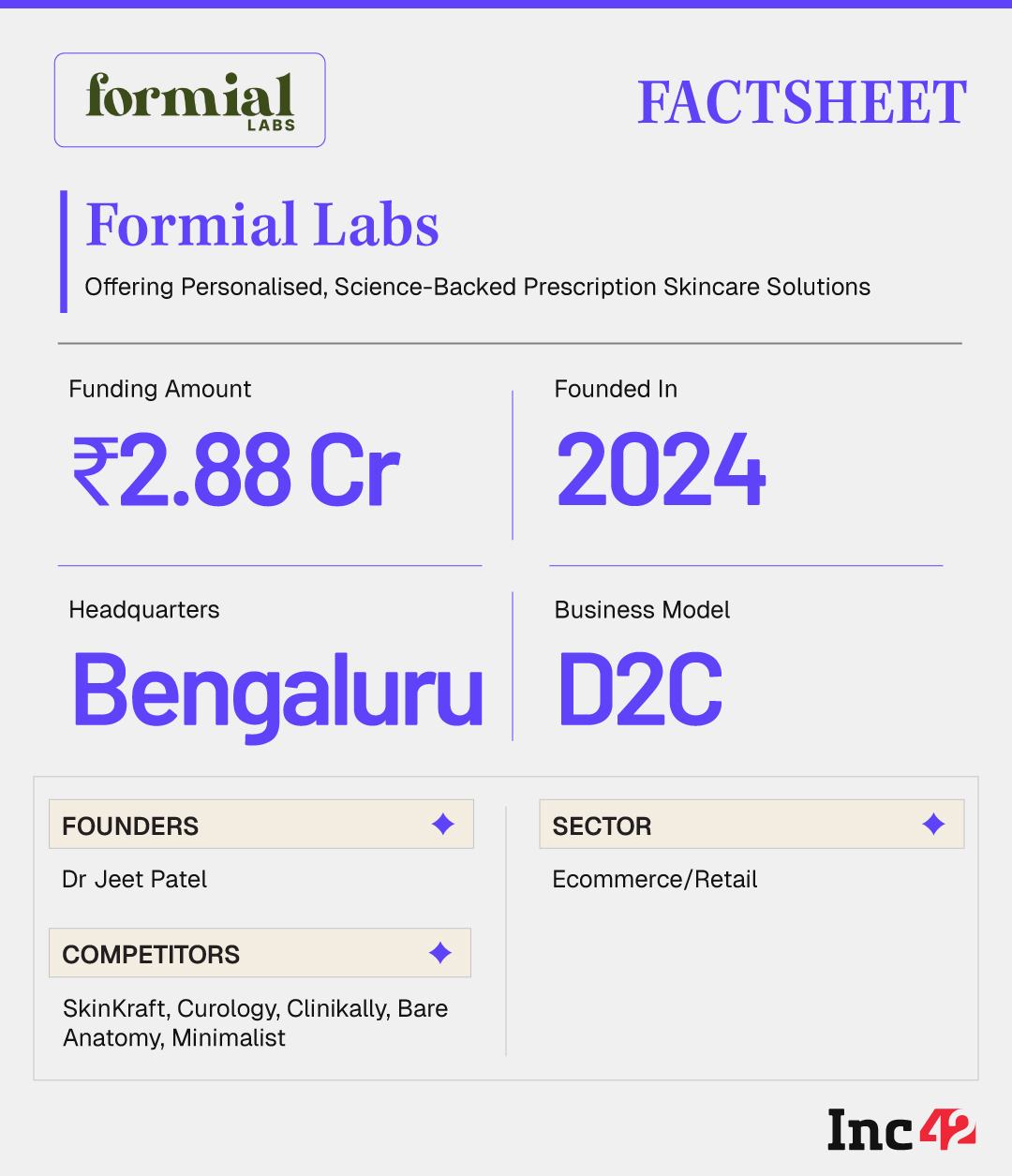
THE STARTUP SPOTLIGHT | HOW FORMIAL LABS IS TAKING THE GUESSWORK OUT OF SKINCARE
- Formial Labs aims to address the trial-and-error approach to skincare by offering customised formulations tailored to individual skin concerns, including acne, pigmentation and uneven skin texture.
- The startup combines dermatological expertise with personalised treatment plans, seeking to simplify skincare decisions and deliver more targeted solutions.
- As India’s beauty market becomes increasingly crowded, Formial is betting on personalisation and professional guidance to differentiate itself from conventional skincare brands and build long-term consumer relationships.
ECOMMERCE BUZZ
Nykaa’s Q2 Profit More Than Triples: Beauty and fashion ecommerce major Nykaa reported a more than threefold jump in its Q2 profit to ₹101 Cr, while revenue grew 28% YoY. The strong performance reflects the company’s growing scale as it continues to expand its beauty and fashion businesses.
Lenskart’s Q2 Profit Surges 125%: Eyewear major Lenskart reported a 125% YoY jump in Q2 profit to ₹233 Cr, while revenue climbed 36%. The numbers highlight the company’s improving profitability alongside its expanding eyewear business.
GIVA Bags ₹975 Cr Funding: Jewellery startup GIVA raised ₹975 Cr in a funding round led by Multiples PE as it doubles down on offline expansion. The company plans to open 160 new stores in FY27, signalling its ambitions to scale its omnichannel jewellery business.
Blue Ashva Exits iD Fresh In ₹50 Cr Deal: Early investor Blue Ashva Capital exited iD Fresh Food by selling its entire stake for ₹50 Cr in a secondary transaction. The deal, co-led by Upsurge India, Triumph Global Fund and White Whale Ventures, saw around 1% equity change hands as the ready-to-cook food brand continues its growth journey ahead of its IPO ambitions.
THE DEEP DIVE
THE OPERATOR QUESTION
How Should Premium Beauty Brands Choose Between Marketplaces And Quick Commerce Without Compromising Their Positioning?
Bonish Jain, founder and director at PAC Cosmetics which targets professional makeup artists and everyday consumers, says these are the five things that matter:
- Understand Purchase Behaviour: Not every beauty purchase is driven by convenience. Consumers buying foundations, concealers or setting sprays often want to compare shades, explore swatches, read reviews and understand product performance. The channel should support this decision-making process.
- Protect Positioning: Being available everywhere isn’t always the right strategy. Quick commerce screens offer limited room to showcase an extensive portfolio or communicate the brand story. For premium brands, how products are presented matters as much as where they are sold.
- Look Beyond Transactions: Marketplaces are more than sales channels. They enable discovery, allowing consumers to explore different categories and products. Alongside influencers, makeup artists and tutorials, they help build brand presence, improve product visibility and strengthen consumer engagement.
- Evaluate Channel Economics: Every additional platform requires investment, inventory planning, marketing support and operational bandwidth. Assess the overall contribution of each channel, including opportunities to improve assortment, understand consumer preferences and strengthen platform partnerships.
- Prioritise Sustainable Growth: Focus on improving product discovery, online experiences and repeat engagement across existing channels. Evaluate new opportunities, including quick commerce, based on business potential, consumer needs and brand fit. Growth isn’t about being present everywhere, but choosing platforms that support long-term scalability.
[Edited by Nikhil Subramaniam]
The post Beauty Brands Go Quick Commerce-First appeared first on Inc42 Media.
This content is published by Inc42 and has not been created or edited by Hello Headlines. View original