Jensen Huang’s Exit: How Deep Does NVIDIA’s AI Ecosystem Run In India?
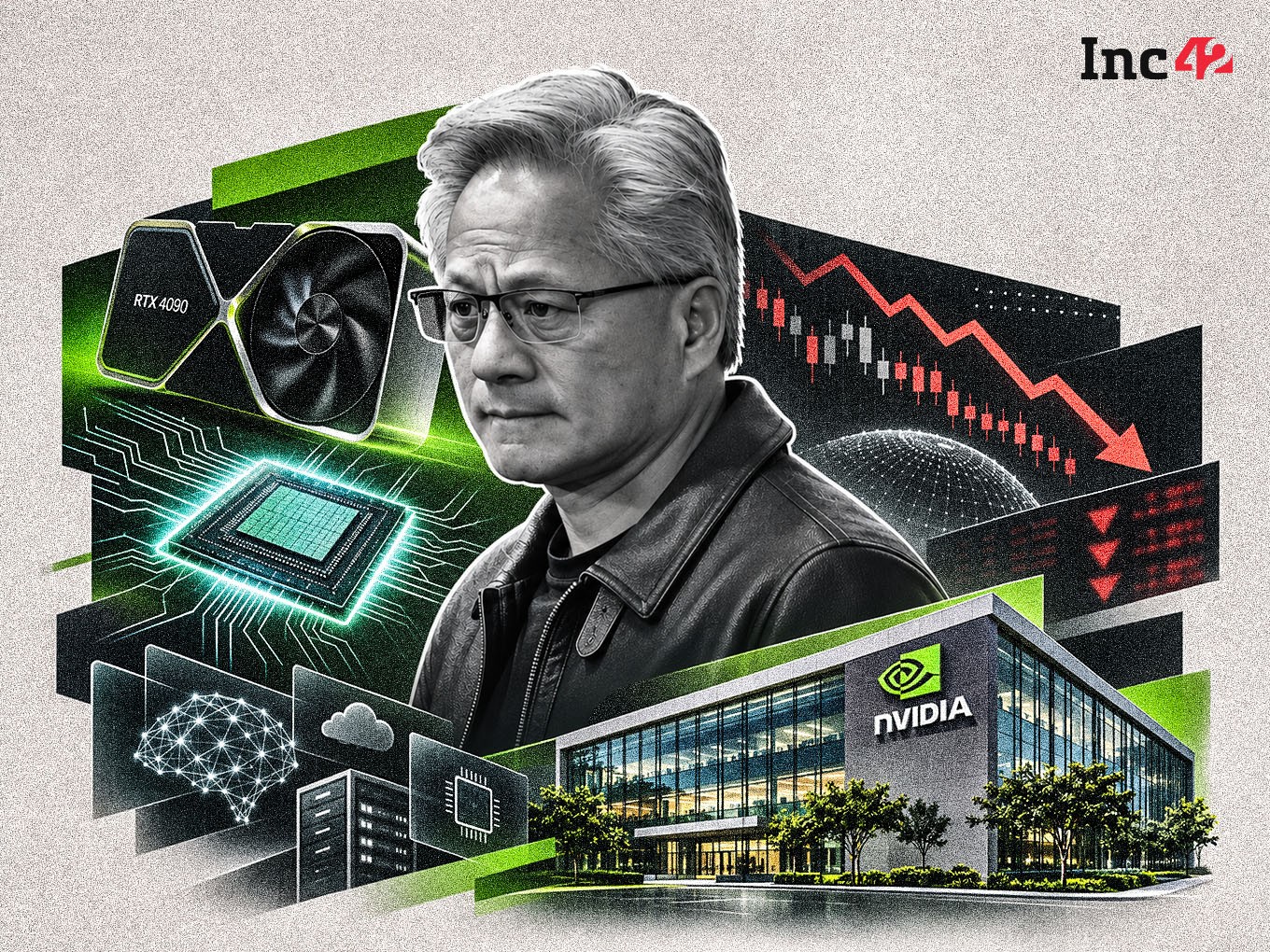
Jensen Huang’s exit from NVIDIA has put the spotlight on the company’s leadership and succession plans. But for India, the more consequential question is what happens to an ecosystem that has increasingly come to depend on the American chipmaker for its AI ambitions.
From data centre operators ordering thousands of GPUs to startups building on its software stack, NVIDIA has established relationships across almost every layer of India’s AI industry. Its influence extends beyond hardware procurement to cloud infrastructure, developer tools, technical partnerships, startup incubation and even equity investments. It is also helping Indian companies access global investors and customers.
The scale of this presence is visible in the country’s expanding AI infrastructure ambitions.
Some of the key partnerships include Yotta Data Services committing to deploying more than 20,000 NVIDIA Blackwell Ultra GPUs, while Greenko promoters-backed AM Intelligence (AMI) has announced orders for 29,000 next-generation Rubin GPUs. L&T’s Vyoma, meanwhile, is developing a 10,000-GPU AI Factory using NVIDIA’s B300 architecture.
But these relationships are not identical. Some companies procure hardware, others access NVIDIA’s technology through OEMs and systems integrators, while several startups rely primarily on its software and developer ecosystem.
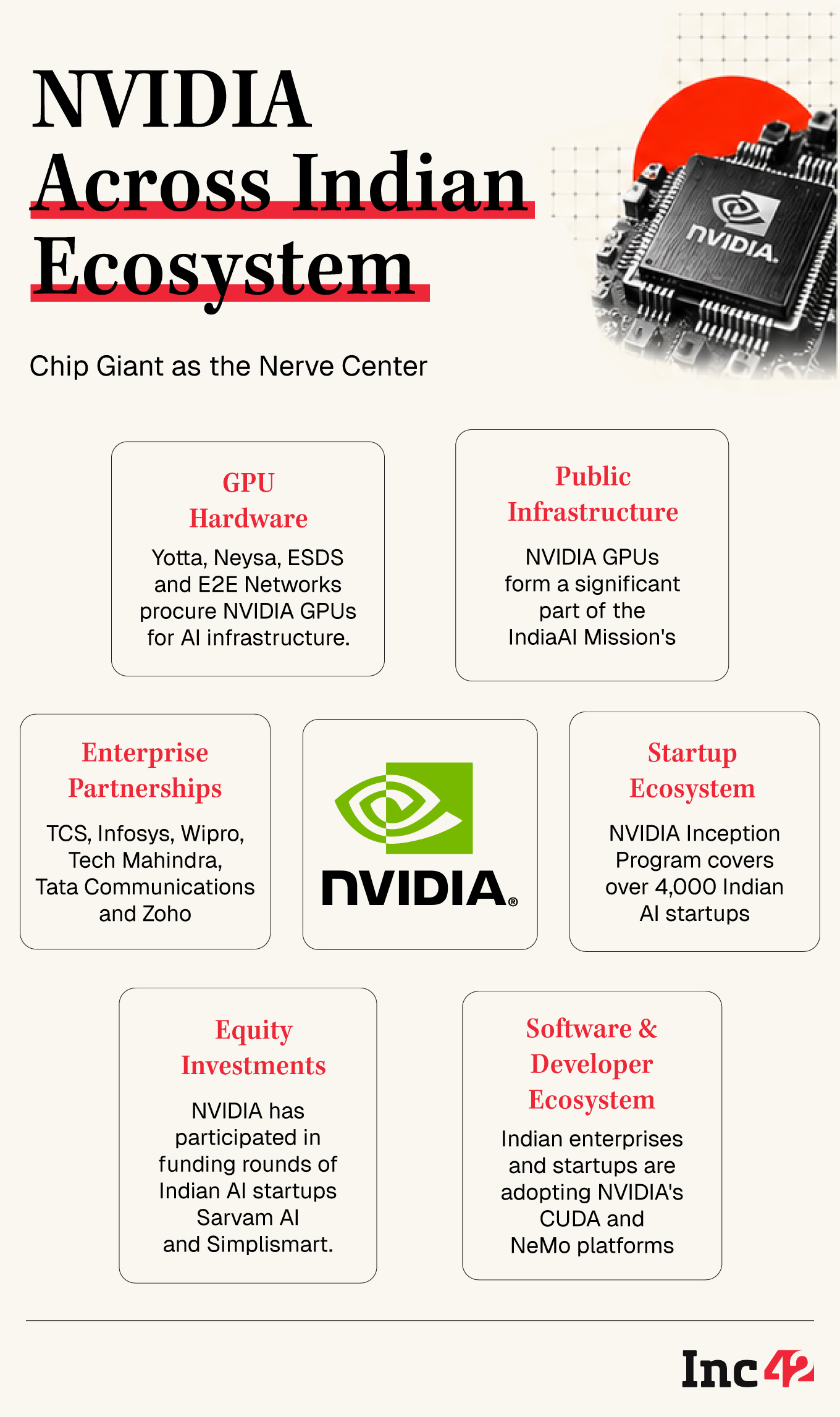
India’s dependence on NVIDIA runs across three layers: hardware, software and commercial relationships.
Competing with NVIDIA and providing alternatives to its Indian partners, therefore, requires more than matching its hardware. Rivals must also replicate its software ecosystem and industry relationships, Sanchit Vir Gogoi, analyst and founder of Greyhound Research, told Inc42.
The question is whether Huang’s departure changes any of these relationships, and how exposed Indian companies are to a change in NVIDIA’s priorities.
NVIDIA’s Grip On AI Compute
India’s AI infrastructure buildout is increasingly being shaped around NVIDIA’s GPUs. Yotta, Neysa, ESDS, AMI, E2E Networks and L&T Vyoma are among the companies making large commitments to the chipmaker’s hardware, although the procurement arrangements and partnerships differ.
According to Counterpoint Research, quoted by Moneycontrol, there have been commitments of over $4–5 Bn toward Nvidia’s GPU-powered AI data centres. This included both AI stack and infrastructure partnerships.
That dependence also has a policy dimension. The IndiaAI Mission’s common compute programme relies on a network of empanelled cloud and infrastructure providers. IndiaAI Mission, which had onboarded over 45,000 GPUs by June 2026. By August, it had approved 237 projects for subsidised compute, with 93.18 Lakh GPU hours sanctioned.
Any disruption in access to advanced GPUs could therefore affect not just private data centre operators but also the availability and pricing of compute for startups, researchers and government-backed AI projects.
The Geopolitical GPU Game
Huang’s exit has exposed a geopolitical vulnerability in India’s AI infrastructure ambitions: its dependence on a company whose access to global markets, political influence and supply chains is now under greater scrutiny.
The concern is particularly relevant amid renewed US scrutiny of advanced chip exports. The Biden administration’s 2025 AI Diffusion Rule, which had placed India in a middle tier with import caps, was subsequently suspended from enforcement by the Trump administration.
However, the formal rescission process remains incomplete, according to a May 2026 Government Accountability Office assessment, as noted by Vipul Agrawal, partner at law firm Clavius Legal.
More recently, reports have suggested that the US Commerce Department is considering tighter licensing requirements for advanced chip shipments to seven countries, including Singapore, Malaysia and Thailand. India has not been named in the proposed framework so far.
Agrawal says India’s current position is comparatively favourable, but that does not guarantee uninterrupted access.
“On the US Government’s published position, India currently enjoys comparatively favourable treatment for buying advanced AI chips, but that is not a guarantee of supply. Suppliers may ask more about where chips are deployed, who the customers are and where the chips may go next, which could slow procurement.”
He adds that Indian operators must also account for restrictions governing the subsequent transfer or export of controlled hardware. Exports of certain high-performance chips and computers containing these chipsets are only allowed on government authorisation.
For Indian neoclouds and data centre operators, the challenge is therefore not limited to securing an initial GPU shipment. They must also understand the ownership structure of their customers, intended use and potential restrictions on overseas customers accessing their infrastructure.
“Indian neoclouds and data centre operators must assess their obligations under the US Export Administration Regulations (EAR). This includes verifying the export classification of the GPUs, applicable licensing requirements, and the identity of the supplier, consignee, and end-user,” said Shashi Mathews, partner At CMS INDUSLAW.
Indian providers must bear in mind that providing foreign nationals or restricted entities with access to controlled technology or computing power can legally function similarly to exporting the physical item, he added.
Who Can Compete With NVIDIA?
Meanwhile, alternatives are beginning to emerge. AMD’s Instinct accelerators and Google’s Tensor Processing Units (TPUs) offer competing architectures.
The IndiaAI Compute Portal’s empanelment table lists 44,077 compute units from 14 bidders: 35,985 NVIDIA units, 5,548 Google Trillium TPUs, 1,096 AMD MI300X and MI325X units, 1,200 AWS Trainium and Inferentia units, and 248 Intel Gaudi units.
So does India need to diversify? “Yes, by workload, and with evidence,” said Greyhound Research’s Gogoi. “Inference is where portability is closest to ready, because serving software increasingly hides the accelerator from the application.”
Indian startups are also exploring different approaches. Bengaluru-based Turiyam is developing a full-stack compute platform built around inference workloads, CUDA-free middleware and RISC-V hardware. Ziroh Labs, meanwhile, is positioning its Kompact AI runtime as a CPU-first alternative, claiming NVIDIA A100-class inference performance on Intel Xeon processors.
These companies are not yet substitutes for NVIDIA’s large-scale GPU ecosystem. But they reflect an emerging effort to reduce dependence on a single hardware architecture.
The NVIDIA Ecosystem Lock-In
Hardware is only one part of NVIDIA’s influence. Its software, particularly CUDA, is arguably an even more significant source of competitive advantage.
CUDA, NVIDIA’s parallel computing platform, allows developers to build applications that run on its GPUs. Over the years, the company has built an extensive ecosystem of libraries, development tools and frameworks around it, including cuDNN, TensorRT and its broader AI Enterprise platform.
For companies developing and deploying AI models, this ecosystem reduces the time and effort required to build applications on NVIDIA hardware. Developers can use established frameworks and libraries rather than building infrastructure from scratch.
This creates a significant switching cost. A company that has invested years in building its AI applications around CUDA cannot necessarily move to AMD or another accelerator simply by replacing its GPUs. It may have to rewrite parts of its software, optimise workloads and retrain engineering teams.
NVIDIA has also expanded its software offerings beyond the underlying computing platform. Its NeMo framework supports the development and customisation of generative AI models, while NIM provides microservices for deploying AI models in production.
The company has also developed Nemotron, a family of open models, and tools for data curation and model optimisation.
And Indian companies are already using these offerings.
NVIDIA has Sarvam AI, Gnani.ai, Chariot, CoRover.ai, and Tech Mahindra among adopters of its NeMo and Nemotron ecosystem. TCS, Infosys and Wipro have also been building enterprise AI solutions using NVIDIA’s software stack. This software presence is significant because it creates relationships even with companies that do not directly own or operate large GPU clusters.
Will Open Source Survive?
Jensen Huang has also championed open source AI models and development tools, an approach that has helped NVIDIA strengthen its position among developers. Notably, NVIDIA announced that it will acquire Huggingface, one of the world’s largest repositories of open source models, for approximately $13 Bn.
However, its support for open source is also commercially driven. Open models can be adapted and optimised to run on the hardware most widely available to developers. Given NVIDIA’s current market position, this often means its own GPUs and CUDA cores.
Rahul Sai Poruri, CEO of FOSS United Foundation, which supports and promotes open source ecosystem in India, believes NVIDIA’s strategy to drive open source is unlikely to change dramatically after Huang’s departure.
“NVIDIA definitely benefits significantly from the existence of open models. If we have more and more closed models, such as Google’s Gemini, these models could be optimised specifically for Google’s hardware, including its TPUs. Open models, on the other hand, are likely to be optimised for whatever GPU is most widely available to developers. Currently, that is NVIDIA.”
He added that it could take several years, potentially half a decade or more, for the broader ecosystem to meaningfully reduce its dependence on NVIDIA.
Huang’s exit may change the company’s public positioning or priorities over time. However, its software business, developer relationships and established integrations are institutional assets that are unlikely to disappear with a leadership transition.
From Inception To Startup Investments
NVIDIA’s relationship with India extends beyond selling hardware and software; the company has also been building a pipeline of startups, investors and technology partners that can expand the adoption of its computing platforms.
A key part of this strategy is NVIDIA Inception, its global startup programme. The initiative provides early-stage companies with access to technical training, developer tools, preferred pricing on select hardware and software, cloud credits and introductions to potential investors and business partners.
The programme is free and does not require startups to give up equity. NVIDIA says it supports more than 4,000 Indian AI startups, making it an important channel for bringing new developers and companies into its ecosystem.
More recently, NVIDIA has started making direct equity investments in Indian startups.
In August 2026, it participated in a $74 Mn funding tranche for Sarvam AI, becoming the startup’s first strategic investor from the global chip industry. The investment came as Sarvam expanded its efforts to build sovereign AI models and applications for Indian languages.
NVIDIA also participated in Simplismart’s $14 Mn Series B round in October 2026. The startup builds software to help enterprises deploy and optimise AI models and has worked with NVIDIA on technical integrations involving its Dynamo inference software.
These investments are important because they go beyond the traditional customer-vendor relationship. NVIDIA is now backing companies that could become significant consumers of its hardware and software, while also helping them develop products and reach customers.
For India, this could mean greater access to technical resources, compute infrastructure and global investor networks. But it also raises questions about how much of the country’s emerging AI ecosystem will be built around a single technology provider.
Jensen Huang’s role in building NVIDIA’s India presence went beyond overseeing commercial partnerships. His visits helped bring India’s largest conglomerates, IT companies and emerging AI startups into NVIDIA’s global ecosystem.
During his September 2023 visit to India, he outlined collaborations with Reliance and the Tata Group around AI infrastructure and foundation models. A year later, NVIDIA announced a fresh wave of partnerships involving TCS, Tech Mahindra, Tata Communications and Zoho.
Huang’s exit does not necessarily threaten these relationships in the immediate term. For Indian companies, the immediate priority is less about who occupies NVIDIA’s corner office and more about ensuring that their own businesses are not built on assumptions of uninterrupted access and are not exposed to supply chain risks.
The post Jensen Huang’s Exit: How Deep Does NVIDIA’s AI Ecosystem Run In India? appeared first on Inc42 Media.
This content is published by Inc42 and has not been created or edited by Hello Headlines. View original