Oil Cools, But D2C Brands See No Way Out Of Price Hikes
Direct-to-consumer (D2C) startups have been facing mounting cost pressures since the US-Iran conflict drove up global crude prices, making it increasingly difficult for them to protect their already-thin margins.
Even as higher oil prices push up freight, logistics, packaging and raw material costs for new-age brands and manufacturers, revising price tags does not seem to be a viable option for them for their lack of scale and bargaining power, leaving them grappling for alternatives.
Unlike established fast-moving consumer goods (FMCG) companies, which can leverage bulk procurement, supplier bargaining power, and diversified portfolios to absorb cost shocks, smaller D2C brands have far fewer buffers.
Absorbing the increase depletes their already unsure margins, while passing it on to consumers risks losing them and reacquiring them at a higher cost. It’s a catch-22 situation for them.
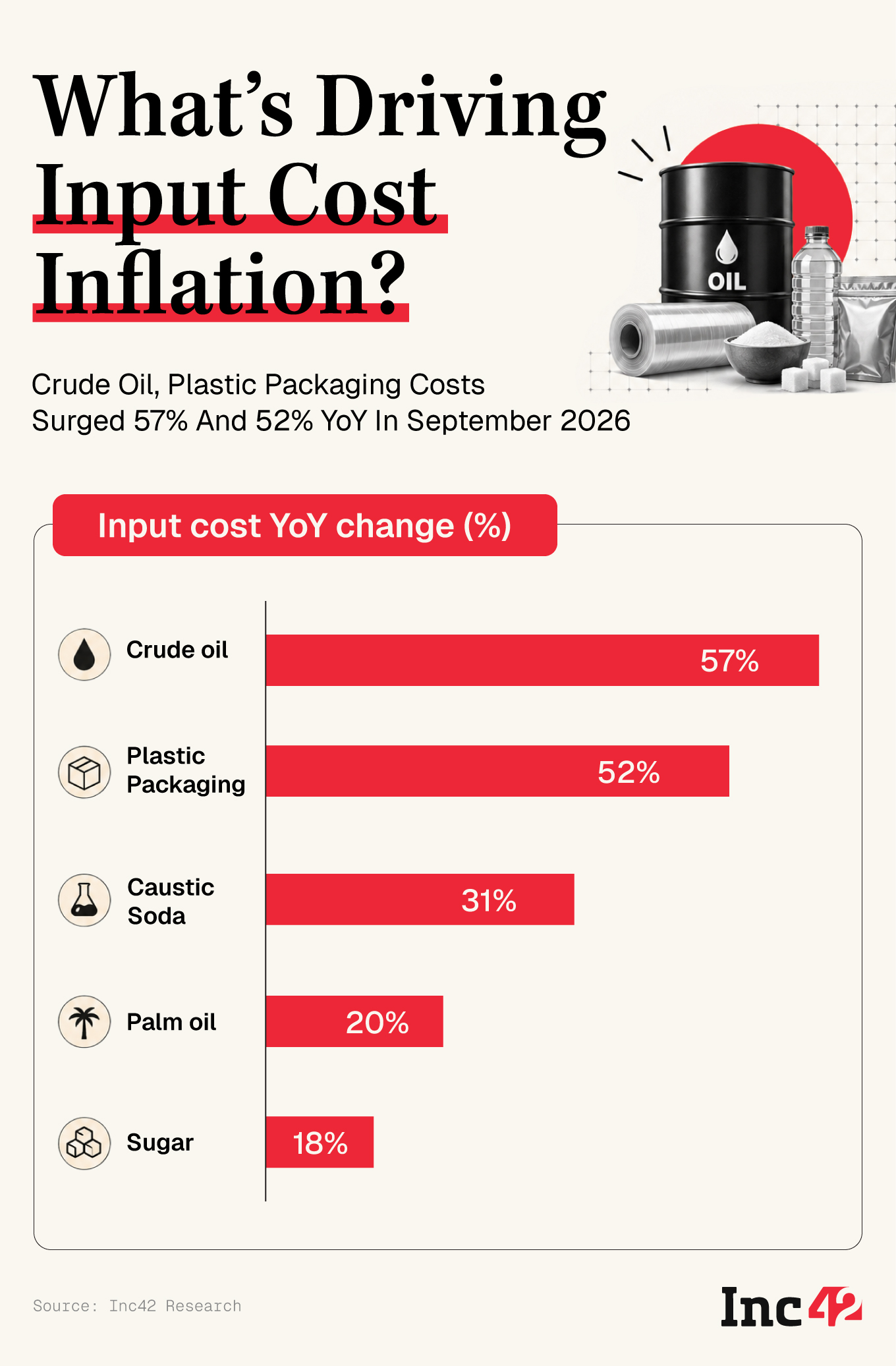
The pressure is particularly visible in categories such as food, beverages and personal care, for which crude-linked packaging, agricultural commodities and imported ingredients account for a significant share of procurement costs.
Higher shipping expenses and volatility in supplier availability have added to the challenge, making it difficult for startups to plan inventory and input requirements.
The festive season did offer some respite on the demand side. Online festive sales grew 17% year-on-year (YoY) to ₹1.41 Lakh Cr in 2026, according to Datum Intelligence’s Festive Barometer.
Elsewhere, ClickPost’s analysis of more than 80 Mn orders across nearly 400 D2C brands indicated that daily orders increased 27% YoY in the run-up to Diwali, while estimated gross merchandise value (GMV) grew 45%.
The problem is that this has not necessarily translated into an easier operating environment for D2Cs. Brands are struggling now to sustain consumer demand beyond the festive period while managing the cost of acquiring customers, fulfilling orders and replenishing inventory.
However, there’s some reason for optimism now. Brent crude, which surged to around $118 per barrel in late October, has since cooled to approximately $95 as of November 16, offering a possible reprieve to businesses grappling with rising input costs. For D2C brands, however, the relief may take time to materialise, as the impact of lower oil prices will take a while to filter through to supply chains, freight rates and packaging costs.
For D2C startups, the bigger question is no longer whether input costs will ease, but how long they will have to absorb the pressure.
How Brands Are Absorbing Cost Spikes
The bigger challenge for startups is not necessarily the rise in input costs itself, but the unpredictability of procurement prices, which makes cost planning and margin management very difficult, said the founder of a large D2C beauty brand who preferred not to be named.
“What bothers startups most is the variation. If a supplier does not stock one product because the price has gone up, the full production (line) might stop,” he said.
For instance, a specialised ingredient may become unavailable because a supplier is unwilling to maintain inventory amid an uncertain price environment. Even if it accounts for a relatively small share of the final product’s cost, its absence can disrupt the manufacturing process altogether. “You cannot make any product with 99% ingredients. That one missing ingredient will hold the thing. Then you scramble and get it from somewhere at any cost,” the founder quoted above added.
Brands that rely on imported ingredients or packaging materials feel the pinch harder. Shipping costs can fluctuate sharply, forcing them to choose between paying a premium to avoid production delays and waiting for freight rates to ease. Either way, higher procurement costs and the need to hold extra inventory strain working capital, leaving less money for scaling-up.
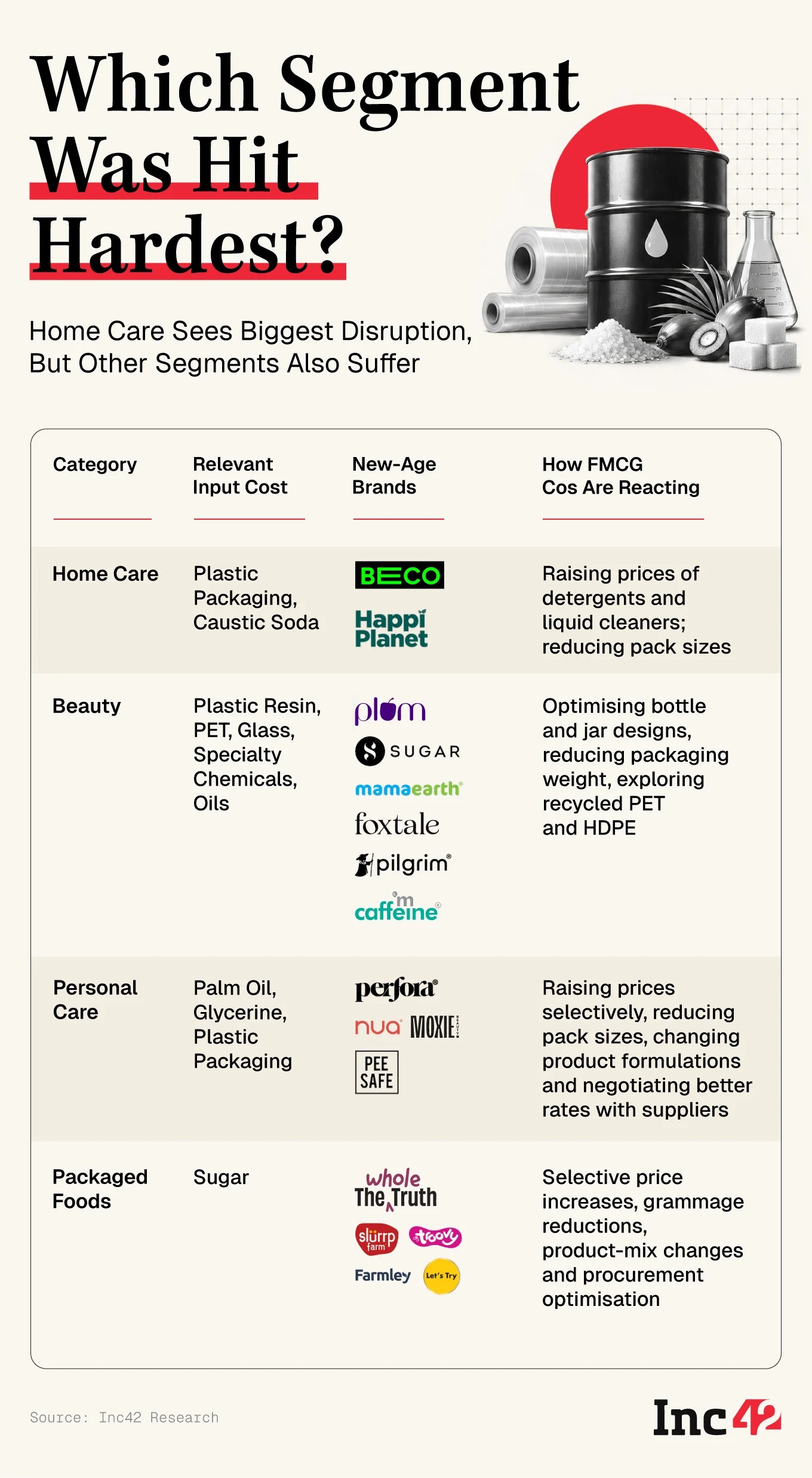
Bharat Birla, executive director at Anand Rathi Investment Banking, said rising commodity and packaging costs have squeezed larger FMCG companies too, particularly in home care, packaged foods and personal care. But for smaller brands, which lack comparable procurement scale, the impact on operating margins can be far more pronounced, he pointed out.
Food & Beverage Startups Face Most Cost Exposure
The impact of input inflation varies depending on the product category. For several non-food D2C businesses, the cost of goods sold (COGS) may account for around 15-20% of the product price, and at most 30%, according to a large D2C beauty brand founder who did not wish to be named.
Food businesses, on the other hand, can have a significantly higher COGS, sometimes reaching 40%. This makes food and beverage brands relatively more vulnerable to fluctuations in agricultural commodities, packaging and transportation costs.
Crude oil is particularly relevant for beverage manufacturers because several packaging materials, including plastic bottles, preforms, caps and labels, are linked to petrochemical inputs.
Nikhil Doda, cofounder of Lahori Zeera, told Inc42, “Most of our raw materials depend on crude. Our preforms, caps and labels are all affected. That hit was there.” The company did not raise prices specifically to offset the recent inflation, although it implemented selective hikes in April-May 2026 as part of its regular price revision cycle, he added.
With Reliance’s Campa expanding and Coca-Cola and PepsiCo sharpening their pricing strategies, further hikes could risk weakening its competitive position. “You cannot increase prices when Coke and Pepsi have decreased their prices from ₹20 to ₹10,” Doda said.
So, for emerging consumer brands, the pricing dilemma is sharper: with fewer buffers to absorb cost shocks, they must protect margins without pricing themselves out of the market.
Why Cutting Discounts May Be Easier Than Raising Prices
Unlike established FMCG players with decades of consumer loyalty, D2C brands rely heavily on digital advertising, promotions and discounts to acquire and retain customers, making price hikes risky in a market where consumers have plenty of alternatives. So, mid-sized and smaller companies are having to look at changes in product mix and pack sizes to manage inflation, Birla said.
The room to raise prices, however, is narrowing for all. According to Sandeep Abhange, research analyst – consumer and midcaps at LKP Securities, large FMCG companies have so far absorbed roughly half of the input cost inflation. “HUL faced 8-10% material inflation but took only 2-5% price hikes, while Dabur took 4% against 10% inflation,” he said.
Startups, Abhange said, could increasingly resort to calibrated price increases and changes in pack sizes, particularly at lower price points. Smaller packs may see grammage reductions, while larger packs could see more direct price increases.
Also, brands should evaluate input inflation alongside marketing expenditure, said the beauty brand founder. “For D2C companies, the cost of goods has a relatively limited impact on overall prices in several categories. If some ingredients become twice as expensive, the cost may go up from, say, 18% to 22%, but marketing costs around 30%.”
This means a reduction in marketing expenditure or discounting could sometimes have a greater impact on profitability than a marginal improvement in procurement costs.
Brands with healthy gross margins, repeat customers and efficient marketing strategies may therefore be better positioned to absorb inflation. Those dependent on aggressive discounts and paid customer acquisition could face greater pressure.
The challenge is particularly relevant after the festive season, when promotional activity begins to moderate and brands have to convert seasonal buyers into repeat customers.
Abhange expects another meaningful round of price increases in Q3 and Q4 FY27, particularly across categories such as detergents, soaps, biscuits, noodles and packaged snacks, which remain exposed to crude-linked inputs and agricultural commodities.
Crude Prices Have Cooled, But Will Startups See Relief?
The softening of crude prices has offered some optimism. However, even as expectations of improved global supply have weighed on prices, geopolitical and shipping-related uncertainties continue to pose risks.
For Indian startups, the transmission of lower crude prices into procurement costs is unlikely to be immediate. “Even if crude cools down, the effect on our procurement levels will take at least five to six months. It’s a process, and things should also remain stable,” Doda said.
Suppliers may still be working with inventory procured at higher prices, while shipping and conversion costs can take additional time to adjust.
Doda added that geopolitical uncertainty makes it difficult to predict when the situation will normalise. If global prices remain stable, he expects the impact to gradually reach procurement costs over the next five to six months.
Birla too predicts a similar timeline. This means packaging-intensive businesses may have to wait until the first half of calendar 2027 to see a meaningful reduction in some input costs, provided the decline is sustained.
The broader margin outlook, however, remains cautious. Abhange expects gross margins across FMCG companies to remain under pressure through Q3 and Q4 FY27, with stabilisation likely only from Q1 FY28 (April to June 2027) as lower crude prices and easing packaging costs gradually feed through.
The timelines are not necessarily interchangeable for every D2C business. The pace of relief will depend on the category, supplier contracts, inventory cycles and the extent to which a brand relies on crude-linked inputs.
Next Few Quarters Will Test Unit Economics
For D2C startups, the next phase will be about managing growth without allowing higher procurement and marketing expenses to erode profitability.
Lower crude prices offer a positive signal, but the relief will take time to reach procurement costs. For packaging-intensive businesses, the five-to-six-month transmission period cited by Doda and Birla suggests that meaningful cost normalisation may take until the first half of 2027, provided global prices remain stable.
A broader recovery in FMCG margins could take longer, with Abhange pointing to Q1 FY28 as a possible turning point.
In the interim, D2Cs will have to focus on supplier diversification, inventory planning, reducing avoidable marketing expenditure and improving gross margins rather than relying solely on price increases.
The current cost cycle may not necessarily become a demand-side problem for the sector, but could reveal the difference between brands that have built resilient operating models and those whose growth depends on continuous discounts and external capital.
For emerging consumer businesses, the festive season may have brought more customers through the door, but the bigger test now is whether they can retain those customers, fulfil demand and make money from every additional order.
[Edited by Chinmay Chaudhuri]
The post Oil Cools, But D2C Brands See No Way Out Of Price Hikes appeared first on Inc42 Media.
This content is published by Inc42 and has not been created or edited by Hello Headlines. View original