As Groundwater Levels Fall, Rewari Is Reviving 10 Ponds to Store 120 Million Litres of Water
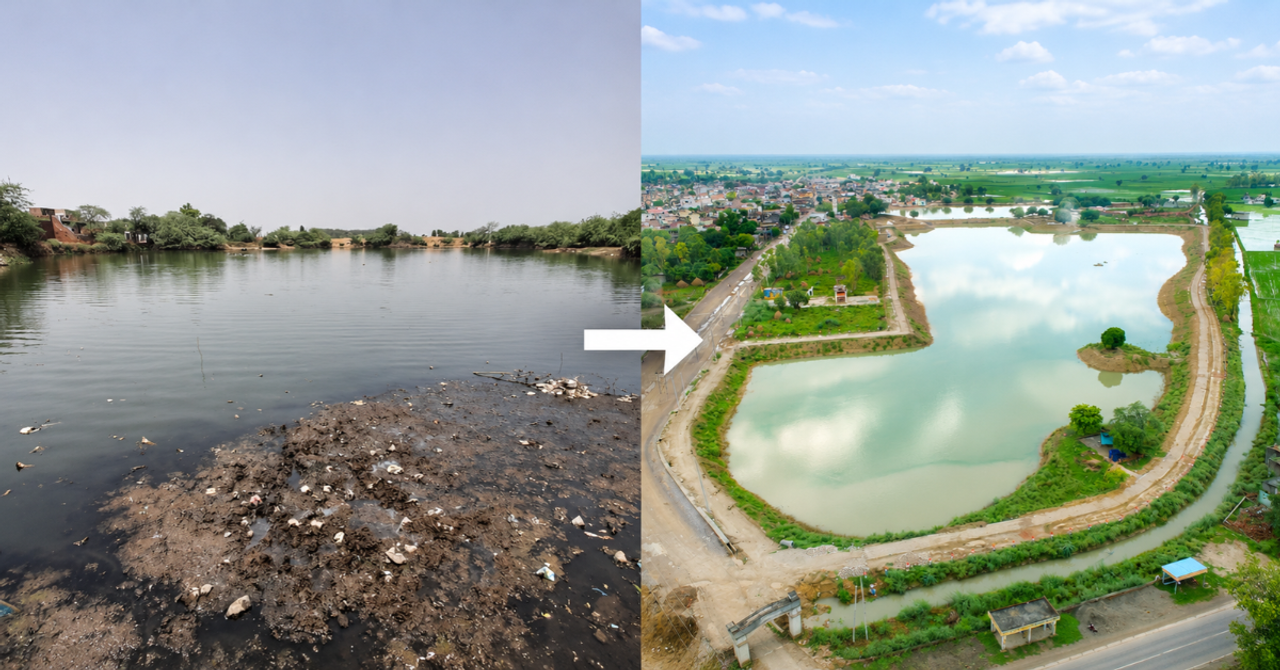
For a village that depends on the monsoon, a pond can make the difference between rainwater that runs away and water that remains available after the rains.
It can collect rainfall, support nearby farms and, depending on the soil and water conditions, help replenish groundwater. Over time, however, silt, waste and neglect can reduce how much water a pond holds.
In Haryana's Rewari district, where groundwater has been under pressure for years, 10 village ponds are now at the centre of a new conservation effort.
The Energy and Resources Institute (TERI) and Nokia India have joined hands to restore these waterbodies over 24 months, with a target of increasing their combined storage capacity to 120 million litres.
The project, announced on 10 November 2026, also plans to plant native vegetation, improve public spaces around the ponds and involve villagers in their upkeep. If the work achieves its goals, around 22,000 people could benefit directly, while another 50,000 could benefit indirectly.
Why Rewari is turning back to its ponds
Rewari's water worries are not new.
In 2019, a Government of India report under the Jal Shakti Abhiyan described the district as water-stressed. It said groundwater levels had been declining, with conditions especially serious in Khol block, classified as over-exploited.
That means water was being drawn from underground faster than it could be naturally replenished. For communities that rely on groundwater for everyday needs and farming, this makes conserving every possible source of water important.
At the time, the district administration had begun mapping existing water resources. Gram Panchayats made inventories of village ponds and other water structures, helping officials identify what could be repaired or improved.

The idea was to make better use of the systems that villages already had.
Traditional ponds are part of that picture. When cared for, they can hold rainwater, provide habitat for small wildlife and help water soak into the ground where conditions permit. When their inlets get blocked or their storage space fills with sediment, they become less effective.
The new Rewari project builds on the wider need to protect these familiar but valuable waterbodies.
What will change around the 10 ponds?
TERI and Nokia India signed a memorandum of understanding at TERI Gram in Gwal Pahari, Haryana, to begin the Nokia Pond Rejuvenation Project.
The plan is to enhance the ponds' combined water storage capacity to 1,20,000 cubic metres, or 120 million litres. This is a target for the coming two years, rather than water already conserved.
For villagers, the potential value is straightforward: ponds that can collect and retain more water may help support local water needs and contribute to groundwater recharge.
The project also aims to improve the land around the ponds through native planting. Plants suited to the area can help hold pond banks together, slow rainwater runoff and trap some of the soil that might otherwise wash into the water.
A 2022 review published in the journal Wetlands explains that vegetated areas around ponds can reduce sediment and pollutants entering them, while supporting the surrounding ecosystem.
But planting alone is not enough. The choice of species, where they are placed and whether they survive will shape their usefulness. TERI's announcement includes native planting, although the number of individual plants and the species to be used still need clarification.
Alongside the ecological work, the initiative proposes 100 streetlights, benches and dustbins around the ponds. These additions are intended to make the spaces safer and easier for residents to use and care for.
Who will look after the ponds afterwards?
A restored pond can deteriorate again if rubbish collects, channels become blocked or new plants are left without care.
That is why the project includes community participation rather than treating restoration as a one-time construction job.
Residents and Gram Panchayats could help identify problems, discourage dumping and raise maintenance concerns. Farmers, too, have a stake in protecting water sources that may support agriculture.
At the project announcement, Dr Dipankar Saharia, Executive Director of TERI, spoke about "community-led conservation" and securing water for communities and farms.
The involvement of local people will matter particularly after the 24-month project ends. The ponds will need attention through changing seasons, including when there is little rainfall.
🤝 TERI and Nokia India Join Hands to Strengthen Water Security in Haryana TERI and Nokia India recently signed an MoU to launch a pond rejuvenation initiative in Rewari, Haryana, aimed at improving local water security through ecological restoration and community participation. The MoU was signed by Dr Dipankar Saharia, Executive Director, TERI, and Ms Vibha Mehra, India Country Manager, Nokia, at TERI Gram, Gwal Pahari. The programme seeks to address water stress in one of India's key agricultural and industrial regions while supporting sustainable natural resource management. Supported under Nokia India's CSR programme, the initiative will focus on the rejuvenation of approximately 10 ponds, alongside native tree plantation and community engagement activities designed to promote long-term environmental stewardship. The partnership reflects a shared commitment to creating meaningful impact through community-led environmental action and advancing India's sustainable development goals. @sahariadipankar | @nokia | #WaterSecurity #PondRejuvenation #CSR #Sustainability #ClimateAction #CommunityDevelopment #EnvironmentalStewardship
— TERI (@teriin) November 10, 2026
TERI estimates that 22,000 people could benefit directly and a further 50,000 indirectly, based on Census 2011 figures. Those are projected benefits, and the actual results will depend on the restoration work and long-term maintenance.
The real test will be whether water continues to reach the ponds, their banks remain protected and residents have support to maintain them.
For Rewari, the promise of the initiative is rooted in something villages have known for generations: a pond is useful when it holds water and people continue to care for it.
If these 10 ponds become healthier and remain that way, their value could be felt in the everyday lives of the communities around them, long after the last bench is installed and the restoration teams have left.
Sources:
‘TERI and Nokia India Sign MoU to Rejuvenate 10 Ponds in Haryana’s Rewari District’: Published on 10 November 2026
'Rewari outlines district water conservation plan’: By Ministry of Water Resources, Published on 25 November 2019
‘Current Status of Ponds in India: A Framework for Restoration, Policies and Circular Economy’: By Shweta Yadav, V.C Goyal, Published on 4 November 2022
This content is published by The Better India and has not been created or edited by Hello Headlines. View original