AI Is Supercharging Cyberattacks, But Are Indian Enterprises Ready?
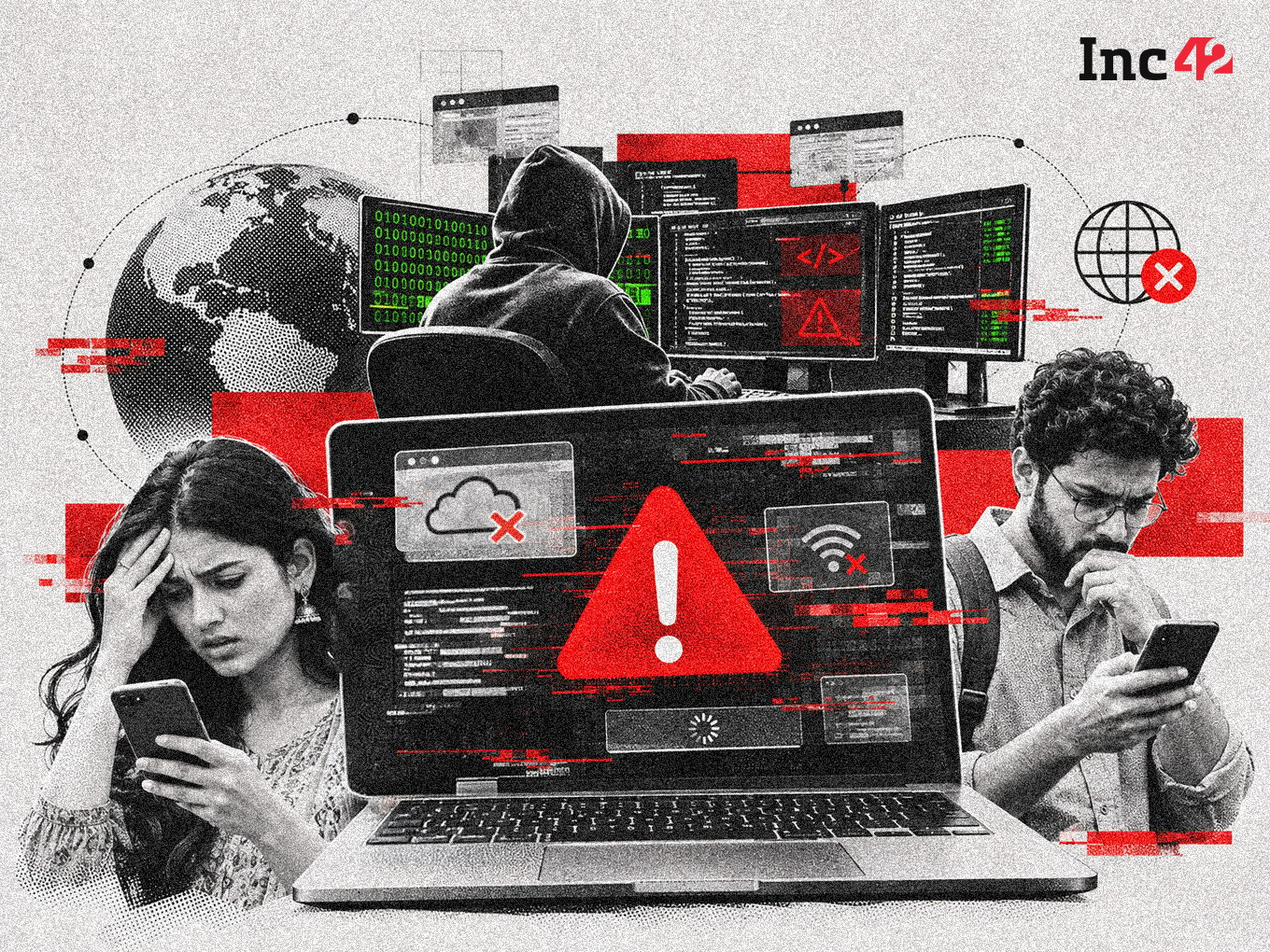
It has been a week of outages. From big tech giants like Microsoft and Apple to JPMorgan Chase and the US Federal Aviation Administration (FAA), high-profile disruptions at key digital installations exposed how fragile the global digital infrastructure could be.
While these incidents have not yet been established as AI-assisted cyberattacks, Nikesh Arora, CEO of Palo Alto Networks, one of the world’s largest cybersecurity companies, said that the events of week were far from a coincidence.
“So what the (cybersecurity) industry tried to warn enterprises about six months ago is here. The events of this week so far are not a coincidence. AI is making it easy for hackers to attack multiple customers,” said Arora in post on X.
Besides AI-assisted cyberattacks, he also blamed some of the outages on the a “deluge of patches” from vendors rushing to fix AI-discovered vulnerabilities. Noting that this “deluge” of patches was overwhelming IT teams, he urged the enterprises to test infrastructure across multiple AI models and revamp security operations centres.
His comments brought the spotlight back on the growing threat of AI-led cyberattacks. By automating reconnaissance, writing exploit code on the fly and allowing threat actors to probe thousands of targets simultaneously, AI is drastically compressing the time between discovering a flaw and weaponising it – leaving human defenders struggling to keep pace.
With new vulnerabilities surfacing every single day, how is AI making it harder for enterprises to keep pace with cyberattackers?
Cyberattacks In The AI Era
Cybersecurity expert Ritesh Bhatia, founder of cybersecurity platform V4WEB, believes that AI is not necessarily making cyberattacks more sophisticated. Instead, he says that the technology is accelerating techniques that attackers have been using for years.
According to him, the change is primarily visible in three areas: speed, scale and realism.
Tasks that earlier took days or months can now be completed in seconds, minutes or hours. Generative AI (GenAI) has also made phishing emails more convincing by eliminating grammatical errors that could previously alert recipients. Voice cloning and deepfakes further allow attackers to impersonate senior executives and issue fraudulent instructions.
Bhatia also flagged the problem of what he described as “shadow infrastructure” or “shadow assets” at large enterprises – systems that remain untracked, forgotten or outside regular IT monitoring. AI-assisted scanning can help attackers identify vulnerabilities in these overlooked systems, he adds.
Third-party vendors are another concern. Even large enterprises with strong cybersecurity teams often depend on smaller service providers that may not have comparable security capabilities. These vendors can become easier targets, particularly as AI lowers the barrier to learning hacking techniques.
“What previously required multiple individuals with specialised skills can now increasingly be handled by a single attacker. The bigger concern is the scale at which these operations can be replicated across organisations,” said Manohar Reddy Pagilla, threat researcher at CloudSEK.
He also added that the recent outages have highlighted the concentration risk across the global technology ecosystem. Pagilla further adds that from an attacker’s perspective, compromising a technology provider serving hundreds of organisations can be more rewarding than targeting each business individually.
Yet, the threat is no longer confined to external third-party vendors. As enterprises race to embed AI into their own workflows, they are inadvertently also expanding their exposure to cyberattacks from within.
The Widening Enterprise Attack Surface
Within enterprises, AI is opening up new fronts of vulnerability: accelerating how fast bug-laden software is shipped while simultaneously supercharging how quickly its code can be broken.
Developers can now generate and deploy vast volumes of code with minimal human scrutiny. This has increased the odds of critical flaws (in authentication, payment logic, and API integrations) slipping into production before being adequately reviewed.
Attackers, meanwhile, are using the same technology to probe multiple weaknesses at once, reverse-engineer applications, and map out attack paths in a fraction of the time it once took.
“The same capabilities that make our security testing faster can also make attackers substantially more effective,” said founder and CTO of Security Brigade Yash Kadakia.
Compounding the issue of unvetted code is the rapid spread of AI across day-to-day business operations, a trend Akshit Kaushik, cofounder and CBO of Mitigata, flags as a major new blind spot.
Enterprises are increasingly entrusting AI systems to handle customer queries, process refunds, generate code, and access internal databases. At the same time, employees are independently adopting unapproved “shadow AI” tools, often completely out of sight of security teams.
Every new integration creates a fresh entry point. Kaushik warns that attackers can hide malicious instructions inside seemingly routine emails and documents, manipulating enterprise AI assistants into leaking sensitive data or executing unauthorised actions.
To close these expanding gaps, he believes businesses must establish strict visibility and governance – tracking every AI tool deployed internally, auditing the data these systems can access, and ensuring their AI systems operate strictly within defined boundaries.
What Should Indian Enterprises Do?
For India, where banking, real-time payments, telecommunications, power, and public services are built on deeply interconnected digital infrastructure, the margin for error is shrinking fast.
Security experts suggest that Indian enterprises must move beyond traditional perimeter defense and focus on three core pillars:
Sovereign Resilience and System Modernisation: Kaushal Bheda, director at Pelorus Technologies, warns that India’s reliance on foreign software and cloud platforms for critical infrastructure introduces a distinct layer of geopolitical and supply-chain risk.
To insulate sensitive infrastructure, he believes that Indian enterprises should aggressively upgrade legacy systems, continuously monitor networks, and invest in indigenous security products designed and controlled within the country.
Proactive Cyber Hygiene and Threat Hunting: CloudSEK’s Pagilla advises organisations to immediately lock down their most common entry points: exposed credentials, unpatched internet-facing assets, excessive access permissions, and third-party vendor vulnerabilities.
Rather than relying solely on internal alerts, he recommends augmenting existing security operations centres (SOCs) with external threat intelligence to detect and neutralise threats before they breach internal networks.
Board-Level Incident Readiness: V4WEB’s Bhatia argues that Indian companies must shift their mindset from pure prevention to inevitable recovery. “Death, taxes and cyberhacks are bound to happen,” he noted.
According to Bhatia, Indian enterprises should regularly test data backups, rehearse restoration protocols and preparing clear crisis-communication playbooks for customers, partners, regulators and stock exchanges.
“Today, the most important thing that companies should prioritise is incident response. When an incident happens, don’t think that it won’t happen. Are you ready to respond to it? Are you resilient enough? Have you tested your backups? Are you able to restore them?” added Bhatia.
For Indian enterprises, therefore, the question is no longer simply whether AI can make cyberattacks more effective. It is whether their security teams, infrastructure, and leadership can respond at the exact same speed.
The post AI Is Supercharging Cyberattacks, But Are Indian Enterprises Ready? appeared first on Inc42 Media.
This content is published by Inc42 and has not been created or edited by Hello Headlines. View original