All Smoke No Fire At The ‘Historic’ Shenzhen Meet
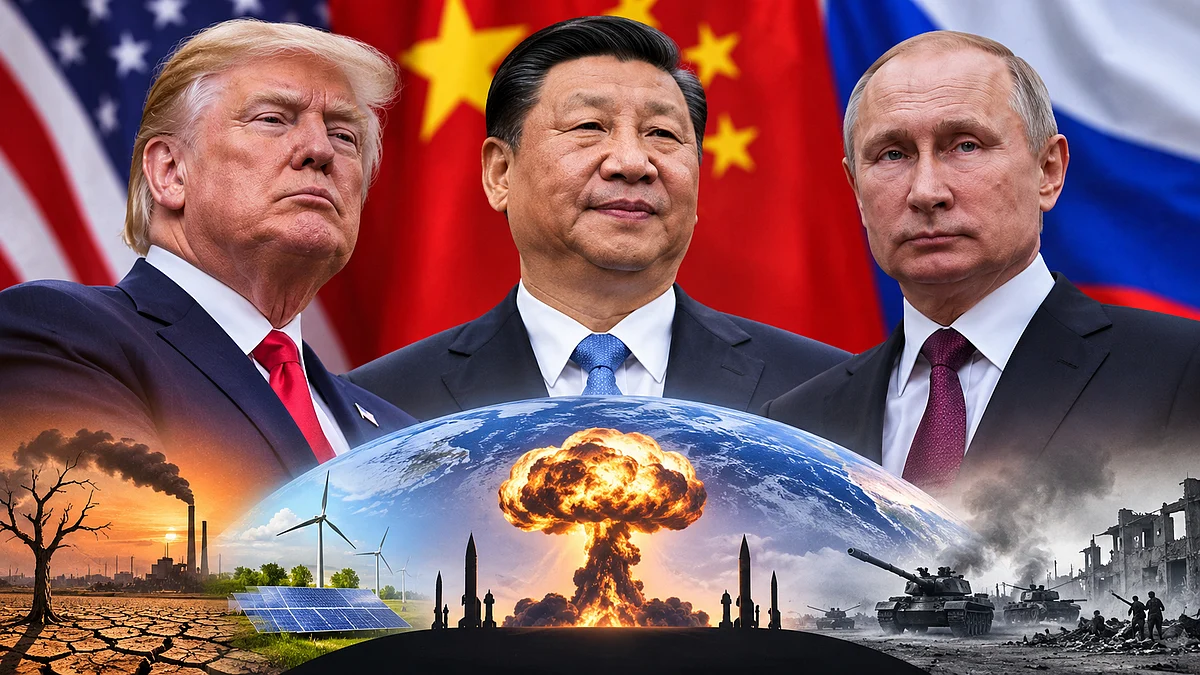
More form than substance, a lingering impression of the declaration issued, following the trilateral meeting among US President Donald Trump, his Chinese and Russian counterparts Xi Jinping and Vladimir Putin, respectively, on the sidelines of the Asia-Pacific Economic Cooperation summit on Thursday, is that the leaders were having the last laugh at the global multilateral framework and the rule of law, predictably yielding few tangibles. Media commentators must be excused for their exaggerated reading of the parleys at Shenzhen as the 21st century equivalent of the 1945 Yalta conference, where Franklin D Roosevelt, Winston Churchill, and Joseph Stalin sliced up post-war Germany and Europe in line with their ideological orientations. The world today is vastly more multipolar than Washington, Moscow, and Beijing might be willing to acknowledge, as nations of the global South assert their independence and self-interest on matters ranging from trade to climate and disarmament.
President Trump could not have sounded more anachronistic when he gloated over the clout the three powers wielded to shape the course of arms control merely by virtue of having amassed the world’s largest arsenals of atomic bombs. Consider the New START nuclear agreement between the US and Russia, which expired in February. The deal capped their respective arsenals at 1550 deployed strategic nuclear warheads. Last year, Putin proposed maintaining the status quo for another year ahead of any prospective renewal. But anxious to prevent China from catching up with US capabilities, Trump almost made it a precondition that Beijing should join three-way negotiations before any new pact could be established, but there is no clear direction so far.
The larger picture on the world atomic weapons scenario is one of an abject failure of the P-5 nuclear weapons states—Britain, France, and the trio that met at Shenzhen—to advance non-proliferation more than 5 decades since the NPT (Nuclear Non-Proliferation Treaty) came into existence. Today, there are nearly 10 countries that officially or otherwise possess these lethal weapons of mass destruction and justify them as a deterrent. Disillusionment with this dangerous state of affairs has led to the adoption of the 2017 nuclear weapons prohibition treaty that entered into force in 2021.
The Shenzhen meet is also noteworthy for the glaring silence on the most burning issue of our times. The three countries are among the world’s top five climate polluters. President Trump has contemptuously withdrawn the US from the multilateral Paris 2015 climate agreement. His closest allies at home and in Latin America simply deny global warming. China is a world leader in renewables, yet is unlikely to jettison its dependence on coal in a hurry, like Russia on its vast oil reserves. Given their competition for regional dominance and global supremacy, they necessarily regard the ongoing wars in Ukraine and the Middle East from that prism alone.
This content is published by Free Press Journal and has not been created or edited by Hello Headlines. View original