Swish FY26: Revenue Surges Close To ₹50 Cr While Loss Widens To ₹91 Cr
Quick food delivery startup Swish clocked in a revenue of over ₹50 Cr in its first fiscal year. However, heavy expenses pushed the Bengaluru-based startup deep into the red.
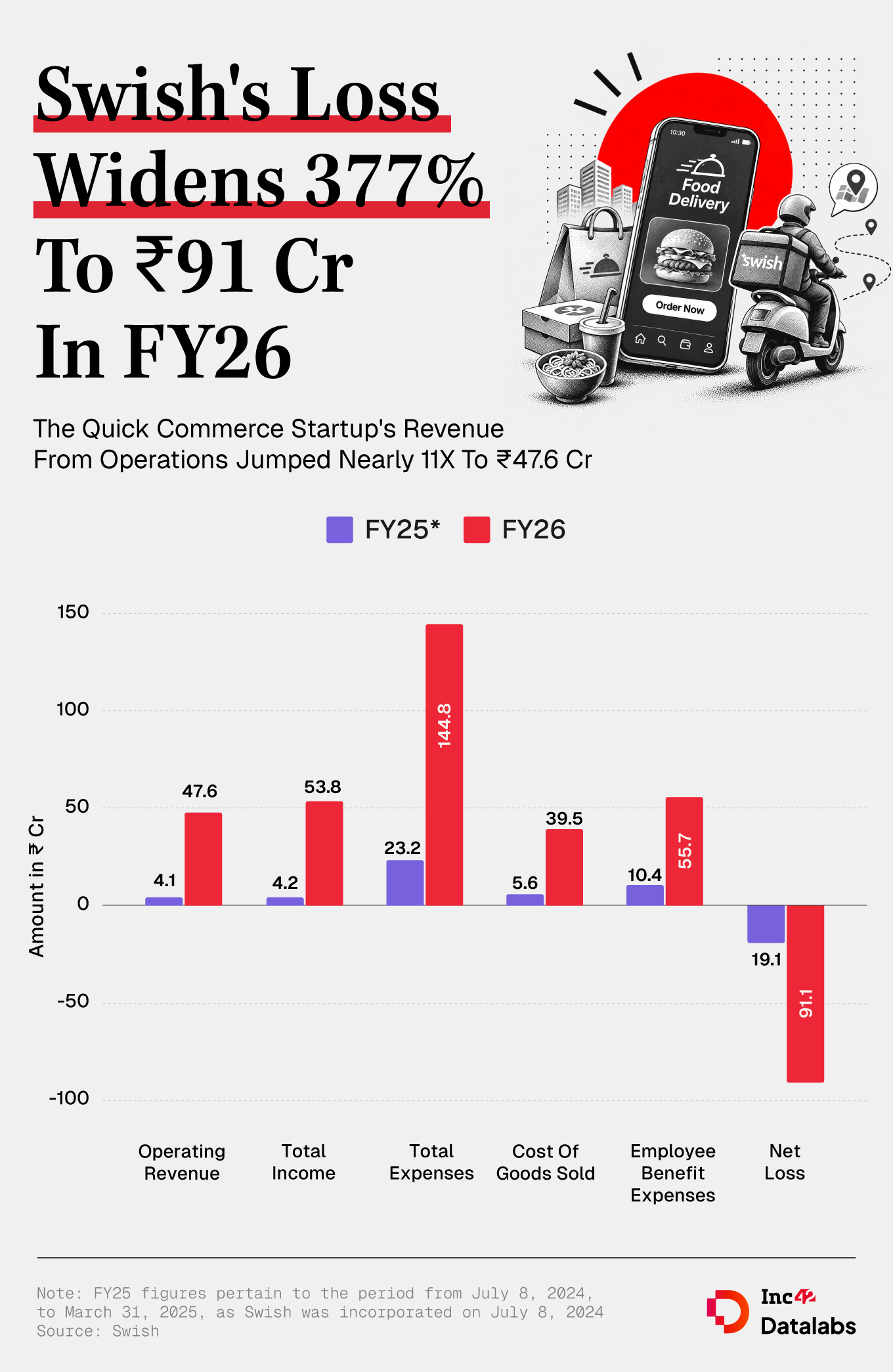
Swish’s operating revenue for the fiscal jumped over 10X YoY to ₹47.6 Cr, while its net loss surged close to 4X to ₹91.1 Cr during the year.
Notably, Swish’s FY25 financial statements cover only the period between July 8, 2024, and March 31, 2025, following its incorporation in July 2024. Therefore, the year-on-year growth figures are based on a shorter operating period and are not directly comparable with a full-year performance.
The startup’s total income, including other income, rose to ₹53.8 Cr in FY26 from ₹4.2 Cr in FY25. Meanwhile, its total expenses surged more than 5X to ₹144.8 Cr, significantly outpacing revenue growth.
Founded in 2024 by Aniket Shah, Ujjwal Sukheja and Saran S, Swish operates a vertically integrated quick food delivery model, with the startup owning and managing its neighbourhood kitchens, technology and last-mile delivery operations.
Its kitchens typically serve customers within a one-kilometre radius, with the platform promising food deliveries in around 10-15 minutes.
Unlike the asset-light aggregator model followed by Swiggy and Zomato, Swish operates its own kitchens, with dedicated preparation, cooking and assembly stations.
The startup has expanded its presence across Bengaluru, Gurugram, Noida, Delhi and Ghaziabad, covering nearly 50 pincodes.
In September 2026, Swish raised $24 Mn (around ₹228 Cr) in a funding round led by Bertelsmann India Investments, with participation from existing investors Accel, Bain Capital Ventures and Hara Global.
The startup said it would use the proceeds to expand its kitchen network, enter new cities and strengthen its supply chain infrastructure. It is targeting a network of more than 1,000 kitchens over the next five years. Prior to that it also raised $38 Mn in March 2026.
The startup has also been experimenting with new delivery formats.
In October 2026, it began piloting Swish Go, a feature that allows customers to order food from third-party restaurants and cloud kitchens, marking a departure from its core kitchen-led model. The service is being tested in select Bengaluru pincodes and is positioned around affordable food delivery without packaging and platform fees.
Swish’s Expenses Surge 5X
Swish’s employee benefit expenses emerged as its largest expense head, rising over 5X to ₹55.71 Cr in FY26 from ₹10.37 Cr in FY25. Cost of goods sold jumped 586% to ₹39.48 Cr, while other expenses surged 565% to ₹44.39 Cr during the year.
The widening losses come amid increased scrutiny over the economics of ultra-fast food delivery. Several players, including Swiggy, have recalibrated their bets in the segment, with the latter shutting down its standalone 10-minute food delivery app SNACC earlier this year amid profitability concerns.
Zing has also moved away from the model, citing weaker-than-expected demand and high operating costs.
The post Swish FY26: Revenue Surges Close To ₹50 Cr While Loss Widens To ₹91 Cr appeared first on Inc42 Media.
This content is published by Inc42 and has not been created or edited by Hello Headlines. View original