Sarvam AI Defends Token Factory, Says Homegrown Models Remain Core Focus
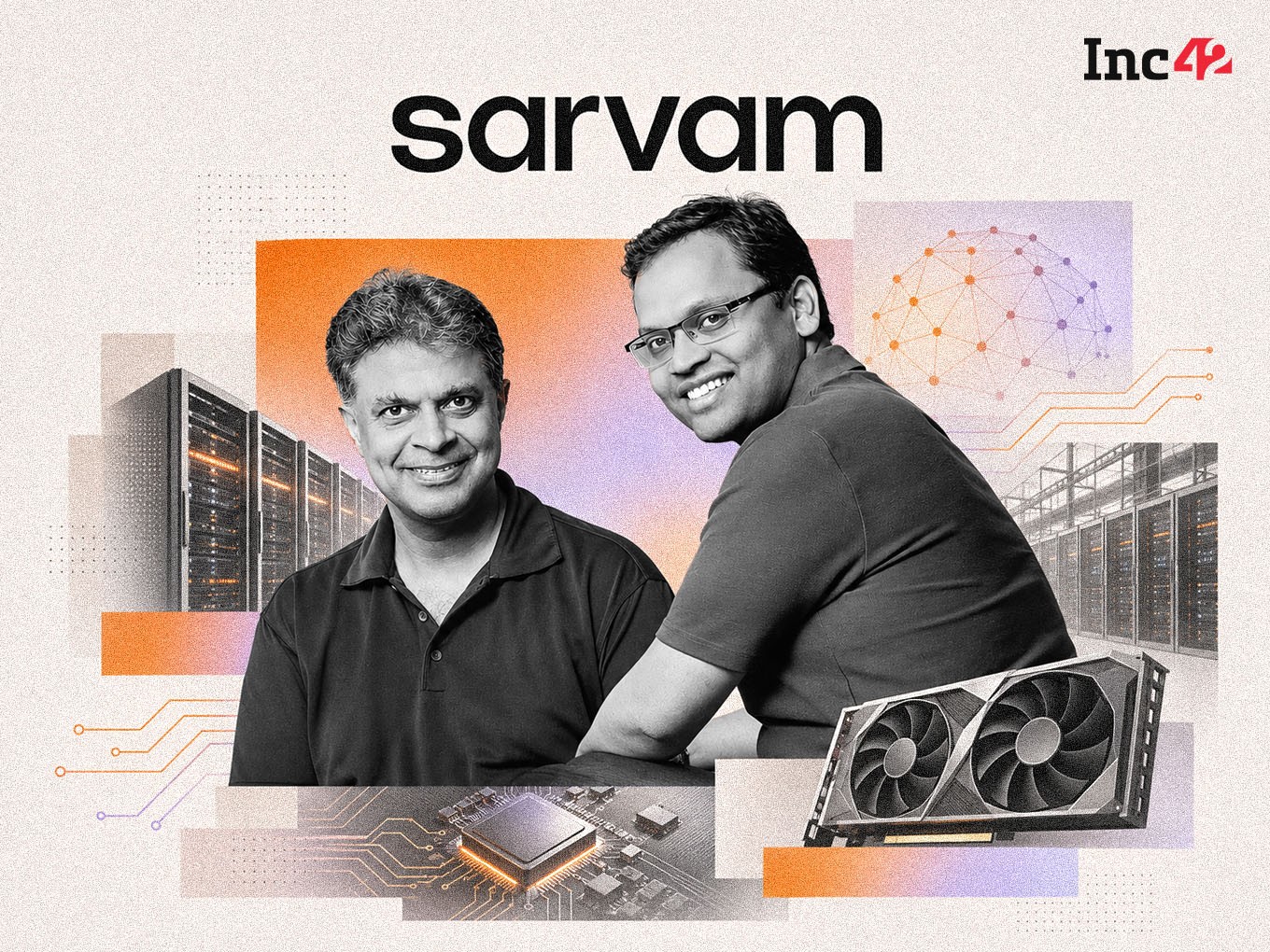
AI unicorn Sarvam AI has defended its Token Factory business, saying the platform runs on privately procured GPUs rather than government-subsidised computing capacity, while reiterating that developing homegrown AI models remains its core focus.
In a post on X, cofounder Pratyush Kumar addressed questions about the startup’s government support, its decision to host global open-weight models, and whether its expansion into inference infrastructure signals a shift away from building indigenous models.
Notably, Token Factory’s launch had sparked online debates about Sarvam’s use of government subsidised compute capacity and its ability to anchor India’s indigenous AI ambitions.
Kumar said the IndiaAI Mission gave around 20 startups access to GPUs at a 40% discount. Sarvam used this computing capacity to train its 105-billion-parameter foundation model from scratch, completing and releasing it in February 2026, he said.
He added that the government did not make direct payments to Sarvam. Instead, the subsidy went to GPU cloud providers, which supplied discounted computing resources to participating startups.
Sarvam’s access to the government-supported GPU allocation ended in March this year. The startup said Token Factory operates on GPUs it procured privately.
Under the IndiaAI Mission, Sarvam received access to 4,096 Nvidia H100 GPUs to develop indigenous foundation models. The six-month computing allocation was valued at around ₹247 Cr, including a government subsidy of ₹98.68 Cr.
The Inference Business Case
The clarification follows the launch of Token Factory, which hosts Sarvam’s own models alongside global open-weight models, including Google’s Gemma and China’s DeepSeek and Kimi, on GPU infrastructure in India.
The platform lets developers and enterprises access multiple models through a single API, without procuring GPUs or managing model deployment themselves. It charges customers for the tokens they use.
Kumar said open-weight models offer enterprises cost advantages and greater control over their AI systems. However, Indian businesses requiring data to remain within the country and fast responses for interactive applications need access to locally hosted models, he argued.
He claimed Sarvam has optimised its data centre-scale inference infrastructure to offer token prices comparable to or lower than global providers such as Fireworks AI, Baseten, and Together AI.
Kumar said India consumes a few trillion tokens daily, with most of this demand served from overseas. Building domestic inference capacity could reduce that dependence while creating a commercial opportunity, he argued.
He added that Sarvam would continue reducing costs and widening access to inference services in India.
Sarvam Reiterates Focus On Homegrown Models
Kumar said building inference infrastructure does not conflict with Sarvam’s core mission of training its own models.
Over the past few months, the startup has optimised its training systems for NVIDIA’s Blackwell GPUs alongside building Token Factory and expanding its enterprise offerings, he said.
Using this infrastructure, Sarvam trained Sarvam-105B-1711, an upgraded version of its 105-billion-parameter model, which it released yesterday.
The company claimed improvements in reasoning, tool use, Indian languages, and work tasks involving multiple steps. Kumar described it as one of the strongest models in the Flash-Lite category, which targets high-volume applications such as customer support and voice agents.
Kumar said the model can power its agentic AI product Indus. Alongside the model weights, Sarvam is releasing training and inference recipes to help developers build on the technology.
The startup plans to release more models across vision, speech, and edge AI over the next two weeks. It is also working with partners to bring the latest training-grade computing infrastructure to India for its next generation of larger models.
Kumar said Sarvam aims to pursue larger models while building a sustainable commercial business serving enterprises and population-scale applications.
The post Sarvam AI Defends Token Factory, Says Homegrown Models Remain Core Focus appeared first on Inc42 Media.
This content is published by Inc42 and has not been created or edited by Hello Headlines. View original