Layoffs At JioStar, AidenAI Nets $32 Mn & More

JioStar’s Second Round Of Layoffs
Layoffs hit two major pillars of India’s digital economy this week. Media giant JioStar is trimming at least 150 jobs, while Google Cloud India confirmed that it slashed around 30 roles last week. But why are corporate giants laying off teams even as digital demand climbs?
JioStar Draws Its Axe: Barely 18 months after cutting over 1,000 roles following the Viacom18-Star India merger, JioStar is initiating a second round of layoffs that will impact roles across marketing, production, studios and operations. Sources suggest that the final number could be higher than 150. The latest layoffs reflect mounting profitability pressures at the media giant.
JioStar’s Margin Pressure: The media giant’s financials tell a more complicated story. Despite higher revenue and viewership, margins are shrinking – Q2 FY27 EBITDA fell 11% YoY and margins contracted 600 bps. At the same time, JioStar is investing in content, sports rights and international expansion. This expansion spree appears to have taken a toll on its finances and raised questions over whether its growth is translating into profits.
Google Cloud Downsizes: Hyperscaler Google Cloud has also confirmed that it eliminated nearly 30 roles in India last week, calling it a “small organisational change” amid a reprioritisation of work. The company rejected rumours of large-scale layoffs but did not disclose impacted teams or functions.
A Broader Wave: JioStar and Google Cloud are not alone in trimming their workforces. Oracle, PayPal, Amazon and Uber all announced job cuts in India in recent months, reportedly impacting more than 3,500 roles.
Besides this, Microsoft and Google have both rolled out voluntary exit plans for employees instead of resorting to layoffs. This reflects a broader push across the tech ecosystem to control costs, restructure teams and redirect spending towards AI and automation.
As questions remain over whether these big giants can build sustainable businesses without repeatedly shrinking their workforces, here is all about the JioStar layoff saga…
From The Editor’s Desk
 AidenAI Nets $32 Mn
- The enterprise AI startup has raised nearly ₹297 Cr in its Series A round led by A91 Partners to bolster its tech stack and engineering capabilities. It also plans to build a team of more than 1,000 frontier AI engineers through its AidenAI Builder Academy.
- Founded in 2023, the startup helps large enterprises integrate AI into existing apps, data infrastructure and business workflows. It also offers an AI-driven platform that helps businesses modernise legacy software systems.
- The fundraise comes as enterprises increasingly explore agentic AI applications to automate workflows and streamline operations. On the back of this, the Indian enterprise AI market is projected to become a $71 Bn opportunity by 2030.
 Turtlemint Under GST Radar
- Maharashtra GST authorities are conducting searches at the registered office of the insurance tech company’s subsidiary, Turtlemint Insurance Broking Services, in Mumbai. The search and seizure operation is currently underway.
- Turtlemint said that the searches were conducted under Section 67 of the Maharashtra Goods and Services Tax Act, 2017. However, it did not disclose the specific alleged violations or a tax demand.
- Founded in 2015, Turtlemint operates an omnichannel insurance distribution platform that enables over 6.6 Lakh financial advisors to sell motor, health, and life insurance. This comes less than five months after the company listed on the exchanges in June.
 Shadowfax To Acquire Borzo
- The listed logistics platform is acquiring the Indian arm of Borzo (formerly WeFast) for ₹23.3 Cr. The deal will enable Shadowfax to enter the on-demand intra-city goods transportation category and expand its reach.
- Founded in 2012, Borzo operates a fleet of over 32,000 delivery partners across five Indian cities and claims to fulfil over 1.2 Cr deliveries annually. It relocated its base from Amsterdam to Mumbai in 2024 and closed CY25 with an adjusted top line of ₹200 Cr.
- This acquisition comes as the listed startup looks to build on the traction of its D2C-focused Shadowfax 360 offering and strong growth in its hyperlocal business to broaden its full-stack logistics platform.
 GalaxEye’s Mission Drishti
- The spacetech startup has awarded a multi-year contract to Bellatrix Aerospace. Under this, Bellatrix will design, build and deliver its Arka Hall-effect electric propulsion systems for GalaxEye’s 30 Drishti Gen-II satellites.
- Under the phased schedule, deliveries will begin with propulsion systems for the first two satellites and will subsequently be scaled to 30. The satellites will be part of an OptoSAR constellation that GalaxEye aims to deploy by 2030.
- Founded in 2021, GalaxEye combines optical imaging and synthetic aperture radar on a single satellite. Its OptoSAR technology supports Earth observation through clouds and at night for defence and agriculture use cases. It has raised $27 Mn to date.
Former Sequoia Exec’s New AI Bet
- Former Sequoia India investor Sudhanshu Mishra has launched an agentic AI startup called Demi.AI in the US. The platform is currently in beta mode and is available for a select few users.
- The new venture will look to build an AI assistant that can anticipate users’ requirements and complete work before being explicitly instructed. Its individual paid plan starts at $25 per month, while team pricing comes with a customised price tag.
- Mishra worked on early-stage investments at Sequoia India, primarily leading the VC firm’s crypto-focused efforts. He subsequently joined Paradigm, a crypto-focused investment firm, as an investment partner.
Inc42 Markets
Inc42 Startup Spotlight
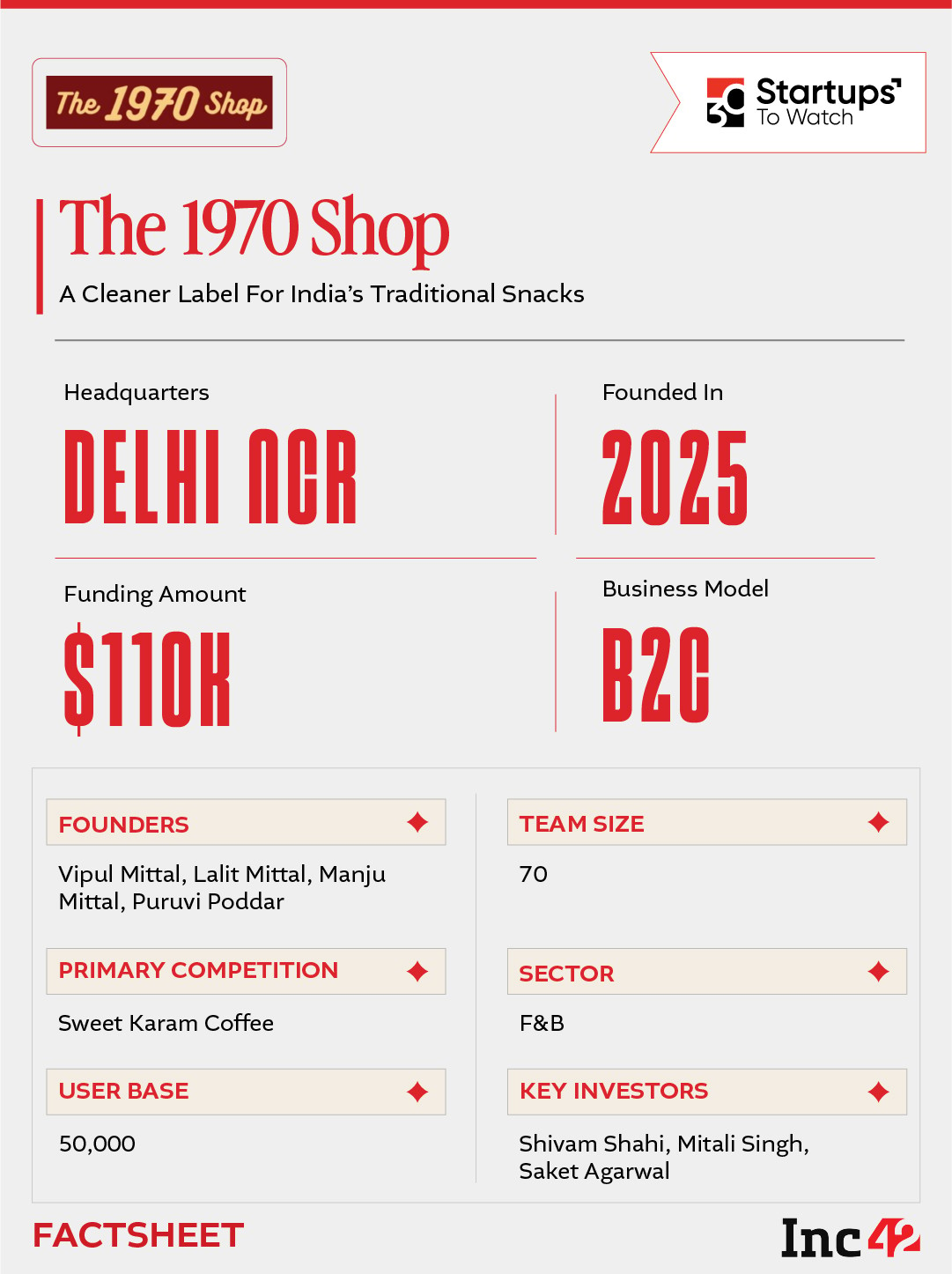
How The 1970 Shop Wants To Make Mithai Guilt-Free
India’s favourite festive snacks are often loaded with palm oil, sugar and preservatives. This leaves health-conscious consumers torn between taste and nutrition. The 1970 Shop wants to solve this conundrum with cleaner alternatives and recognisable ingredients.
A Modern Recipe: Founded in 2025, The 1970 Shop sells a range of products including atta biscuits, thekua, dal kachori papdi and besan laddoos. The brand mills its own flour and makes its products in-house using desi ghee, groundnut oil, jaggery and desi khaand. The brand claims that its products contain no maida, refined sugar, palm oil, preservatives or acidity regulators.
Tapping Into Nostalgia: The startup positions itself around nostalgia and ingredient transparency, reviving recipes such as Bihari thekua and North Indian atta pinni. Its products are designed for everyday snacking as well as festivals, gifting and family gatherings. It claims to have so far served over 50,000 customers, with more than 100% revenue growth over three months and CM2 profitability.
The Clean Snacking Bet: Going forward, The 1970 Shop is targeting an FY27 revenue run rate of ₹18 Cr and plans to increase monthly sales from 30 tonnes to 150 tonnes by 2028. Its growth will depend on maintaining quality and freshness while scaling production and distribution.
With the Indian healthy snacks market projected to become a $8.1 Bn opportunity by 2033, can The 1970 Shop make clean-label Indian snacks mainstream?
Infographic Of The Day
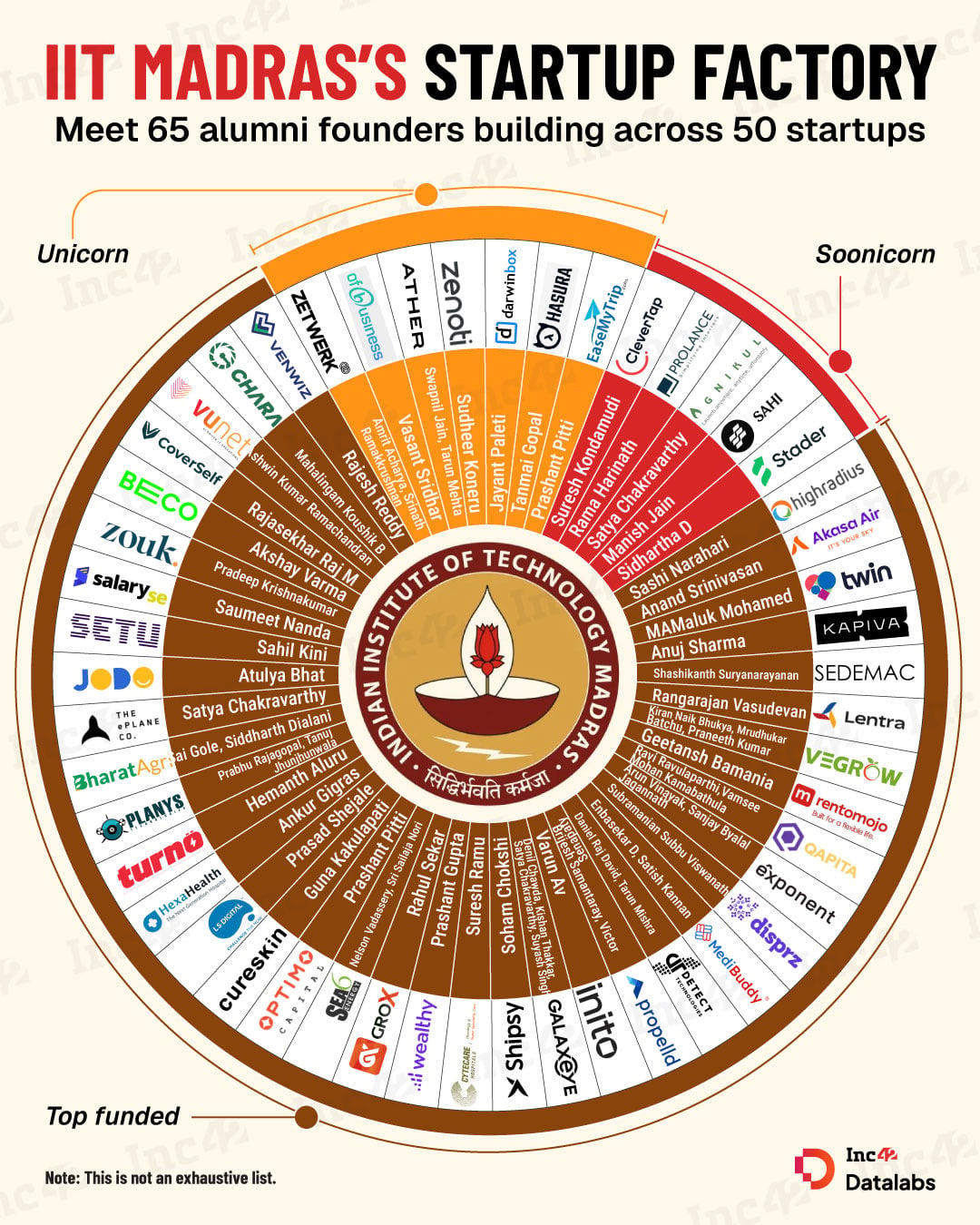
IIT Madras has been making headlines for more than just its academic legacy! It has already incubated 567 startups, with a combined valuation of ₹74,100 Cr. Here is all about it…
The post Layoffs At JioStar, AidenAI Nets $32 Mn & More appeared first on Inc42 Media.
This content is published by Inc42 and has not been created or edited by Hello Headlines. View original