From local roots to national reach: How three Rajasthan startups are scaling beyond the state
Ask three Rajasthan founders what got them started, and you hear about three very different problems. Many farmers in the state still pay to get their produce graded before they can sell it. In Kota, India’s coaching capital, student mental health has drawn scrutiny all the way up to the Supreme Court. And most of the technology behind the 5G icon on an Indian phone screen comes from abroad.
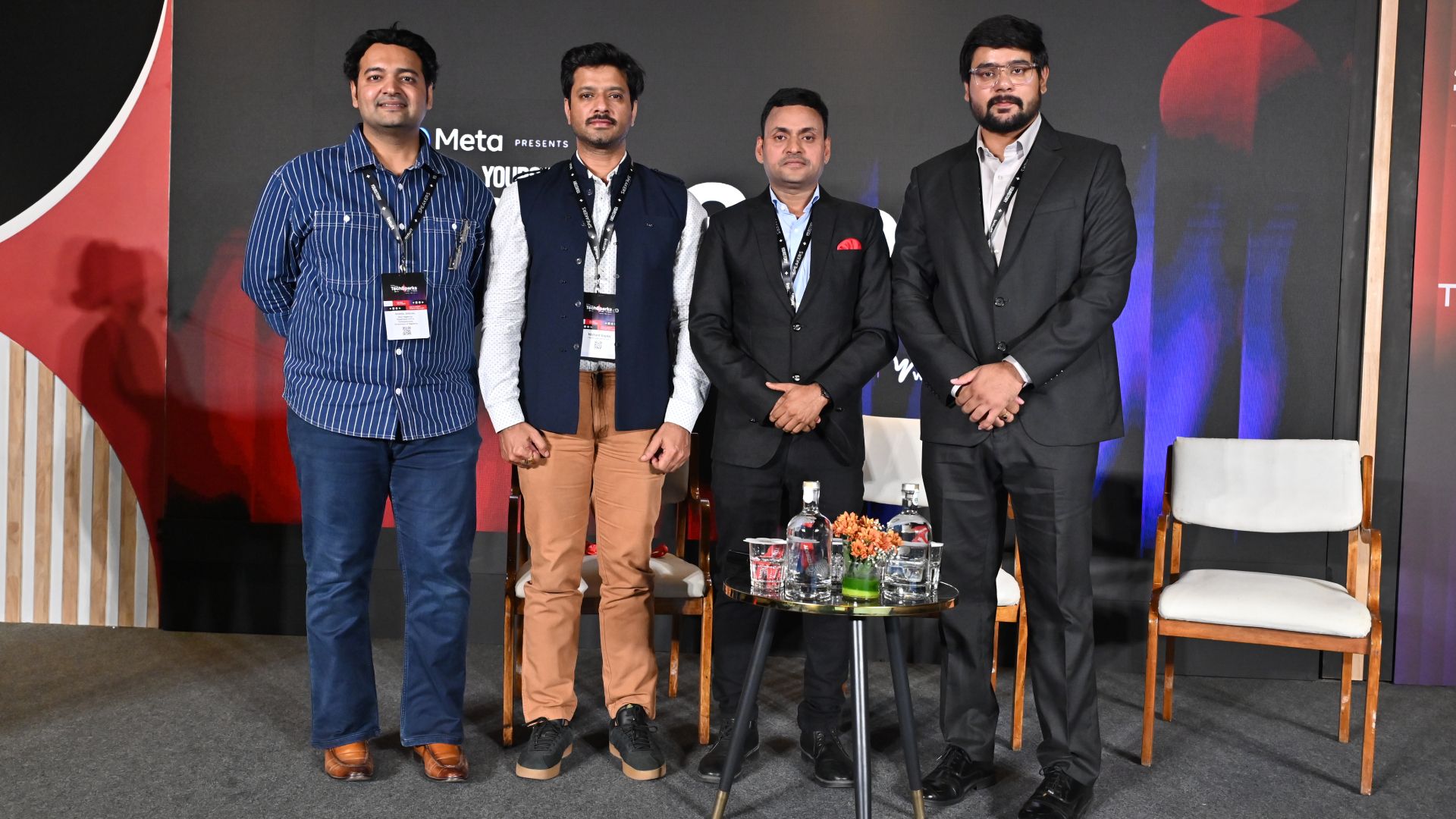
For the founders on stage at TechSparks 2026, each of these became the starting point of a startup that began in Rajasthan and is now reaching well beyond it.
In a panel titled ‘From local roots to national reach: Scaling startups from Rajasthan’, Nishant Gupta, Co-founder of ChurningMind; Siddharth Pathak, Founder of SafeSpace Personal Wellness; and Hargovind Bansal, Founder and CEO of HNNOIX, spoke with Dhawal Singhal, Program Manager at iStart Rajasthan, about building for hard-to-reach users and scaling from a Tier II base.
iStart is the Rajasthan government’s startup program, run by the Department of IT & Communication. Singhal said it now has more than 9,400 registered startups and offers incubation, grants of up to Rs 60 lakh, and a Rs 100 crore fund of funds. It also lets government departments give startups work orders directly instead of through standard tenders.
Building AI for the farmer, not the demo
ChurningMind is building AI for people in rural India across agriculture, health, labour, education, and geospatial intelligence. Gupta said the goal is to bring them under one umbrella so that no one feels left out, from farmers to migrant workers moving between states and rural women who struggle to access healthcare or government schemes.
Asked what it takes to move from a demo to a product people can depend on, Gupta pointed to language. Rural users speak regional languages, so ChurningMind is working on real-time voice-to-voice translation. The aim is for a farmer in a remote part of Rajasthan to talk directly to a farmer in Odisha, each in their own language, without needing English or Hindi.
Its flagship agriculture platform tackles a more basic problem. Farmers often have to pay to get their produce graded before they can approach traders. Gupta said younger farmers now use 4G and 5G phones, and ChurningMind uses that access to offer real-time crop scanning, market prices, and trader connections across India, not just in their own district. The platform links farmers, farmer producer organizations (FPOs), mandis, exporters, traders, and government agencies.
ChurningMind is also working with the Rajasthan government on e-governance, Gupta said, aimed at setting a benchmark that can be adopted nationally.
“You have to keep churning about how you can serve better,” he said, explaining the company’s name.
Mental health support that knows when to step back
Pathak’s path to founding SafeSpace began with his own setback. He spent five years preparing for the civil services exam but did not clear it, and said it left him with low self-esteem until a friend studying psychology helped him through it. He later joined a certification program in agentic AI and built a prototype in three months.
SafeSpace is a proactive, AI-powered mental health platform for students. Users log their mood daily, and AI tracks patterns over time. Real psychologists stay in the loop: if the AI detects a crisis, the user is connected to a professional, and if a student’s weekly trend dips, a psychologist reaches out.
Rajasthan, home to the coaching hub of Kota, has faced intense scrutiny over student mental health. In September 2025, the state passed the Rajasthan Coaching Centres (Control and Regulation) Bill, which provides for a state-level portal and a 24x7 counselling helpline for students.
Pathak said he is working closely with the state’s higher education department, which is building a portal for coaching institutions.
Research with SafeSpace’s clinical psychologists surprised him. Relationship issues, not studies, were students’ top mental health concern; studies ranked fifth. Parents, he said, were among the strongest supporters. “Our children don’t talk to us,” he recalled parents telling him. Many wanted their children to have a professional to talk to, even if it was not them.
SafeSpace started as a direct-to-consumer app but shifted to selling to institutions. The Central Board of Secondary Education (CBSE) now requires affiliated schools to appoint one counselling and wellness teacher for every 500 students, under a circular issued in January 2026 following a public interest litigation in the Rajasthan High Court.
Pathak said many school counsellors are underused, so SafeSpace offers schools a dashboard with anonymous, class-level data to help them reach students who need support.
Talking about how SafeSpace prevents students from becoming emotionally dependent on an AI chatbot, Pathak said the platform caps daily conversations at 30. Students with serious concerns are directed to a psychologist or to Tele MANAS, the government’s 24-hour mental health helpline, which SafeSpace has integrated. Tele MANAS has received more than 47 lakh calls since it launched in October 2022.
“I want to normalize mental health, not as a rich people thing,” he said, adding that he wants government schools and colleges to have the same access as private ones.
Putting India at the 6G standards table
Bansal, who grew up in a small town in Rajasthan, spent 17 years in the US innovation ecosystem working on 4G, 5G, location, and healthcare technologies. He said that work led to more than 350 patents filed and granted in over 15 countries.
He returned to build HNNOIX, a deeptech company developing AI-native 6G technology. His motivation was: the phones in people’s pockets and the 4G and 5G networks they run on are largely built on foreign technology, and India pays high royalties as a result.
Bansal explained standardization with a school uniform analogy. Just as students follow a set uniform, technologies such as 4G, 5G or satellite communications must follow global standards so devices from different makers work together. Companies present their technology to global bodies such as 3GPP and the International Telecommunication Union (ITU), and accepted technologies become standards, which adds value to the country behind them.
India’s participation in 3GPP has grown quickly. The number of Indian participants rose from 717 in 2020 to 1,787 in 2025, while technical contributions increased from 196 to 2,943 over the same period. Under the Bharat 6G Vision, India aims to contribute at least 10% of global 6G standards and patents. HNNOIX holds 3GPP membership with support from the Department of Telecommunications and represents India as part of government delegations at the ITU, Bansal said.
Asked what pays the bills when 6G is years away, Bansal said building a generation of telecom technology takes seven to eight years. Work on 5G, he noted, began around 2012, well before South Korea launched the first commercial networks in 2019. India adopted 4G and 5G after other countries had already built them. With 6G expected to be deployed globally around 2030, India is choosing to participate from the start.
HNNOIX is also driving a mission to develop one lakh technology inventors by 2030, which Bansal said was presented to the prime minister last year. The company has reached more than 50,000 learners across every state and union territory and filed more than 200 patents in India, the US and Europe, he said. No single company can build that capability alone, he added, which is why HNNOIX works with institutions to develop inventors.
Starting a company with global customers such as Apple and Samsung from Rajasthan was tough, he admitted. With no similar startup in India, people struggled to understand the idea. Bansal saw that as both a challenge and an opportunity, since it also meant there were no competitors. Over time, he said, iStart helped with mentorship, connections to institutions, and introductions to the central government, including nominations for international delegations.
Lessons for founders from smaller cities
Each founder closed with one takeaway for founders building outside metros.
Gupta, a data scientist with a master’s degree from the US and 15 years of work experience, said his journey from the US to learning from farmers in rural Rajasthan has shaped his goal: helping farmers become agripreneurs known across India and globally.
Bansal urged founders not to let challenges stop them before they start. “Dream big. Do not see the challenges when you start something,” he said. “You motivate yourself by looking at the success stories, not the failure stories.”
Pathak returned to access, saying mental health support should reach every student, regardless of the school they attend.
Together, their stories made a case that a Rajasthan address is no barrier to building for national or global markets. With patient support from the state, a clear understanding of underserved users, and a willingness to take on problems few others are tackling, startups from smaller cities can design solutions that travel well beyond where they began.
If you or someone you know needs support, call Tele MANAS, the government’s free 24-hour mental health helpline, at 14416.
This content is published by YourStory and has not been created or edited by Hello Headlines. View original