Finding India’s Next AI Goldmine
A recent debate over investors’ lack of interest in India’s hardware and deeptech bets has brought some longstanding challenges in the ecosystem back into focus. These include a lack of patient capital, pressure from limited partners (LPs) for early distributions, consensus-driven investing, and the difficulty of underwriting long development and qualification cycles.
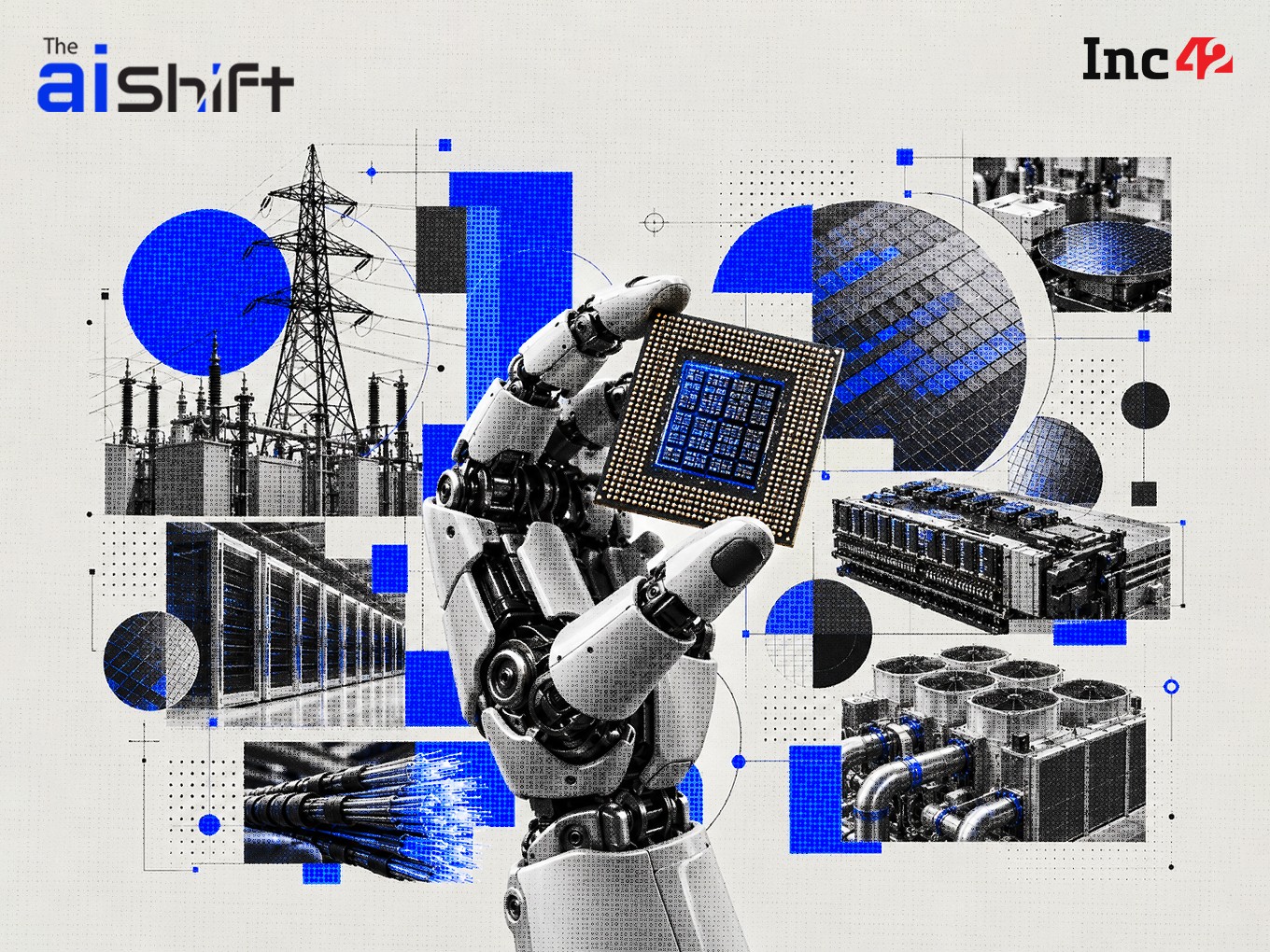
As AI infrastructure moves beyond a pure compute race to focus on the layers that determine how efficiently systems run, India stands at the cusp of a significant opportunity. However, simply adding more computing power will not be enough for the country to establish itself as a global AI leader.
Instead, opportunities are emerging in the supporting infrastructure. Data centres, for instance, need more efficient power delivery, better cooling systems, and faster connections between processors and memory. These layers are becoming increasingly critical as they directly influence real-world performance and the total cost of ownership of AI infrastructure.
For India, the debate and the technical opportunity converge. Rather than trying to compete across the entire AI hardware stack, the country can develop specialised technologies.
To understand which of these layers offer the strongest multiplier effects and what it will take for India to own them, we spoke to VCs tracking the homegrown deeptech ecosystem. Let’s unravel what they said in this edition of The AI Shift…
The Need To Power Data Centres
A consensus among VCs pointed to power delivery as the first major opportunity. As AI systems become more power-dense, improving power efficiency becomes an increasingly important engineering challenge.
Natasha Malpani, founder and general partner of Boundless Ventures, sees an opportunity in power electronics, grid-edge systems and cooling designed for hot and humid environments. Data centres operating in Indian cities must manage local temperature and humidity conditions, potentially creating demand for technologies that can also serve other tropical markets.
“The multiplier here is integration,” she said.
Power semiconductors can serve AI data centres, electric vehicles and energy infrastructure. The opportunity, therefore, is to develop components that address multiple markets instead of relying on demand from one category.
Cooling is also closely connected to this opportunity. Liquid-cooling systems help manage the heat generated by high-density computing equipment, creating demand for coolant distribution units, heat exchangers and direct-to-chip cooling technology.
The second opportunity lies in moving data between processors and memory. Debraj Banerjee, general partner of F2A (Fundamentum Frontier Advisors), which recently closed a ₹3,000 Cr fund for deeptech, argues that India should target the interconnect and memory layer of AI chips. This includes high-speed SerDes circuits, PCIe and CXL controllers, chiplet interconnects, and memory expansion silicon.
These technologies help processors exchange data and access memory efficiently. Banerjee’s argument is that standards-based technologies can give new entrants a route into multiple chip ecosystems without requiring them to challenge established GPU platforms directly.
“India shouldn’t try to win the fab race. It should own the plumbing of AI chips, the interconnect and memory layer, because that’s where the bottleneck is moving and where one design earns on every chip shipped worldwide,” he recommended.
The multiplier here is the business model. Companies that own valuable semiconductor IP could license it to multiple manufacturers and potentially earn royalties across global shipments, rather than relying entirely on engineering fees.
Pranav Pai, managing partner of 3one4 Capital, added a third dimension: India’s established semiconductor and systems-design talent can support demand for custom embedded-system design, verification and testing.
But he argues that value capture requires moving beyond services. “The opportunity is to move deeper, into components, advanced materials, proprietary process equipment, and finally product and system IP, which is where value capture will concentrate,” Pai said.
For AI infrastructure, this means turning engineering capabilities into products that global customers repeatedly buy.
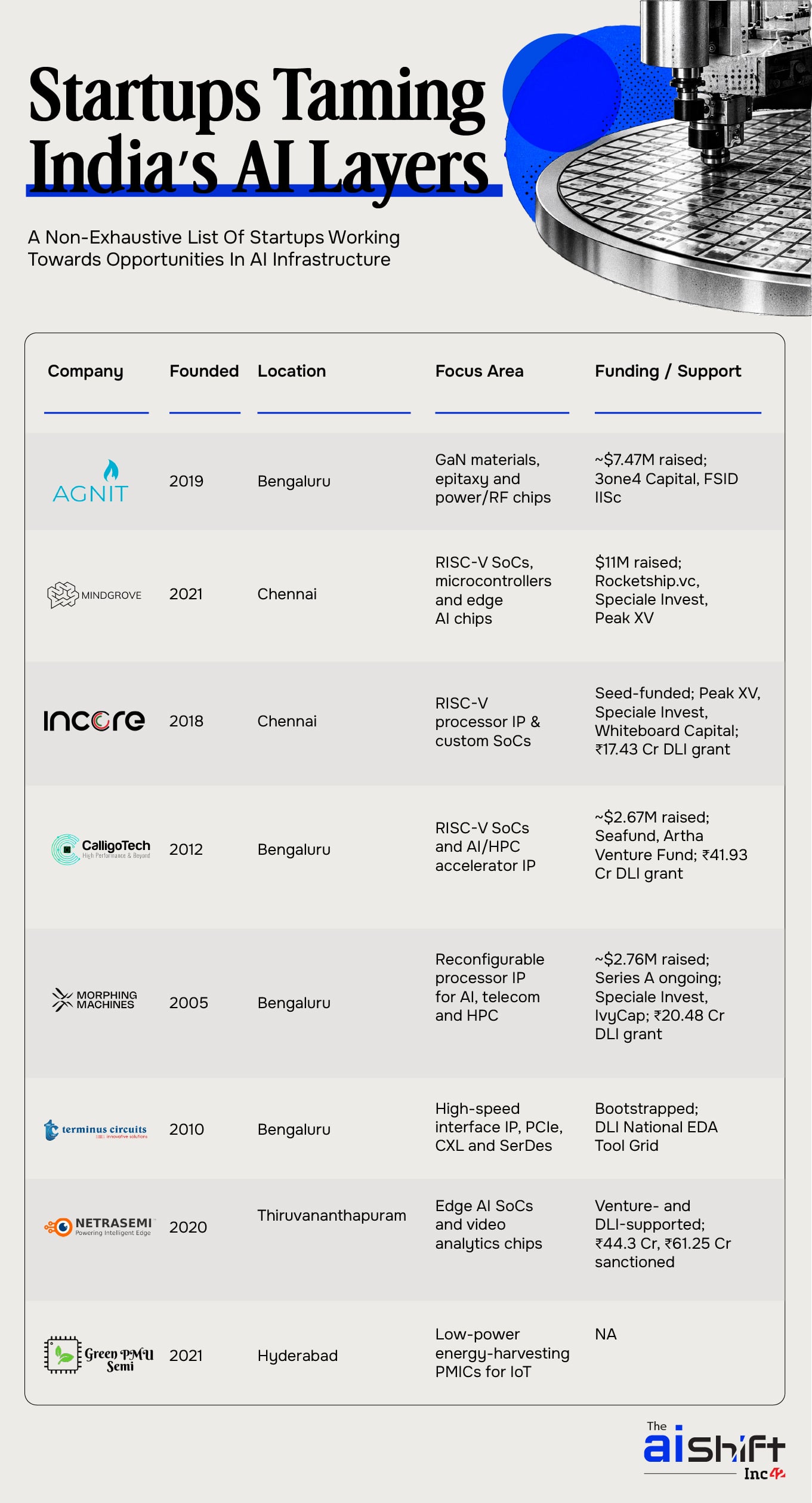
Who’s Taming The AI Infrastructure Layer
Some Indian startups are already building in these areas, although their commercial maturity and ownership of technology differ.
Bengaluru-based C2i Semiconductors developed power-management technology for AI data centres, including multiphase controllers and smart power stages. Then, German semiconductor company Infineon completed its acquisition of C2i on October 5, 2026, strengthening its power-management capabilities and expanding its research and development footprint in India. The deal demonstrates how Indian-developed technology can attract a global strategic buyer.
Ahmedabad-based KuhlTherm is addressing the thermal-management problem. It develops liquid-cooling systems for high-density computing, including rear-door heat exchangers and coolant distribution units. Its next test is to demonstrate reliability, secure customer deployments and scale beyond early stage development.
In data movement, LightSpeed Photonics is developing optical interconnect technology for AI and high-performance computing. The company raised $6.5 Mn in a funding round led by pi Ventures last year. Its work highlights an emerging opportunity in using light to transmit data, although commercial adoption will depend on integration with existing systems, manufacturing readiness and customer qualification.
Government support is also building the broader semiconductor design ecosystem. Earlier this year, 24 chip-design projects were supported under the Design Linked Incentive scheme, producing 16 tape-outs, six fabricated chips and 10 patents. The projects had engaged more than 1,000 specialised engineers and developed over 140 reusable semiconductor IP cores.
These figures show growing design activity. However, chip-design progress is not the same as a proven position in the global AI hardware supply chain.
What Comes Next?
India’s challenge is to turn early technical progress into commercially competitive products. Semiconductor development involves long design and testing cycles, while cooling and power systems must demonstrate reliability under demanding operating conditions. Global customers are unlikely to switch suppliers without evidence that new products can meet performance, safety and service requirements.
Banerjee of F2A said the biggest gaps are not necessarily engineering talent, but patient capital and a lack of willingness to work with first-time chip companies. His thesis points to a need for investors who understand hardware development timelines and can support businesses through product qualification, rather than expecting rapid commercial returns.
Access to manufacturing and advanced packaging is another constraint. India’s design ecosystem is expanding, but startups still need to establish where their IP resides, which components can be produced domestically and where they depend on overseas suppliers.
The government’s Design Linked Incentive scheme provides financial incentives and design infrastructure support, but moving from prototype to volume production is still a challenge.
The next phase should be judged by commercial milestones: customer qualification, repeat orders, manufacturing scale and licensing revenue. For instance, for power and cooling startups, the test is whether their products can deliver measurable efficiency improvements and win deployments. Similarly, for semiconductor IP companies, it is whether global manufacturers adopt their designs and generate recurring revenue.
Overall, VCs agree that Indian startups need to choose where their engineering strengths can translate into proprietary technology, then build the capital, manufacturing and customer relationships needed to commercialise that technology.
The opportunity is visible. Whether it becomes a lasting advantage will depend on how many Indian startups can move from promising designs to products that global infrastructure providers cannot easily do without.
Top Stories From India & Around The World
-
- BioStack Raises $9.5 Mn: The AI-powered healthtech platform raised $9.5 Mn to build training datasets for medical AI, addressing the shortage of high-quality healthcare data needed to develop and improve AI models.
- Protectt.ai To Acquire Bosch’s AIShield: The AI-native cybersecurity startup is acquiring a controlling stake in Bosch-incubated AIShield to expand into enterprise AI security, with plans to scale its team and build a broader security platform.
- Tradl Raises $4.1 Mn: The Bengaluru-based startup raised $4.1 Mn from Nexus Venture Partners and Stellaris Venture Partners to help retail traders screen stocks, analyse markets and test trading strategies using AI-powered tools.
- OpenAI Launches GPT-6.1 Terra: OpenAI introduced GPT-6.1 Terra, a model designed for faster computer use, visual reasoning and coding. The company says its standard API pricing is 50% lower than that of GPT-5.6 Terra, targeting high-volume professional workflows.
The Weekly Buzz: Anthropic Files For Blockbuster IPO
Anthropic publicly filed its S-1 registration statement with the SEC this week, setting the stage for a mid-November Nasdaq listing under the stock ticker ANT.
The prospectus revealed explosive growth, first-half 2026 revenue of roughly $16.3 Bn, up more than 1,300% YoY in the most recent quarter, alongside a net loss of $80.7 Bn for the same period and soaring cloud costs.
The filing underscores Anthropic’s unusual governance structure designed to protect its safety mission and founder control even as it courts public markets. Enterprise adoption is highlighted, with thousands of customers spending six figures or more.
Founders have also restated that Claude will remain free of advertising. The move positions Anthropic as one of the largest pure-play AI IPOs in history and puts pressure on rivals still raising private capital. Investors and regulators will now scrutinise the detailed risk factors as the offering takes shape.
Startup In The Spotlight: Creedom
Founded by Naveen Murugan, Naveen Sowriraj and Aswin Dhananjai, Bengaluru-based Creedom is building an AI growth coach to help content creators understand their performance and improve their reach on platforms such as Instagram and YouTube.
For creators, identifying that a Reel or video has underperformed is only part of the challenge. Understanding why it failed to gain traction and what to change in future content remains difficult, particularly when traditional analytics dashboards offer data without personalised guidance.
Creedom initially operated as a learning platform for creators, reaching more than 1.5 Lakh creators in India before pivoting to an AI-led product. Its platform connects with creators’ Instagram and YouTube accounts, analyses content and performance, identifies trends and recommends what they should create next.
At the heart of the platform is Cree, an AI companion that allows creators to interact with their performance data conversationally instead of navigating conventional analytics dashboards. By turning content metrics into personalised, actionable advice, the startup aims to help creators make more informed decisions about their content strategy.
With India’s creator economy reaching 4.12 Mn creators in 2025, Creedom is entering a market that includes creator analytics tools such as vidIQ and TubeBuddy, alongside native platforms such as YouTube Studio and Instagram Insights.
Prompt Of The Week
What prompts and hacks are CTOs, CEOs and cofounders using these days to streamline their work?
Here’s Manavdeep Singh Grover, cofounder & CEO of SuperLiving, with a prompt he uses to turn an A/B test result into a clear ship, kill or keep-running decision.
“You are my analytics lead, and your job is to tell me the actionables from insights, not just what happened.
The A/B experiment: [what changed, the variants, the split, the start date, and who sees it].
Before any numbers:
- Check the live setup matches what I described: the split, the targeting, the pricing, and the exact wording users see in each variant. Flag any mismatch first.
- Judge it on one metric: total revenue per user who saw the test, across every product, and 6 month LTV projection. Not just the product we changed.
Then read it honestly:
- Count each user in the variant they first saw, never by what they bought.
- Show new and existing users separately, and weight by day if the split or the traffic changed mid-test.
- Show the full journey for each variant: started checkout, paid, cancelled the same day, and what they bought instead.
- Give the difference with a range and the chance each variant is really ahead. If it’s too early, tell me how many more days you need.
- Tell me the break-even: how many buyers the pricier option can lose and still win.
End with:
- Your call in one line: ship it, kill it, or keep running, and why.
- The one thing that could prove the call wrong, and the date we’ll know.
Use plain language and a table for every comparison.”
Editor’s Note: Some prompts may need to be adjusted by users for best results or may not work as intended for certain users.
[Edited by: Shishir Parasher]
[Creatives by Varshita Srivastava]
The post Finding India’s Next AI Goldmine appeared first on Inc42 Media.
This content is published by Inc42 and has not been created or edited by Hello Headlines. View original