From Bipolar Diagnosis To Bestselling Author — ‘I Do Not Consider Myself Unwell’
This article has been published in partnership with India Mental Health Alliance.
Aparna Piramal Raje is a writer, columnist, bestselling author, and mother of two. She has also lived with bipolar disorder for over two decades. Here, she shares the seven 'therapies' — from her family's love to a sleep routine she calls 'religion' — that help her live a full, happy life.
It is March 2013, and I am at a yoga ashram in Bihar for a weeklong retreat. And I am coming apart.
I haven't slept more than three hours a night in several days. I'm talking to myself. There are voices in my head, and my thoughts are so scattered and disorganised that I can't hold on to any of them. I am having a psychotic breakdown.
When the retreat ends, I can't manage the journey back to Mumbai on my own. My husband has to come and get me, and escort me home.

Seeing the state I'm in, I'm taken to a psychiatrist and put on medication. And for the first time, what I have been living with gets a name: bipolar disorder, a serious mental health condition.
Thirteen years without a name
The diagnosis was new. The condition was not.
It had first surfaced in the year 2000, when I was in my mid-20s, and remained undiagnosed for more than a decade. I had been raised in Mumbai and London and studied at Harvard Business School and Oxford University. I had worked in my family's office furniture business and as a journalist. Through all of it, I had been riding highs and lows I didn't understand.

Looking back, I can see the pattern. Too many projects and deadlines pushed me into mania more than once, in both jobs. Work, for me, had become a trigger.
After the ashram, I recovered from the psychosis, only to be plunged into depression for several months. Eventually, I came out of that too.
“ I don't consider myself unwell, even though it is an illness”
It may sound strange, but the diagnosis came as a relief. For the first time, my family and I had a roadmap for how to treat and manage what was happening to me.

It also taught me what bipolar disorder actually is. As I understand it, it is a mood disorder brought on by psychological triggers and chemical imbalances in the brain. It causes extreme shifts in mood.
At one end is mania: energetic phases where I barely sleep, have delusions of grandeur, and sometimes tip into psychosis. At the other end is depression, when I am low on energy and in low spirits. In between, there are long stretches of stability and normalcy, though every patient's cycles are different.

Everyone has mood swings, so please don't assume you are bipolar because you have some. Bipolar disorder means extreme swings, and very specific changes in behaviour.
Most importantly, the diagnosis showed me that personality and illness are different things. I have a normal personality. I also have a medical condition that needs to be managed and treated, like any other medical condition.

So I don't consider myself unwell, even though it is an illness. That insight became the bedrock of my self-acceptance — and without self-acceptance, no healing can take place.
Learning to survive
I'm an optimist by nature, and I always look for solutions. Over the next ten years, it was these solutions and "hacks" that helped me heal and recover.
It took a lot to make everything come together: the right medication, a trustworthy doctor, supportive family and friends, a manageable job, a spiritual practice, self-reflection, and fulfilling lifestyle pursuits. At times, it felt like a matter of tremendous planetary alignment!

But I came to see that three "therapies" are essential just to survive, especially in a crisis. None of them can be substituted.
The first is medical therapy. I see my psychiatrist, take additional medication when I need it, and continue talk therapy. I cannot stress enough how much a good therapist matters.
As I understand it, my mood episodes are psychological triggers causing chemical imbalances. If I haven't slept well for five nights in a row, I'm likely to tip into hypomania. But what is keeping me awake for five nights in a row? That is usually something psychological.

Therapy helps me find those triggers, understand myself, and manage my mood swings. I've seen therapists for two decades, and they've given me incredible insight into what lies beneath my ups and downs. I still see mine every fortnight. It is essential to my stability.
The second is love therapy — the care of the people closest to me. For me, that is my husband, my two sons and my sister. All of them look after me when I'm unwell, and I'm lucky to have their unconditional support and acceptance.

The third is lifestyle therapy. Self-care turned out to be just as necessary as doctors and caregivers. A disciplined lifestyle matters for everyone, but especially for those of us living with a mental health challenge.
I exercise regularly, play games, and eat a nutritious diet. But sleep, as far as I'm concerned, is religion. A regular sleep routine is the single biggest factor in my emotional and mental well-being, and I'm much happier now that I'm disciplined about it.

So I have dinner at home with my husband and kids most evenings. I rarely go out at night more than twice a week, and I don't work after dinner. Most nights, I get my seven to eight hours.
Learning to thrive
Surviving is one thing. Thriving — being well enough to write a book, or to stand before strangers and talk about my mental health — needed something more. It needed self-reflection, self-inquiry and inner work. That is where the other four therapies came in.
Self-therapy began on the page. I journal, I use positive affirmations, and I keep returning to both to understand what triggers my mood swings and how to regulate my emotions.

Spiritual therapy came through a regular study of Vedanta. It helped me look at the root causes of my ups and downs, and it has made me calmer and more at peace.
The therapy of empathy came from other people. Mental health, I've learnt, is a team sport, so I made a point of asking for help. I shared my vulnerability with many friends, mentors and colleagues, and it made a huge difference.

These allies made safe spaces for me to share my thoughts and emotions, during manic or depressive phases and in recovery afterwards. They turned listening into an art form. They offered acceptance, patience, empathy and advice without judgement — and sometimes stepped in directly when things got difficult. If it takes a village to raise a child, it takes a community of allies to heal a mind.

Work therapy was the one I least expected. Work had pushed me into mania before, so how could it ever be therapeutic?
Over time, I learnt that structured, fulfilling work could be an anchor. Approached with the right balance and intention, it gives me stability and meaning, along with a sense of control, accomplishment and identity. It is no longer only about income or career. It is a way to channel my energy constructively, and to build the routines that help me manage my moods.

The strategy that makes this possible is what I call playing 'opposite-handed'. Imagine playing a sport with your other hand: you'd play more mindfully and more slowly. That's how I now work. I recognise my limits and take breaks before I burn out, and this has let me thrive at work despite how unpredictable bipolar disorder can be.

Together, these four therapies helped me understand myself, regulate myself, and move from just coping to thriving.
Back on the stage
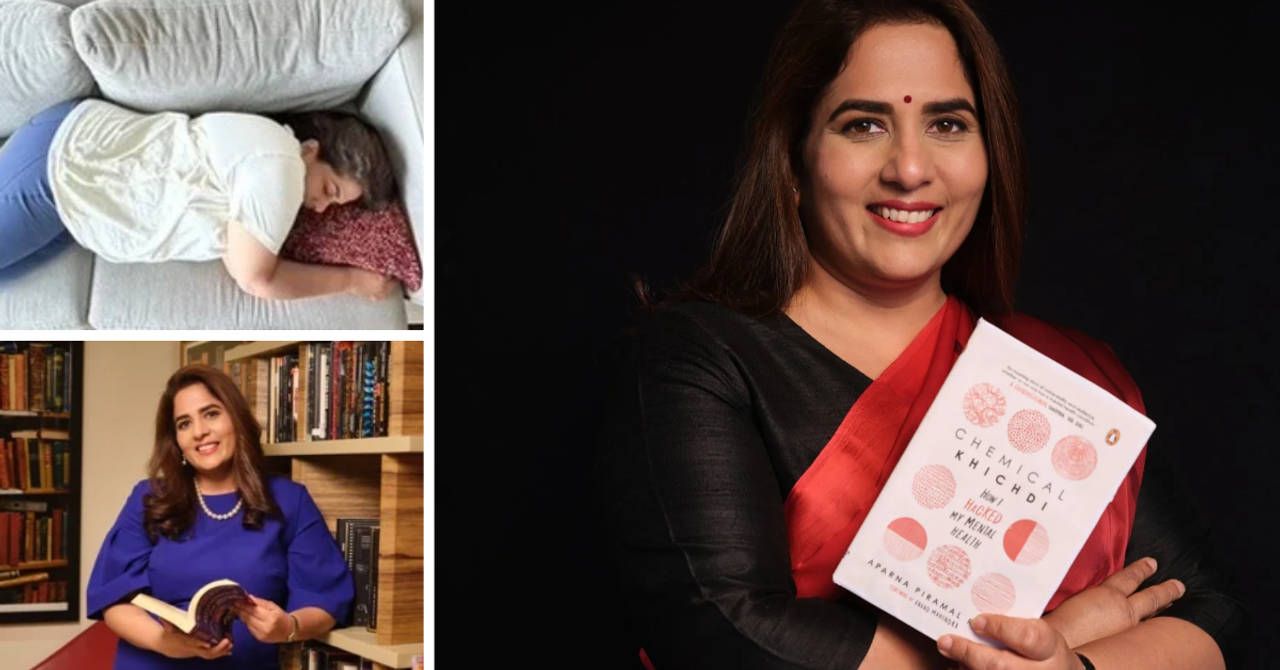
By May 2022, I had been stable for over four years. That month, I stood on stage at the Royal Opera House in Mumbai, one of India's most prestigious theatres, in front of 400 people. I made a speech, and my sister and I released my book, Chemical Khichdi: How I Hacked My Mental Health — the story of my journey of healing and recovery.

It went on to become an official national bestseller. Over the next few years, I was invited to speak at 150 talks across the country and online, breaking taboos about mental health.
Then, in November 2025, I stood on a stage in Bangalore among eleven brave women, each of us holding a copy of Homecoming: Mental Health Journeys of Resilience, Healing and Wholeness. Written by Neha Kirpal and Dr Nandini Murali, it is a unique anthology of Indian women's mental health journeys, and mine is one of them.

A few years earlier, Neha and I had talked about her hopes of writing a book. Now Chemical Khichdi was being seen as a forerunner in a growing movement of mental health books in India, and I was beginning to be seen as a mental health advocate. It was deeply satisfying.
Happy, thriving and bipolar
Today, I'm 50. I live in Mumbai with my husband, our two teenage sons and my in-laws, and I work as a writer, columnist and public speaker.
In more than two decades of living with bipolar disorder, I've had about a dozen episodes of mania, or its milder form, hypomania. That's quite a lot. But I haven't had a full-blown manic episode or depression in over eight years, and I have a "normal" personal and professional life.

The mood swings haven't vanished. I still feel things with more intensity and volatility than most people. The difference is that I'm in control now (well, most of the time). I've learnt to witness my emotions without being consumed by them, using these seven therapies.
I believe happiness is a decision. For me, it is a choice and a daily practice, and these therapies are my everyday toolkit.

I have also come to realise that my vulnerability is my guru. My bipolarity has been my biggest source of illumination. Nearly ten years ago, I wrote this in my journal:
"I have come to realise that the stronger you are, the more hurt you can handle. And the less you share that hurt with anyone, the more the accumulated emotion.
I've experienced every possible negative emotion - anger, frustration, resentment, fear and paranoia. It has made me volatile, manic, uncontrollable, deluded, sleep-deprived and generally a pain to handle.

But from that has emerged so much that's good about my life: truth, compassion, wisdom, patience and most of all, love. Could I live without being bipolar? Absolutely. And my family would echo that ten times over. But it has provided me the opportunity to examine my life like no other."
If you're where I once was
I've come a long way since that ashram in 2013.
So here is what I'd want you to know. There's no need to be scared of a mental health condition. In my experience, it can be managed like any physical health condition. Recognise the symptoms early, and respond before things escalate. It's difficult at first, but it gets much easier with time, and it doesn't have to stand in the way of a family life, a social life or a career.

Take charge of your mental health. Get timely professional advice. Tell your family what's going on, and accept their help. Rest and slow down when you need to. Make allies, and open up to them. And develop your own therapies and hacks.
Whether you live with bipolar disorder or any other mental health condition, I hope my story encourages you to get help when you need it. You can live the life you want to.
This content is published by The Better India and has not been created or edited by Hello Headlines. View original