Netflix Flips Its India Script

What if Netflix’s next big hit in India is not an expensive scripted original, but a reality show with a ready-made fan base? The streaming giant appears to be warming up to an idea it once seemed determined to move away from: television.
Netflix is increasingly turning to established television franchises, reality formats and non-fiction programming to reach a wider audience in India. Its recent content choices, including Lock Upp, The Great Indian Kapil Show and deals for MTV Hustle and MTV Roadies, point to that shift in India.
The change is significant for a platform that initially built its India proposition around premium, urban-focused originals and international programming. In the fourth quarter of 2021, Netflix cofounder and the then CEO Reed Hastings described India as a “frustrating” market. He also stated that the company had not managed to get its flywheel spinning here as it had in other major markets.
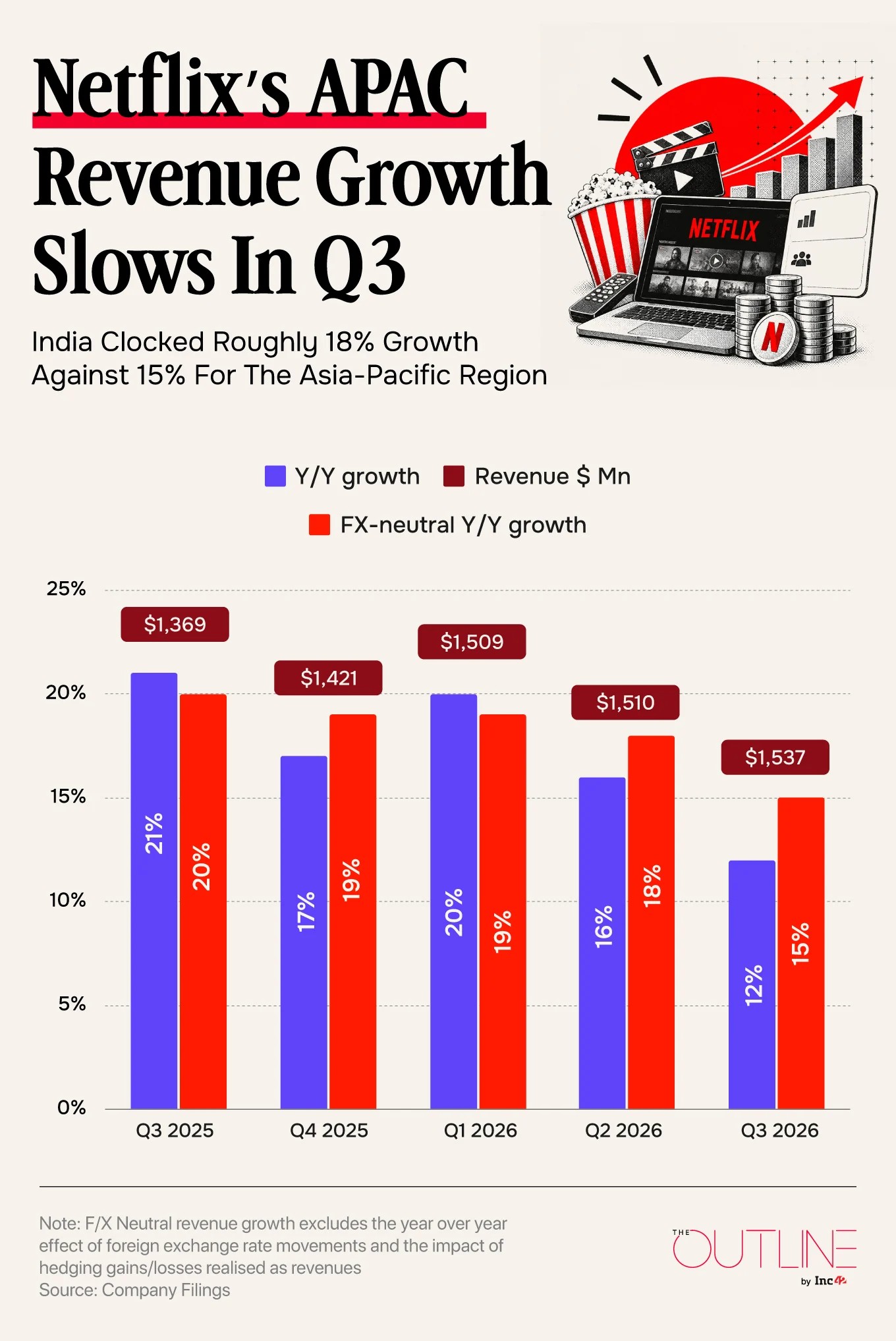
Nearly five years later, Netflix emerged stronger. In the July-September quarter of 2026, its India revenue grew 18% year-on-year (YoY) on a foreign-exchange-neutral basis, while viewing hours increased 24%. The company also recorded its largest-ever quarter of paid net additions in the country.
The growth was driven by a content lineup featuring Lock Upp, Netflix’s first daily reality series, as well as scripted titles such as Musafir Cafe and Operation Safed Sagar. Netflix said Lock Upp generated the highest viewing hours of any title on its platform in India, measured over the first 91 days.
So, was this simply a strong quarter or evidence of a more fundamental shift in Netflix’s India playbook?
Netflix Looks Beyond Its Urban Comfort Zone
Netflix’s growing interest in reality television is becoming difficult to miss. The platform has even bought MTV Roadies to Netflix India in a deal worth around ₹18 Cr with JioStar, as per media reports. And the strategy is not limited to one show.
Over the past year, non-fiction content has assumed greater importance in Netflix’s strategy. This is also part of a larger effort to move beyond its Tier I, urban-centric audience.
According to an industry analyst at one of the Big Four consulting firms, if Netflix wants to deepen its penetration and crack the Indian market, it cannot continue catering largely to the same urban viewers. It needs formats and stories that resonate with audiences across smaller cities and towns as well.
Reality and unscripted formats could help bridge that gap. Lock Upp’s performance on Netflix offers an early indication of the format’s potential.
Regional programming is another part of this effort. Netflix is working with local production houses and regional OTT players to deepen its presence in language markets. Netflix has partnered with Bengali streaming platform Hoichoi to bring its upcoming series to a wider audience. Under the two-year deal, the shows will premiere in Bengali on Hoichoi and also be available on Netflix in Hindi, Tamil and Telugu.
Going All In On Bollywood Blockbusters
Netflix has continued to expand its film catalogue by securing streaming rights to established Bollywood titles and major theatrical releases. Its partnership with Yash Raj Films (YRF), announced last year, is one example.
The deal brought a curated selection of YRF films to Netflix in phases, including nine Shah Rukh Khan films such as Dilwale Dulhania Le Jayenge, Mohabbatein and Veer-Zaara, along with Salman Khan blockbusters Ek Tha Tiger, Sultan and Tiger Zinda Hai. The lineup also included classics such as Chandni and Silsila, and Ranveer Singh films including Band Baaja Baaraat and Gunday.
The strategy extends beyond catalogue licensing to recent theatrical releases. Netflix also picked up the streaming rights to Dhurandhar, which landed on the platform in January 2026 following its release in theatres. For its sequel, Dhurandhar: The Revenge, Netflix secured international streaming rights, while JioHotstar acquired the India rights.
An Ormax Media analysis of 126 films that crossed one million domestic footfalls in 2025 found that Netflix held a 36% share of streaming rights across the titles, the highest among platforms. Its share in Hindi theatrical films stood at 57%, up from 50% in 2024.
The Race To Grab Eyeballs Gets Fiercer
Netflix’s India strategy is taking shape against the backdrop of an increasingly crowded streaming market. According to JustWatch’s Q2 2026 report, Netflix and Amazon Prime Video were tied at the top, each accounting for 22% of measured consumer interest.
Netflix is also seeing stronger traction on the ground. In Q3 2026, the company recorded its highest-ever quarterly paid net additions in India, crediting a strong local content slate and its first transaction-based loyalty bundle with Flipkart. The partnership gives Netflix another route to consumers beyond direct subscriptions, tapping into Flipkart’s existing commerce ecosystem.
Its competitors, meanwhile, are not sitting still. Amazon Prime Video is doubling down on Indian intellectual property, multilingual programming and established franchises, while also looking to take Indian stories to global audiences. At its 2026 content showcase, the platform unveiled nearly 55 Indian original series and films, with more than 100 projects in development or production.
JioHotstar, on the other hand, is banking on a combination of television content, live sports, originals and regional programming to hold on to its mass-market audience. In January 2026, it introduced monthly subscription plans across its Mobile, Super and Premium tiers, starting at ₹79, making access more flexible for smartphone viewers and connected-TV households.
Apple TV+ is also widening its distribution reach. After gaining four percentage points in JustWatch’s rankings over the past year, it has expanded its India offering through an iCloud+ subscription bundle that combines access to Apple TV and Apple Arcade with cloud storage.
But audience growth is only one part of the equation.
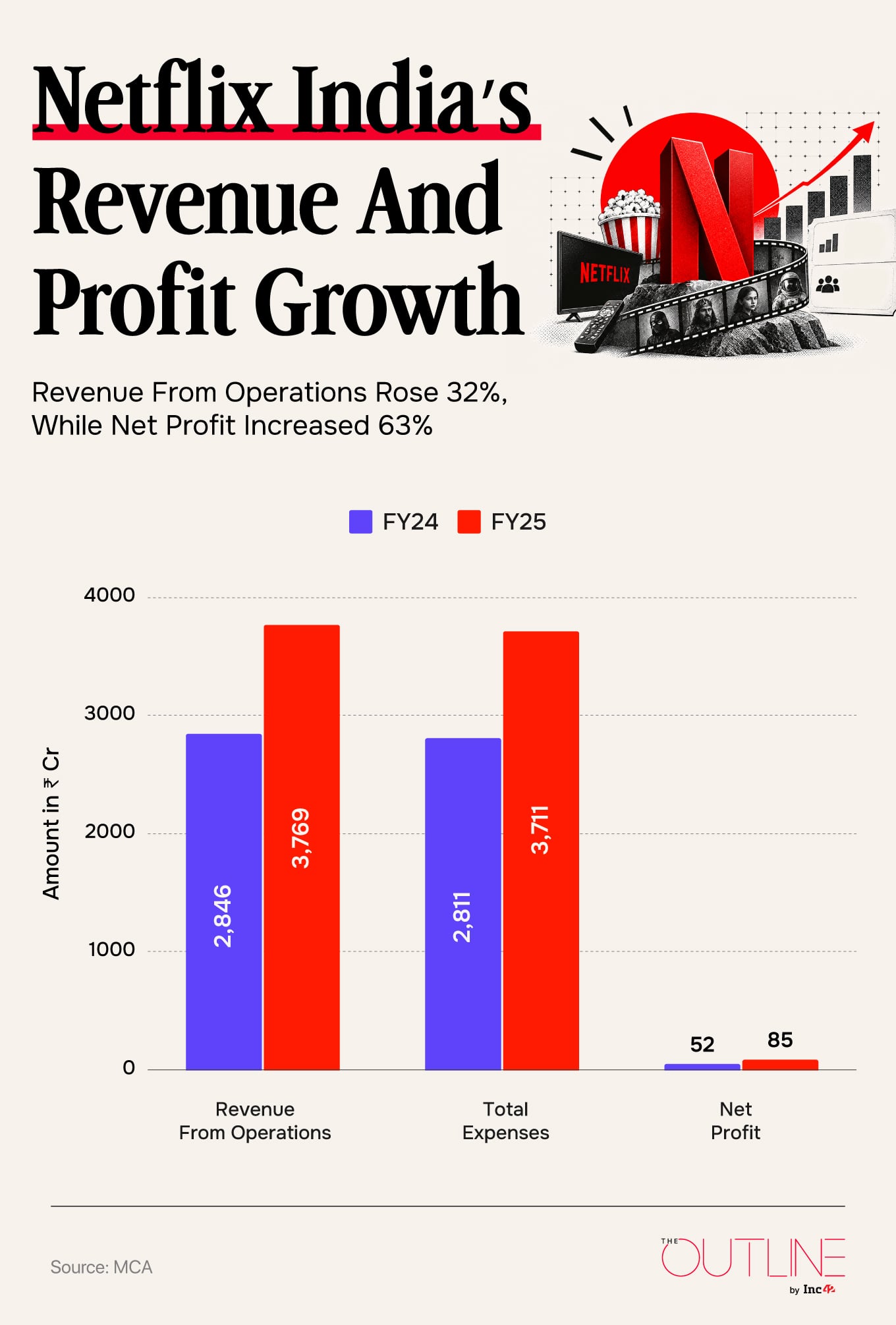
Netflix’s financial performance in India offers another measure of its progress. Netflix Entertainment Services India LLP reported a 63% increase in net profit to ₹85 Cr in FY25, while revenue from operations grew 32% to ₹3,769 Cr, according to filings with the Ministry of Corporate Affairs.
The cost of that growth, however, remains significant. Total expenses rose 32% to ₹3,711 Cr during the year. Other expenses, which include content production, marketing and related operating costs, increased 35% to ₹3,616 Cr, while personnel costs declined to ₹88 Cr from ₹106 Cr.
With content and related operating expenses accounting for most of its cost base, the company will need to ensure that its investments in new formats, wider audiences and distribution partnerships translate into sustained revenue growth and stronger returns on content spending.
Can It Go Mass Without Losing Its Edge?
Netflix’s position in India’s content market also varies across language industries. The South Indian film market is more fragmented, with producers having multiple streaming platforms to sell their content to, giving them greater bargaining power. On the other hand, the Hindi film industry has become more dependent on Netflix, according to industry sources.
For Netflix, however, the bigger challenge is balancing audience expansion with its premium content positioning. Its growing focus on reality shows, established television franchises and mass-market formats could help it reach viewers beyond its traditional urban audience.
But moving too far towards familiar, broad-appeal programming also carries the risk of diluting the distinctive content proposition that helped build Netflix. The platform will need to widen its audience without losing the storytelling ambition and premium identity that set it apart from other streaming services.
This tension was also evident when Netflix co-CEO Ted Sarandos questioned, on Nikhil Kamath’s podcast, whether the platform had introduced Sacred Games too early in its India journey. His remarks irked sections of India’s creative community, which raises concerns over whether Netflix’s evolving strategy could come at the cost of the creative ambition that defined its early India slate.
That balancing act will be central to Netflix’s next phase of growth in India. Reality shows and established television franchises can bring in viewers who may not have been drawn to its earlier slate of premium scripted originals. Regional partnerships can deepen its presence across language markets, while distribution tie-ups can make subscriptions more accessible. However, the early growth signals need to translate into sustained engagement and subscriber additions for the strategy to deliver lasting results.
One strong quarter, even with record paid net additions, does not necessarily mean Netflix has cracked India. The company continues to face competition from Prime Video and JioHotstar, alongside a growing number of platforms competing for viewers, content and production partnerships. Can Netflix turn its new mass-market appeal into a lasting winning formula without losing its DNA?
[Edited by Shishir Parasher]
The post Netflix Flips Its India Script appeared first on Inc42 Media.
This content is published by Inc42 and has not been created or edited by Hello Headlines. View original