For Generations, These Tamil Nadu Villages Have Gone Cracker-Free to Protect Bats
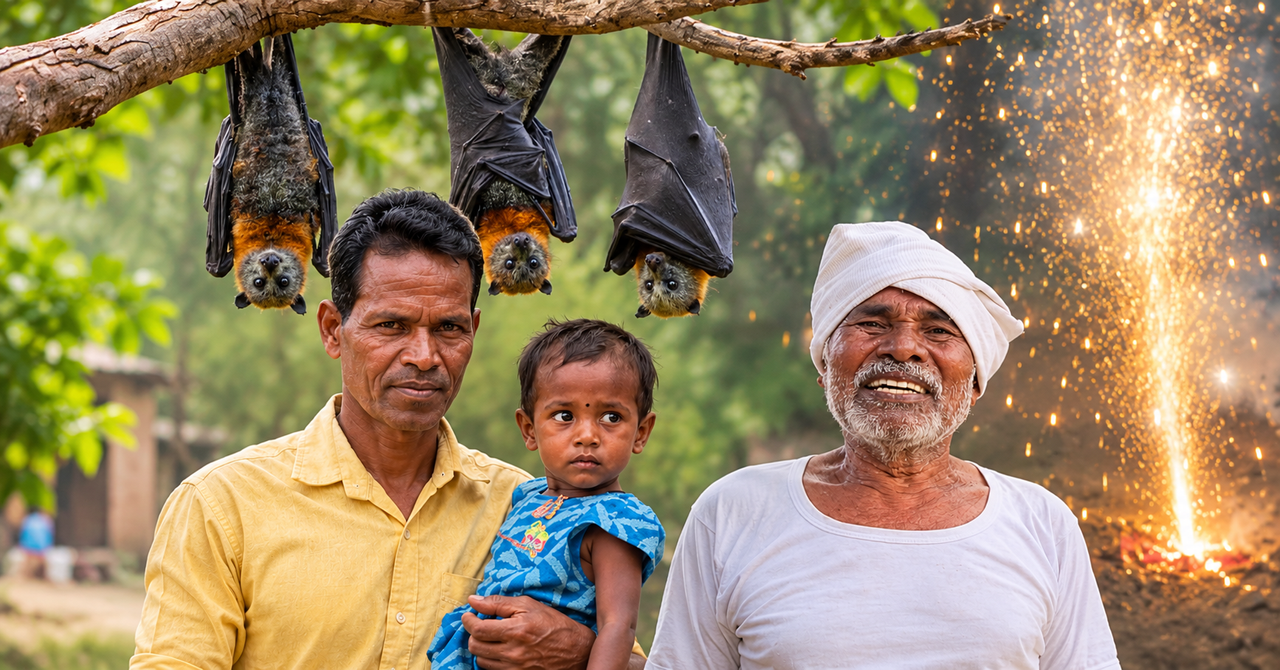
In parts of Tamil Nadu, Diwali comes with an unusual rule: leave the firecrackers out. The reason hangs upside down in the trees.
Hundreds of bats roost in village banyans and tamarinds. Rather than drive them away, residents have built traditions around protecting them. In some places, the custom is tied to a sacred tree or local deity. In others, it began with families feeding the animals.
The stories are different, but the relationship is striking. These villagers do not see the bats as pests to chase away. They see them as neighbours, guests or even protectors, and have learnt to celebrate Diwali around their presence.
The night shift that keeps nature growing
When fruit bats leave their roosts after sunset, they begin a nightly journey in search of fruit and nectar. Their work, however, extends well beyond finding food.

As bats eat fruit, they disperse seeds across the landscape, helping plants regenerate in places where seeds might otherwise never reach. By feeding on nectar, some also pollinate flowers. These activities support the growth of trees and vegetation, which in turn provide food and shelter for other wildlife.
Their daytime roosts are just as important. Large colonies often gather in the same trees, returning to familiar resting places after a night of foraging. Sudden, loud firecracker bursts and flashes of light can alarm bats and disturb their roosting behaviour. Repeated disturbance may cause them to abandon a tree and seek another place to rest.
For the villages that share their landscape with these animals, keeping Diwali quiet is a simple way to reduce that disturbance.
The family that climbed a tree to feed bats
In Kazhuperumpakkam, near Vanur in Villupuram district, the story began with a tamarind tree. Families noticed bats gathering around it to feed on its fruit. Instead of driving them away, they began leaving food for the animals.
The care went further. Men climbed the tree and placed a large vessel between its branches, filling it with water. Children watched the bats move around the tree and, as they grew older, continued the practice of feeding them.

The village eventually took responsibility for protecting the animals. The panchayat banned firecrackers, and the practice continued even after the families who first cared for the bats moved away.
The village has also faced a difficult side of conservation. Residents said the bat colony once numbered in the thousands, but hunting and disturbance led to a decline. The bats moved to another banyan tree after the old one lost branches.
In Perambur, near Kollidam in Mayiladuthurai district, the relationship has a more spiritual connection. Hundreds of bats roost in a sprawling banyan tree called Vavvaal Thoppu, or the bat grove. A shrine dedicated to Lord Muneeswaran stands nearby, and residents consider the grove sacred.
For more than a century, villagers have avoided firecrackers during Diwali. The festival is still celebrated, but residents gather at the Sri Aaladiamman temple instead of filling the night with fireworks.
A father stopped his son from bursting crackers. Three generations followed.
In Thoppupatti and Saampatti, in Tiruchirappalli district, hundreds of fruit bats roost in a large banyan tree near a statue of the village deity, Muniyappa Swamy. Residents believe the bats bring good fortune and protect the community.

Dhanraj, a resident of Saampatti, told India Today that villagers avoid crackers because the noise disturbs the bats. He described watching them fly out in the evening and return by dawn as a sight that makes the village proud.
In Kalapattu, near Katpadi, the custom has a personal memory attached to it. G Sampath recalled that when he was 12, his father stopped him from bursting crackers because bats roosted in the village's trees. The practice has continued for three generations.
The village's protection goes beyond Diwali. Residents refuse to let outsiders catch or hunt the bats. Yet they make one exception: firecrackers are allowed during funeral ceremonies, when they are part of local rites. Sampath acknowledged that the noise may frighten the animals, but described it as unavoidable.
Schoolchildren are learning to protect their winged neighbours
At Kittampalayam, near Coimbatore, the effort to protect bats has reached the classroom. In November 2012, Government Middle School hosted a bat and bird conservation programme, introducing students to the animals that roost in their village.

The children learnt why bats matter and took part in an awareness rally alongside villagers, conservationists and personnel from a nearby Border Security Force base.
The programme was part of a wider effort to protect a colony of around 2,000 Indian flying foxes that roosted in two banyan trees and a tamarind tree. Around 350 families had already agreed to avoid firecrackers during Diwali.
The students helped carry that message beyond the school, encouraging the community to see the bats not as intruders, but as fellow inhabitants of the village.
The programme gave children a way to connect what they learnt in class with the wildlife around their homes. By taking part in the rally, they helped carry the message beyond the school gates: protecting the bats meant protecting a part of their village that had shared its trees with them for generations.
The bats are protected from crackers. But what about curious visitors?
For these communities, protecting the bats also means guarding their roosts from hunting and disturbance. In Kazhuperumpakkam, villagers have spoken about outsiders catching bats. The community’s decision to protect the roosts helps keep the animals from being treated as an easy target.

In Kalapattu, residents have also refused to let outsiders catch or hunt the bats. Their protection is rooted in a custom passed down through generations, and in the belief that the animals belong in the village’s trees.
Perambur’s Vavvaal Thoppu presents a different challenge. The banyan tree and its bats are closely tied to local belief, and some residents hope the grove can attract nature lovers. But visitors bring the possibility of noise and disruption.
The question is how to welcome people without turning the bats’ resting place into a spectacle.
These villages have found a way to celebrate Diwali without asking their wild neighbours to leave. Sometimes, protecting wildlife begins with something as simple as choosing not to make a noise.
Sources
‘Choosing bats over fireworks: Coimbatore's Kittampalayam village leads the way this Deepavali too’: by Avantika Krishna for The Hindu, Published on 11 November, 2023
'For over a century, these villagers have celebrated a noiseless Deepavali to protect bats': by Express News Service for The New Indian Express, Published on 24 October, 2019
'For this village in Tamil Nadu, it’s bats over crackers on Deepavali': by Antony Fernando for The New Indian Express, Published on 31 October, 2024
'Tamil Nadu: These villages prefer silent Diwali to protect environment, bats and winged creatures': by Lokpria Vasudevan for India Today, Published on 5 November, 2018
This content is published by The Better India and has not been created or edited by Hello Headlines. View original