Groundwater levels decline in 554 Telangana mandals
Hyderabad: Telangana is facing a severe groundwater crisis, with water levels declining in 554 of the State’s 621 mandals and the area where groundwater is found at depths exceeding 20 metres expanding more than fourfold in a decade. The deterioration was sharp in Greater Hyderabad, where the average water table has fallen by 7.17 metres in a year, exposing the growing vulnerability of the State’s drinking water and irrigation sources.
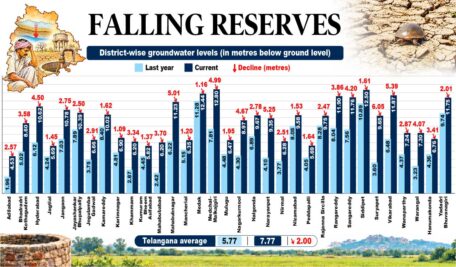
The October report of the Telangana Groundwater Department puts the State’s average groundwater level at 7.77 metres below ground level, a decline of 2 metres compared with October last year. The extent of areas with groundwater below 20 metres has increased from 478 sq km to 2,040 sq km compared with the October averages for 2016-2025. In all, 89 per cent of the mandals have recorded a decline against the decadal average.
The fall is closely linked to deficient rainfall during the current monsoon. Telangana received 628 mm of rainfall between June 1 and October 31, against the normal 831 mm, leaving a deficit of 24 per cent. Of the 33 districts, only 11 received normal rainfall, while 22 recorded a deficit. Jogulamba Gadwal registered the highest shortfall at 50 per cent, followed by Narayanpet at 44 per cent, and Nagarkurnool and Nalgonda at 42 per cent each.
The impact was severe in the western and southern districts. Suryapet recorded the steepest year-on-year fall of 6.05 metres, followed by Vikarabad (5.39 metres), Narayanpet (5.25 metres), Mahabubnagar (5.01 metres) and Medchal-Malkajgiri (4.99 metres). The current groundwater depth stood at 12.80 metres in Medchal-Malkajgiri, 12.44 metres in Medak, 11.90 metres in Rangareddy, 11.87 metres in Vikarabad and 11.76 metres in Sangareddy.
Hyderabad district recorded an average depth of 10.62 metres, compared with 6.12 metres last year, a decline of 4.50 metres. The region received 484 mm of rainfall against its normal 729 mm, a shortfall of 34 per cent.
The decline was not confined to the Musi River basin or urban areas. Reports also pointed to falling groundwater levels in districts across the Krishna and Godavari river basins. Reduced reservoir storage and inadequate replenishment through tanks and irrigation networks have added to the pressure.
With surface water availability constrained, farmers are increasingly dependent on borewells, accelerating extraction. The failure of existing borewells is forcing some farmers to deepen them or drill new ones, further intensifying the stress on aquifers.
The situation raises concerns ahead of the summer, when demand for drinking water and irrigation is expected to increase even as groundwater reserves remain depleted. The problem is no longer confined to a few drought-prone pockets. Groundwater depletion has become a widespread challenge, requiring intervention beyond emergency drinking water supply and seasonal irrigation measures.
This content is published by Telangana Today and has not been created or edited by Hello Headlines. View original