A Clean Road Doesn't Always Mean Clean Air: How 3 Indian Cities Are Tackling Road Dust
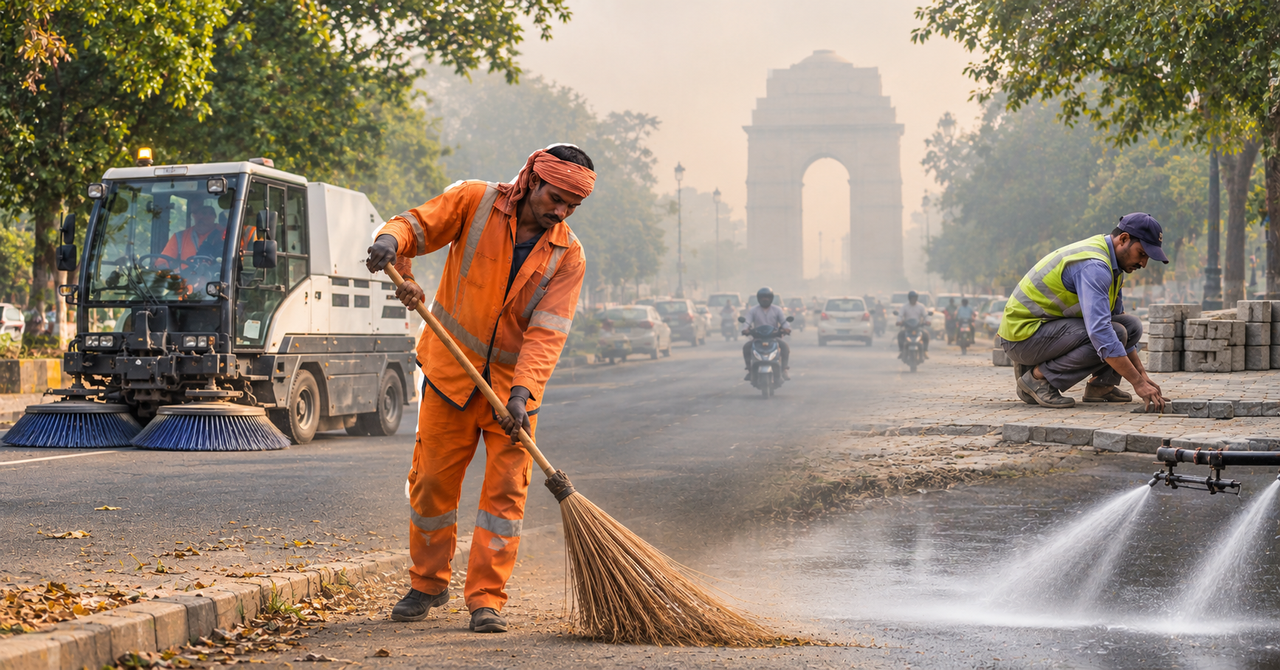
On 5 November, Delhi's Air Quality Index (AQI) reached 370, placing the capital in the very poor category. At Jahangirpuri, the reading climbed to 459, entering the severe category.
As winter settles over northern India, the familiar response is to increase road sweeping, sprinkle water and intensify construction-site inspections.
Yet there is a problem with the way cities clean their roads. A street can look spotless while fine particles escape into the air. Vehicles can then lift the remaining dust again, exposing pedestrians, cyclists and residents to pollution.
The question is not simply whether municipalities should sweep more often, but whether they can remove dust without making it airborne.
Three Indian cities offer different answers. Lucknow has expanded mechanised sweeping, Parwanoo has focused on repairing the surfaces that generate dust, and Chandigarh is testing a method that combines treated-water washing with mechanical cleaning.
Together, their experiences show why cleaner roads require more than a broom.
Lucknow takes cleaning beyond the broom
In September 2026, Lucknow won the top position in the Swachh Vayu Sarvekshan among cities with populations exceeding 10 lakh. Its Ward 70, in Zone 4, also ranked first nationally among wards with more than 30,000 residents.
The recognition followed a citywide effort to tackle several sources of pollution, including road dust, vehicle emissions and waste burning.

The Lucknow Municipal Corporation deployed 97 electric mechanised sweeping machines. These machines use rotating brushes to collect debris, while suction systems can help capture finer material instead of simply pushing it aside.
The city also paved approximately 559.85 km of roads end-to-end, reducing exposed surfaces that passing vehicles can disturb. Officials said the combination of mechanised sweeping and paving helped control resuspended road dust.
The ward-level recognition is particularly significant because air pollution is experienced locally. A city may have an ambitious clean-air plan, but residents encounter its results on the street outside their homes.
Ward 70's achievement shows how clean-air action can be assessed at a neighbourhood level. However, the award does not establish how much pollution the ward's individual interventions reduced. The challenge is to translate recognition into sustained, measurable improvements in the air residents breathe.
Parwanoo fixes the road that creates the dust
In Parwanoo, a town in Himachal Pradesh, officials began by asking a different question: what if the road itself was generating the dust?

An IIT Kanpur study covering the town's 8.5 sq km identified road dust as a major source of air pollution. The municipal response focused on repairing the surfaces and conditions that allowed dust to accumulate.
A 9 km stretch of road was upgraded with paver blocks and interlocking tiles, replacing crumbling surfaces. Drainage systems were improved to prevent erosion, while construction and demolition waste came under closer scrutiny.
The town also developed a 0.27-acre green buffer zone, intensified plantation efforts, and curbed open garbage dumping.
The outcome was measurable. Parwanoo's annual average PM10 concentration fell from 66 micrograms per cubic metre in 2017-18 to 39 micrograms per cubic metre in 2023-24, a reduction of about 41%.
PM10 refers to particles with a diameter of 10 micrometres or less. Road dust can contain these particles, which can enter the respiratory system.
The reduction cannot be attributed to paving alone. Parwanoo's efforts included several interventions, and the town's experience demonstrates the value of addressing dust at its source rather than relying exclusively on cleaning after it has accumulated.
Chandigarh tests whether washing can help
Chandigarh is approaching the problem through a pilot project.
In September 2025, the Chandigarh Pollution Control Committee directed officials to launch a dust-control initiative on a dust-prone road corridor. The plan combined road washing with treated water, mechanised sweeping and cleaning of road shoulders.

Road shoulders matter because loose soil and debris along the edges can be repeatedly disturbed by vehicles. Cleaning only the central carriageway can leave a substantial source of dust untouched.
The committee planned to monitor PM10 levels during the pilot and use the findings to decide whether the intervention could be expanded across the city.
The project also sits within a wider effort to control construction and demolition waste. Authorities directed institutions and agencies to suppress dust at stockyards, cover loose soil with vegetation and use sprinklers or anti-smog guns where appropriate.
The distinction is important: Chandigarh's project was announced as a pilot, not a proven citywide success. Its value lies in testing whether road washing and mechanical cleaning can work together, and whether air-quality monitoring can establish their effectiveness.
What Delhi can learn
Delhi's pollution is not caused by road dust alone. Vehicle emissions, industrial activity, construction, waste burning, agricultural fires and winter weather conditions all contribute to the city's air-quality episodes.
But that does not make road dust control insignificant. It makes targeted interventions more important.
-
Lucknow demonstrates the value of mechanised cleaning and neighbourhood-level action.
-
Parwanoo shows why repairing damaged roads and controlling construction waste can prevent dust from accumulating.
-
Chandigarh is testing whether treated-water washing and shoulder cleaning can improve the results.
The larger lesson is that road cleaning should not be measured only by the amount of dust collected or the number of machines deployed.

Municipalities need to measure how much dust remains on roads, how quickly it returns, and whether particulate pollution declines.
For a city like Delhi, where winter pollution can become a public-health emergency, cleaner roads are not a complete solution. But they are a tangible civic intervention that can be planned, monitored, and improved.
The real test of a clean road is not how it looks after a sweeping vehicle passes. It is how much dust stays out of the air afterwards.
Sources
'Lucknow is known for traffic and dust. How did it top India’s clean-air ranking?': by Maulshree Seth for The Indian Express, Published on 8 September, 2026
'Parwanoo: Industrial town, cleaner crown!': by Ambika Sharma for The Tribune, Published on 13 September, 2025
'Pilot dust-control project in Chandigarh to see road washing with treated water': by Express News Service for The Indian Express, Published on 7 September, 2025
'Delhi AQI at 370 today, 10 monitoring stations record severe pollution': by Express Web Desk for The Indian Express, Published on 5 November, 2026
'CAQM reviews progress of Special Campaign for Removal of Legacy Dust across 12 MCD Zones; Directs Sustained Dust Mitigation Efforts': by Press Information Bureau, Published on 28 July, 2026
This content is published by The Better India and has not been created or edited by Hello Headlines. View original