Hyderabad Needs to Save Every Drop. What Chennai's Rainwater Harvesting Story Can Teach Us
In 1995, Professor Sekhar Raghavan noticed something unusual about the water coming from his tap in Chennai. It had turned salty.
As groundwater levels fell, seawater was seeping into the city's underground freshwater reserves, making the water increasingly difficult to use.
The problem was not that Chennai received too little rain. The city received substantial rainfall, but much of it flowed through roads and drains into the sea instead of replenishing the groundwater beneath its homes.
For Raghavan, this raised a question. If the rain was falling over the city, why was so little of it being saved?
His answer was to take rainwater harvesting to the people. Armed with a bicycle and a simple message, he began visiting neighbourhoods, going from door to door to convince residents to collect rainwater and direct it back into the ground.
Nearly three decades later, his campaign offers a lesson to another Indian city struggling with water scarcity: Hyderabad.
When the rain falls, but the wells run dry
Home to around 1.5 crore people, the city is grappling with an acute drinking water shortage driven by uneven regional water availability, competing agricultural and industrial demand, and a monsoon deficit.
More than 330 of Telangana's 600-plus mandals have been classified as drought-hit, while only around 500 of the state's 6,000-plus lakes have water, according to data shared by the state irrigation department.
The pressure is visible in the city's growing dependence on tankers.
Daily bookings have surged to between 6,000 and 8,000, prompting Hyderabad Metropolitan Water Supply and Sewerage Board Managing Director Ashok Reddy to direct officials to onboard additional tanker operators and begin their registration.
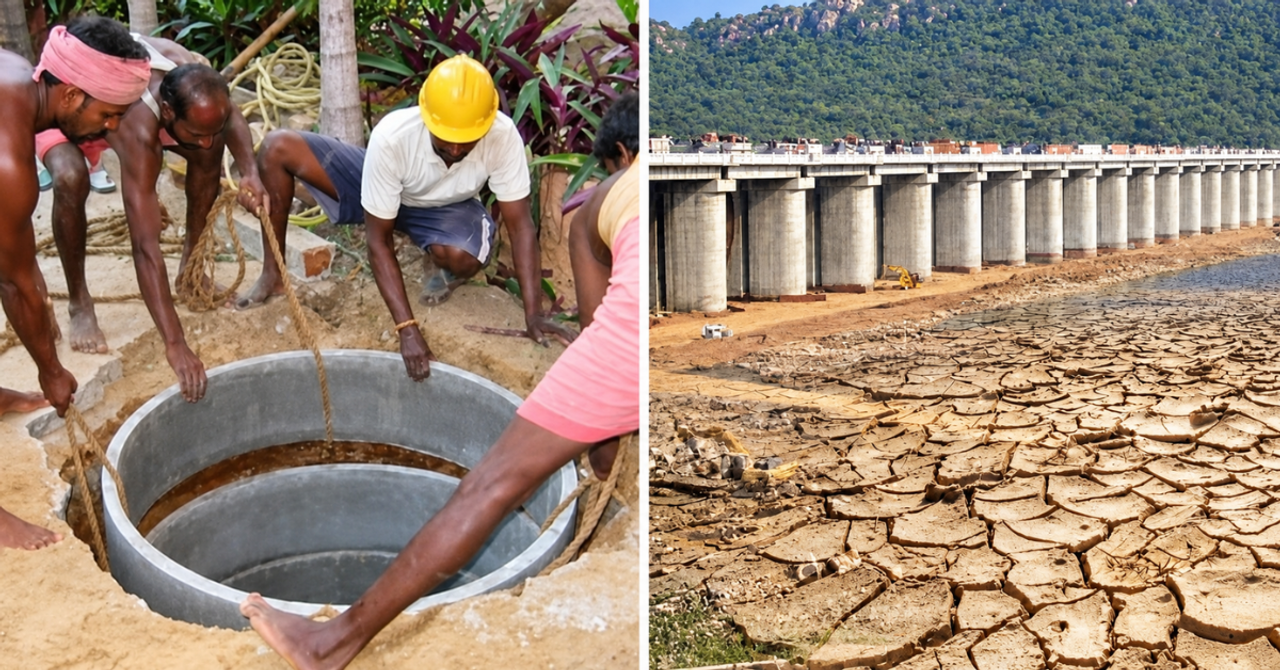
In parts of Secunderabad Cantonment and Hyderabad's outskirts, residents have reported receiving drinking water only once every three to four days. One of the city's main reservoirs has also reportedly fallen to around 13% of its capacity.
But the shortage is not only about how much water a city receives. It is also about how much it can retain.
That is where Chennai's experience becomes relevant.
One bicycle, one neighbourhood at a time
When Raghavan began his campaign in 1995, rainwater harvesting was not a familiar practice among most urban households. He set out to change that, explaining how rainwater collected from rooftops, driveways and other surfaces could be filtered and directed into recharge structures, allowing it to seep into the soil and replenish underground aquifers.
Instead of allowing rainwater to run off into drains, households could capture it and help restore the groundwater they depended on.
However, convincing people was harder than explaining the science.
Raghavan cycled through neighbourhoods, speaking to residents and encouraging them to install harvesting systems. Many initially dismissed the idea, but he continued working with communities to demonstrate how it could be done.
Through the Rain Centre, which he led, he also worked with a team of plumbers and well-diggers to survey systems across the city and demonstrate rainwater harvesting through model houses.
How Chennai turned an idea into a law
In October 2002, the Tamil Nadu government enacted legislation to make rainwater harvesting compulsory. An ordinance followed in June 2003, extending the requirement to all existing buildings across the state, including Chennai.
Property owners were required to install systems by 11 October, 2003. Non-compliance could invite penalties, including fines or disconnection of government water supply.
The government's November 2003 announcement reported that 99.5% of Chennai's residents had implemented rainwater harvesting in their houses and apartment complexes.
But installing a system and making it work are two different things.
View this post on Instagram
A Rain Centre survey conducted in a residential colony between October and November 2003 found that around half the residents had implemented rainwater harvesting unsatisfactorily. Even among those who had installed systems correctly, many focused only on collecting rooftop rainwater.
They overlooked another important source: the rain falling across the rest of their premises.
In apartment complexes, this surface runoff could amount to twice or more the volume collected from rooftops.
Although this water may not be suitable for direct household use, it can still be directed into the soil to replenish groundwater. As it moves through the soil, natural filtration helps remove contaminants.
The missing piece: What happens beyond the rooftop?
Raghavan's work also highlighted a larger gap in Chennai's approach.
While households had a responsibility to harvest rainwater within their properties, public spaces presented another opportunity.
Roads, parks and playgrounds receive considerable rainfall. Yet much of the water flowing through Chennai's stormwater drains is channelled towards the city's waterwys and eventually discharged into the Bay of Bengal.
Instead of allowing all this runoff to escape, the Rain Centre advocated directing suitable urban runoff into recharge structures.
This, however, requires careful planning. Road runoff carries solid waste, fine silt and other contaminants that can clog harvesting structures. Systems must therefore account for filtration, waste removal and regular maintenance.

The city also needs adequate open spaces and appropriately designed recharge structures to prevent stagnant water and flooding.
In other words, collecting rainwater is only one part of managing it.
What Chennai's experience tells Hyderabad
The results of Chennai's efforts became more visible after the rains returned.
Tamil Nadu received below-average rainfall in 2003 and 2004, making the immediate benefits difficult for residents to see. The following year brought heavier rainfall, offering a clearer demonstration of what functioning harvesting systems could achieve.
After the 2005 rains, the Rain Centre observed groundwater levels rising by around 20 feet in areas it monitored, encouraging the team to continue its work.
For nearly 15 years, rainwater harvesting helped Chennai strengthen its groundwater reserves. However, the city's 2019 water crisis exposed the limitations of relying on infrastructure that was no longer adequately maintained. Clogged filters, neglected recharge pits, and poorly functioning systems weakened the impact of the original initiative.
Today, Chennai is exploring additional approaches, including sponge parks and underground rainwater capture systems, to improve its capacity to retain rainfall.
For Hyderabad, the lesson is not simply to replicate Chennai's legislation or install harvesting structures across buildings. It is to build a system in which households, communities and civic authorities share responsibility for capturing rainwater, maintaining recharge structures and protecting groundwater.
Raghavan's journey began with a salty tap and a bicycle. What followed was a citywide conversation that helped turn an overlooked resource into an urban water-management priority.
Sources:
‘Can storm water drains help in recharging groundwater: The case of Chennai’: By India Water Portal team, Published on 22 November 2014
‘Hyderabad in the grips of severe drinking water crisis—8,000 tankers a day, supply once in 3 days’: By Deepika Amirapu, Published on 24 October, 2026
‘Chennai Water Crisis: 71-YO 'Rain Man' Helps Hundreds Recharge Their Groundwater’: By Tanvi Patel, Published on 29 Jun 2019
This content is published by The Better India and has not been created or edited by Hello Headlines. View original