How Pine Labs is building for the agent economy: CTO Sanjeev Kumar on trust, control and execution
AI agents are starting to run real parts of a business, from finding customers to processing complaints. For banks, fintech companies, and enterprises, that raises a basic question: how far can an agent be trusted to act on its own?
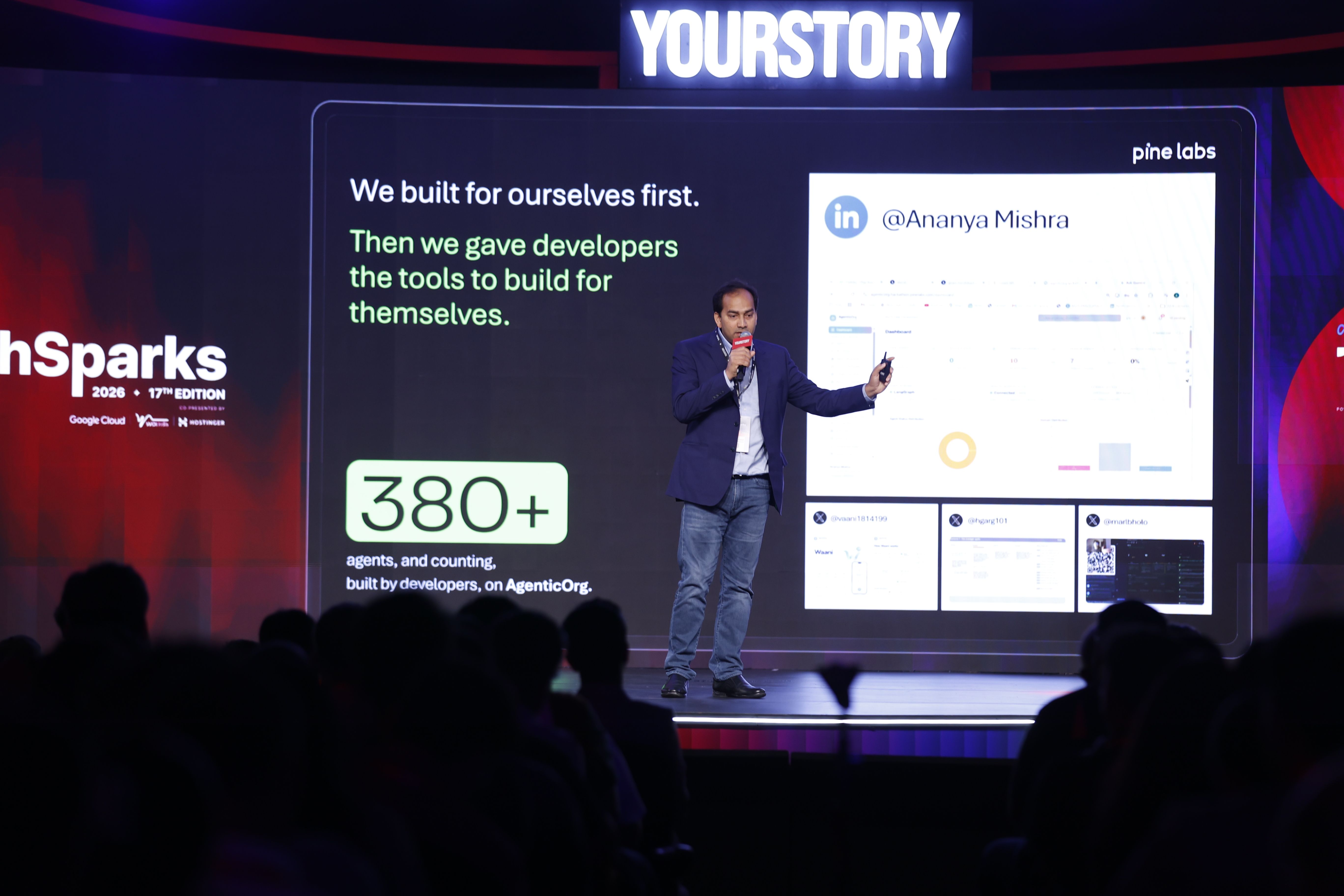
Pine Labs is addressing this question by building an ecosystem that enables AI agents to take on tasks across commerce while keeping their actions accountable. Speaking at its product showcase at TechSparks 2026, Sanjeev Kumar, CTO, Pine Labs, said, “We have tried to make AI a first-class citizen in our ecosystem.”
Over the past 18 months, Pine Labs has been building a commerce operating system around AI agents, combining tools to manage their permissions and track their actions with applications for merchants and enterprise teams. Its Agent Store will open the ecosystem to third-party developers building for merchants and banks.
Building trust into AI agents
For agents to operate in banking and enterprise environments, organizations need to know what they are authorized to do and how their actions can be audited. Pine Labs has developed Grantex, which Kumar described as ‘Open Authorization 2.0 for AI agents’. It assigns each agent a defined set of permissions, an expiry, and a record of the human who authorized it. If an agent authorized to read and draft emails attempts to send one, the action can be blocked and its permissions revoked, including those of any child agents. A tamper-proof, hash-chain audit trail records its actions.
Kumar outlined the work involved in connecting tools and systems, setting up retrieval-augmented generation (RAG), running continuous evaluations, and deciding where human intervention is necessary. These components need to work together before an agent can reliably handle tasks in an enterprise environment.
Pine Labs first deployed the technology across its compliance, finance, HR, and marketing teams, with processing taking place within its own environment. The company is also implementing it with banks in India and overseas.
From cyber fraud complaints to faster resolution
Cora, Pine Labs’ compliance and resolution agent, takes cyber fraud complaints from intake to closure. It matches complaints to transactions, categorizes them, routes them to relevant teams, and prepares responses for review. Kumar said Pine Labs has been able to close some complaints on the same day, compared with the typical three-to-five-day turnaround.
The agent records a 15-step trace of its work, including validation, transaction lookups, settlement checks, and team notifications, along with supporting evidence and confidence levels. When a system connector is unavailable, Cora can use robotic process automation (RPA). In the demonstration, it accessed the government cyber police portal and filled in an action-taken form with transaction details and the disputed amount. A human operator retains control of the password and one-time code and reviews the form before submission.
Opening the platform to developers
Having deployed agents across its own compliance, finance, HR and marketing teams, Pine Labs has since opened its platform to developers and merchant partners. The company is also working with banks in India and overseas.
To show how the technology could be applied beyond its own operations, Kumar pointed to a hackathon organized by Pine Labs and The Ken , which drew more than 380 agent submissions from students, fresh graduates, and engineers across India. The winning entry helped people decide what to cook for dinner.
Developers can create skill files, connect tools, and define tasks in plain English, while AgenticOrg provides visibility into agents, confidence scores, and audit trails via Grantex. The AgenticOrg is intended to help third-party developers build applications for merchants and banks using Pine Labs’ infrastructure.
Helping small merchants run ad campaigns
For smaller businesses, Pine Labs has also developed an ads agent accessible through its merchant interface. Merchants connect their Google Ads account, enter details about their business, and provide a brief, budget, and campaign goal. The agent researches local demand and nearby competitors, then generates ad copy for search, display, and YouTube.
Merchants can request changes and approve the campaign before it goes live. The demonstration showed setup taking about two minutes, with campaign performance and lead routing available through the same interface.
Building an ecosystem for commerce
From internal enterprise workflows and cyber fraud resolution to advertising for small businesses, Pine Labs is applying its agent infrastructure to different parts of commerce. Grantex sets guardrails for what agents can do; AgenticOrg helps teams, individuals, and AI enthusiasts build agents, manage work, and execute tasks, and AgenticOrg is intended to let developers build further applications for merchants and banks.
Pine Labs is betting that the future of commerce will be shaped not just by what AI agents can do, but by how reliably they can do it. By combining the infrastructure to govern agents with applications that solve real business problems, the company is looking to make autonomous AI a working part of commerce, for enterprises, banks, and merchants alike.
This content is published by YourStory and has not been created or edited by Hello Headlines. View original