India rebased its GDP. It still can’t see the Rs 34.5 lakh crore women do free
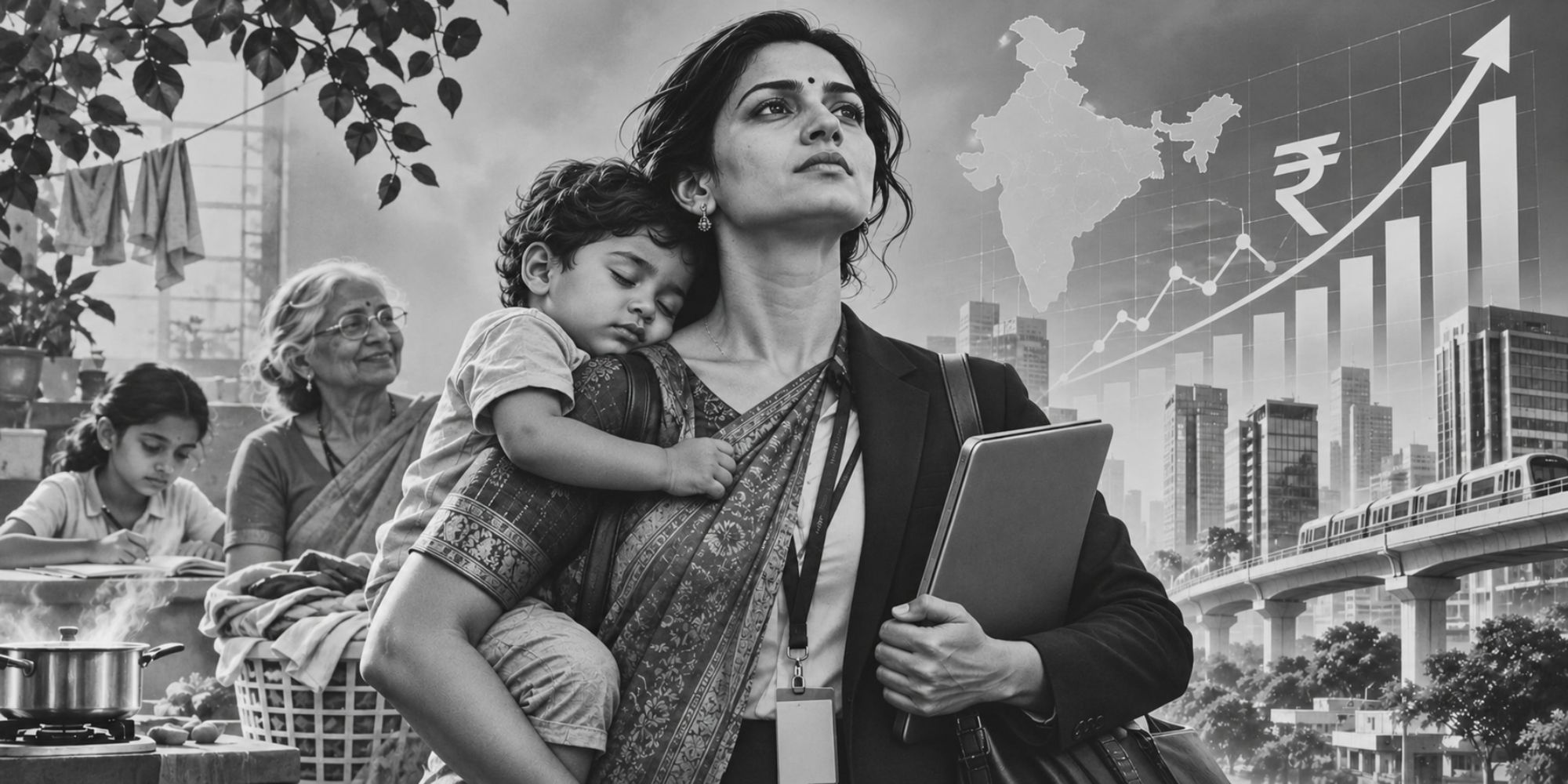
In February 2026, India moved its GDP base year to 2022-23. The National Accounts of India brought in new data sources and reassessed the size of the informal economy. The exercise carried a lesson that policy debates often forget: economic measurement is not fixed. When the statistical system decides an activity deserves to be captured better, the numbers change.
The same quarter, the economy grew 7.8%, keeping India the fastest-growing major economy even through the first full quarter of steep US tariffs and disruption in the Strait of Hormuz. The headlines celebrated. But one kind of work counted for nothing in all that arithmetic: the unpaid domestic and care work that makes every other job possible.
The invisible fifth of the economy
GDP has a defined production boundary, and for good reason. A creche worker paid to look after a child is counted as economic activity. A mother or grandmother doing the same job for free is not. The value has not disappeared; only the payment has.
What sits outside that boundary is large. India's Time Use Survey 2024 shows women aged 15 to 59 spend about 201 minutes a day more than men on unpaid household work. A deeper analysis of the unit-level data puts women's unpaid domestic and care work at 343 minutes a day, against 43 for men. Some 93% of women do this work, compared with 44% of men.
A Ministry of Women and Child Development study values this work at up to Rs 34.5 lakh crore, roughly 15–17% of GDP at weighted average wages. Even the Ministry of Statistics' Time Use Survey report concedes that leaving out unpaid services means GDP "underestimates considerably the total income of a nation."
The global answer is not to abandon GDP but to add a satellite account that measures activity beyond the production boundary. India already has the raw material: two national Time Use Surveys, an accepted valuation method, and a statistical system that has just shown it can rebuild its accounts. What is missing is the decision.
From invisible labour to the second shift
Visibility matters because governments allocate money through the numbers they measure.
According to the UNDP, 44.5% of Indian women outside the labour force cite childcare and homemaking as the main reason. Female labour-force participation has climbed from 23.3% in 2017-18 to about 40% in 2025, by the Periodic Labour Force Survey's measure. Yet women's unpaid workload has barely moved in five years.
A woman who takes a paid job while carrying the same load at home has not been freed to work. She has taken on a second shift. The real policy question is not how to persuade more women to work. It is what infrastructure would make paid work compatible with care.
India's jobs ambition has a care problem
The contradiction shows up in the government's own documents. The Economic Survey's employment chapter calls the care economy a promising source of jobs, and the Economic Survey 2025-26 targets a 55% female workforce. Yet under the Palna scheme, only 11,395 anganwadi-cum-creches had been approved against a target of 17,000 by March 2025. Fewer than 10% of anganwadi centres are in cities, where women's participation is lowest.
The shortfall does not mean the scheme has failed. It means care infrastructure is still being built while the country sets big employment goals. If policymakers want a real rise in women's paid work, childcare must stop being a side programme and become labour-market policy.
What other countries did differently
By the ILO's harmonised estimates, India's female labour-force participation was 32% in 2025. The figure is lower than the PLFS number because the ILO uses a different, internationally comparable definition.
Female labour-force participation, 2025 (ILO estimates) Country Participation rate China 59% Japan 56.5% Bangladesh 46.5% India 32%Source: International Labour Organization (ILO)
Among women of prime working age, participation reaches 85% in Japan and 78% in the United States.
These gaps are policy outcomes, not accidents. Japan raised fathers' take-up of parental leave from 17.1% to 30.1% in a single year by paying for it. Bangladesh, with a fraction of India's output, lifted net pre-primary enrolment from 19.7% in 2018 to 28.5% in 2023 as part of a deliberate push to get women into work. The United States learnt the opposite lesson: prime-age women hit record participation, then gains among mothers of young children stalled where affordable childcare ran out.
No country has gone from developing to developed while leaving half its working-age women outside the paid economy. The road to Viksit Bharat has to take her along, or it will not arrive.
Three ordinary acts of statecraft
1. Measure it. Complete and regularly publish a satellite account for unpaid care work, linked to the Time Use Survey. It should show the work's value, who does it, where it is concentrated and how it changes. The aim is not to inflate GDP but to give planners a second dashboard to act on.
2. Invest in it. The UNDP estimates that spending about 2% of GDP on care services could create more than 11 million jobs. As India urbanises, fertility falls and joint families thin out, who provides care is becoming an economic question, not just a household one.
3. Reclassify it. Care spending should be judged not only as welfare but by its effect on employment, labour supply and productivity. If a childcare centre lets twenty parents stay in work, its value cannot be measured only by the children it serves.
Seeing what GDP cannot
This argument is no longer confined to feminist economics. A working paper from the Economic Advisory Council to the Prime Minister this year calls for moving care "from private burden to social and economic infrastructure." The diagnosis is in, and the evidence backs it. The harder question is whether measurement, budgeting and delivery will follow.
The 2026 rebasing showed that India's statistical system can question long-held assumptions. The same willingness should now extend to the work that sustains the economy from outside its markets.
That means collecting real-time data, publishing a satellite account for unpaid care linked to the Time Use Survey, and treating care infrastructure as a measurable public investment. Every new creche, eldercare service and community care programme should be judged not only by the people it serves but by the paid work it makes possible.
If India wants more women in its workforce, it must budget for the care that makes their work possible. India has shown it can re-measure its economy. Now it must build the care that lets more women take part in it.
This content is published by YourStory and has not been created or edited by Hello Headlines. View original