Kashmiri Fishermen Lose Their River
Kashmir, Observer, Jammu, Srinagar, Latest Kashmir News, Kashmir News, Kashmir Latest News
Mohammad Akbar has spent nearly 47 years fishing in the Sukhnag stream.
The 64-year-old from Arwah village in Budgam inherited the profession from his parents and grandparents. The cold waters descending from the Pir Panjal mountains have sustained his family for generations.
But today, he struggles to catch even a kilogram of fish in a day.
Akbar supports a family of eight, including his wife and six daughters. His age makes it difficult to find another occupation, while the stream that once provided his income has become far less productive.
His experience is shared by many fishermen in the area, whose livelihoods have suffered since the government constructed a concrete structure across Sukhnag at Makhama in autumn 2024.
The structure was built to protect the abutments of a bridge, but its consequences for the stream and the people dependent on it have been severe.
It obstructs the upstream movement of fish, particularly during lean periods when fish migrate towards suitable breeding grounds.
A government project intended to protect infrastructure has damaged an entire fishing economy.
A letter issued by the Assistant Director of Fisheries, Budgam, on November 5, 2026, now provides official confirmation of the damage.
Addressed to the Executive Engineer of the Public Works Department’s Roads and Buildings Division, Beerwah, it states that the concrete structure has harmed Sukhnag’s ecology and fisheries.
The department says the structure was designed and approved without consulting Fisheries officials and without provisions for fish passes or fish ladders.
During construction, departmental employees and local fishermen had strongly opposed the work because of its likely long-term impact.
The letter goes further, saying fish biodiversity in the upstream stretch has changed altogether, while fishermen have reported a severe decline in their catch since construction began.
Fish that swim upstream to breed face a barrier that makes it harder for them to spawn safely. This affects not only the fish available for sale today but also the stream’s fish population in the years to come.
The department has also put a figure on the human cost.
It says 150 registered fishing families depend solely on Sukhnag for their livelihoods through regulated fishing activity.
These are families whose income depends on the health of a single water body.
The November 5 letter follows an earlier communication dated April 3, 2025, in which the Assistant Director had advised the R&B division against proceeding with the construction.
The department had warned that an embankment across the stream would obstruct fish movement, reduce production and damage breeding. The engineering division proceeded despite those objections.
The Flood Spill Channel Division at Narbal also did not issue a No Objection Certificate for the project. Its Executive Engineer, Javed Kurpal, confirmed this to me in a recent conversation.
Two departments with direct knowledge of the river’s ecology and flood management were left out of the planning process.
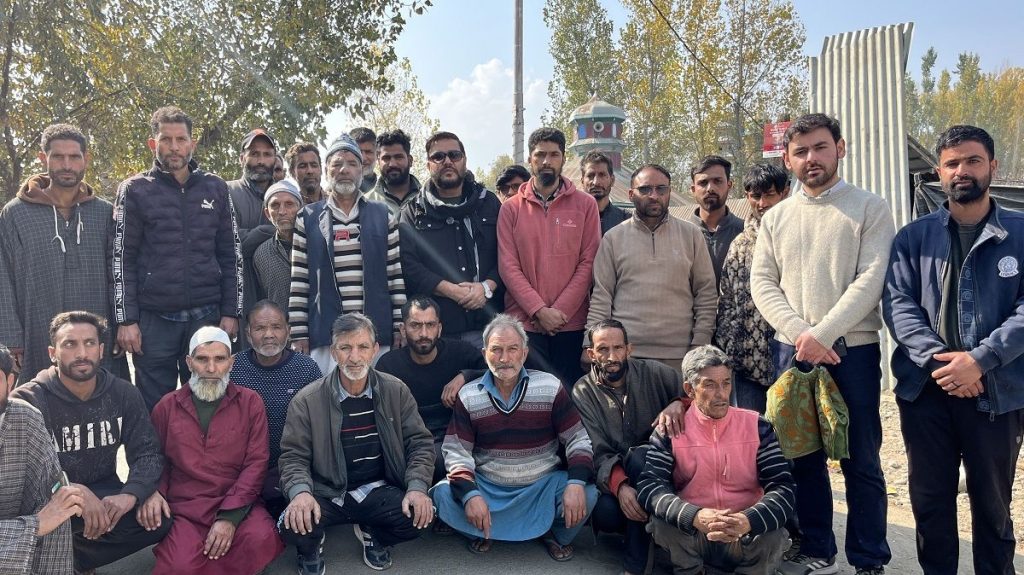
I visited Makhama on November 1 with colleagues from the J&K Climate Action Group and met around two dozen fishermen. Their accounts were deeply troubling.
They said nearly 200 families had suffered because of the structure. Some fishermen also alleged that the contractor had them booked and taken into custody when they protested against the construction.
The difference between the fishermen’s estimate of nearly 200 affected families and the Fisheries Department’s figure of 150 registered families needs to be understood in the context of the people who depend on the stream. The official figure alone establishes the scale of the problem.
Sukhnag had already suffered years of damage from illegal extraction of boulders, sand and gravel. Heavy machinery operated in nearly a dozen villages, disturbing the riverbed and damaging fish habitats.
I took the issue to the National Green Tribunal, which imposed a ban that halted much of the illegal mining.
Over the following two years, the stream began showing signs of recovery and fish numbers improved.
But the Makhama structure has interrupted that recovery.
It also raises a larger question about how government departments prepare tenders and approve public works. Environmental considerations often receive little attention, even when a project directly affects rivers, forests and communities.
A similar controversy emerged over the proposed widening of Canal Avenue in Srinagar.
The R&B Division, Rajbagh, invited tenders in December 2025 for work from Mochwa Baghe Mehtab to Rawalpora bridge. The ₹1.10 crore contract was allotted on January 24, 2026.
The project threatened nearly 200 mulberry trees, while the tender and allotment documents contained no mention of environmental safeguards.
The proposed felling raised questions under the J&K Preservation of Specified Trees Act, 1969, and the Jammu and Kashmir Mulberry Protection Act, 1949.
Permission was granted to cut 62 trees, a decision that needs investigation.
Although the work was halted after I raised the issue publicly, trees in Pirbagh have since been surrounded by concrete.
These cases point to a basic failure in public administration.
Engineers prepare designs and contractors execute them, while the people living with the consequences have little say.
The National Water Policy and the J&K Water Resources (Regulation and Management) Act, 2010, provide a framework for protecting water bodies. Such laws lose their purpose when departments ignore consultation and environmental consequences.
The government has also introduced Design Thinking in the National Education Policy. Its starting point is empathy, understanding the people for whom a decision is being made. That principle should guide engineering departments as well.
A bridge project on a living stream needs inputs from fisheries experts, flood-control officials, environmental specialists and local residents before the tender is issued.
Agriculture Production Minister Javaid Ahmad Dar, who also holds the Fisheries portfolio, has responded to my intervention and asked Fisheries Director Abdul Majeed Tak to initiate legal action against the R&B engineers and contractor.
This is a welcome step.
The next decisions must address the damage itself.
The Fisheries Department has now formally asked the R&B division to remove the concrete structure or install fish passes or fish ladders immediately.
The government should act on this recommendation, restore fish movement and compensate the affected fishermen for the income they have lost over nearly two years.
A bridge can be repaired, strengthened and protected through engineering. A river, however, has its own life, and the families who depend on it cannot be treated as an option.
Mohammad Akbar inherited his profession from generations before him. Whether his daughters will inherit the possibility of a livelihood from Sukhnag now depends on whether the government is prepared to correct its own mistake.
The post Kashmiri Fishermen Lose Their River appeared first on Kashmir Observer.
This content is published by Kashmir Observer and has not been created or edited by Hello Headlines. View original