'Temperature Influences Growth, Yield and Quality': What Warmer Winters Could Mean for Red Carrots
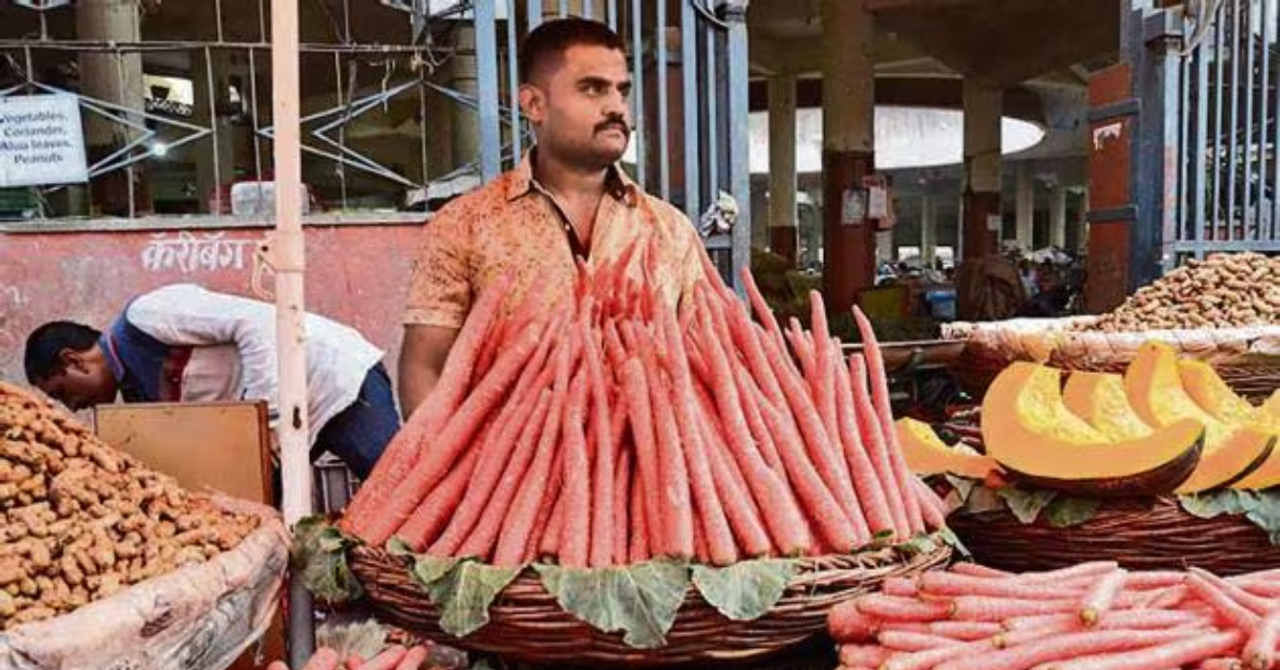
The first sign that winter has arrived in many North Indian kitchens is not the chill in the morning air, but the sight of a heap of red carrots at the vegetable market.
For a few months, the deep-red carrot takes centre stage in markets across Delhi and other parts of North India, where shoppers who buy orange carrots through much of the year will seek out this seasonal variety.
But the red carrot's place in the winter kitchen is tied to more than nostalgia.
Its cultivation depends on growing conditions, including temperature, raising questions about what warmer winters could mean for a crop so closely associated with the season.
Why red carrots rule the winter kitchen
Red carrots, commonly known as lal gajar, are prized for their deep colour, sweetness and juiciness. Their arrival makes a difference to dishes in which the vegetable is the main ingredient, rather than simply one component of a meal.
In gajar ka halwa, grated red carrots cook down with milk and ghee to produce the dessert's characteristic colour and flavour. Kanji draws on a different tradition: carrot sticks ferment in water seasoned with mustard seeds, salt and spices, producing a sharp, tangy drink. Red carrots are also used in winter salads, cooked vegetable dishes and pickles.

The seasonal preference for red carrots is therefore not simply a switch from one colour to another. It is also about the taste, texture and culinary traditions associated with the red variety.
There is a scientific reason to look beyond colour.
In a study published in 2016 in the Indian Journal of Agricultural Sciences, researchers Swati Saha, Pritam Kalia, Amish Kumar Sureja and S Sarkar at the ICAR–Indian Agricultural Research Institute in New Delhi examined 38 tropical carrot lines over four consecutive years, from 2009 to 2012. They compared characteristics including root weight, colour and nutritional composition.
The researchers found considerable differences in the amount of carotenoids and other pigments present in the carrots. One red line, IPC-11 red, contained 9.99 milligrams of total carotenoids per 100 grams. The study also found that some carrot lines performed well under high-temperature conditions, making them potential candidates for future breeding.
A crop shaped by temperature
Carrots are generally associated with cool-season cultivation, although tropical varieties have been developed to grow under warmer conditions. Temperature influences root development, yield and quality, making it an important factor in determining how successfully a variety performs.
Saha and her colleagues put it simply: 'Temperature influences growth, yield and quality of carrots in many different ways.'
Their research was not a study of climate change in farmers' fields. Instead, it explored whether particular carrot lines could withstand heat while retaining desirable characteristics. The researchers noted that 'some inbreds performed well under extreme high temperature without affecting any quality attributes'. Such lines, they suggested, could be selected for further breeding.

India's agricultural research system also maintains red varieties suited to local growing conditions. In a 2020 article in the ICAR journal Indian Horticulture, researchers described Pusa Kesar as a variety with deep-red roots and a small, deep-red core.
They also documented Pusa Rudhira, developed by ICAR-IARI in New Delhi, as a tropical variety with dark-red roots that matures around 85–90 days after sowing and is suitable for cultivation in the National Capital Region.
These varieties show how researchers have worked to develop carrots suited to India's agricultural conditions.
But they also raise a question: how might the conditions in which red carrots are grown change as temperatures rise?
What warming winters could mean
The 2016 study offers a useful starting point for understanding the risks. In discussing earlier research on carrot cultivation, Saha and her colleagues noted that temperatures above 25°C could result in unmarketable roots and lower yields. They also cited research indicating that temperatures below 10°C or above 30°C could produce lighter-coloured roots.
These findings point to a potential concern for growers: that heat can affect not just how much a crop produces, but also the appearance and quality of its roots. For red carrots, whose colour is central to their appeal, that factor is important.
However, these temperature findings should not be treated as proof that climate change is already reducing red carrot production in North India. The effects depend on the variety, the timing of sowing, soil conditions, irrigation and temperatures at different stages of growth.
Preserving a seasonal flavour
The red carrot's winter popularity connects agriculture to everyday food traditions. Its arrival signals the season for halwa made in large batches, jars of kanji left to ferment and pickles prepared for later consumption.
The future of this seasonal crop will depend partly on how effectively farmers and breeders respond to changing growing conditions.
Until then, the seasonal rush for red carrots remains both a culinary tradition and a reason to pay closer attention to the crops that connect India's winter kitchens to its changing climate.
Sources:
‘Climate change and vegetable crops cultivation: A review’: By The Indian Journal of Agricultural Sciences, Published on 27 April 2018
‘Response of carrot (Daucus carota L.) cultivars to different sowing dates on growth and yield’: By P Madhavi Latha, P Syam Sundar Reddy, Ramanjaneya Reddy, V Sudha Vani, Published on 30 December 2015
‘Breeding tropical carrots (Daucus carota) for enhanced nutrition and high temperature stress’: By ICAR-Indian Agricultural Research Institute, Pusa, Published on 11 July 2016
This content is published by The Better India and has not been created or edited by Hello Headlines. View original