12th-century Kalyana Chalukya inscription discovered in Wanaparthy
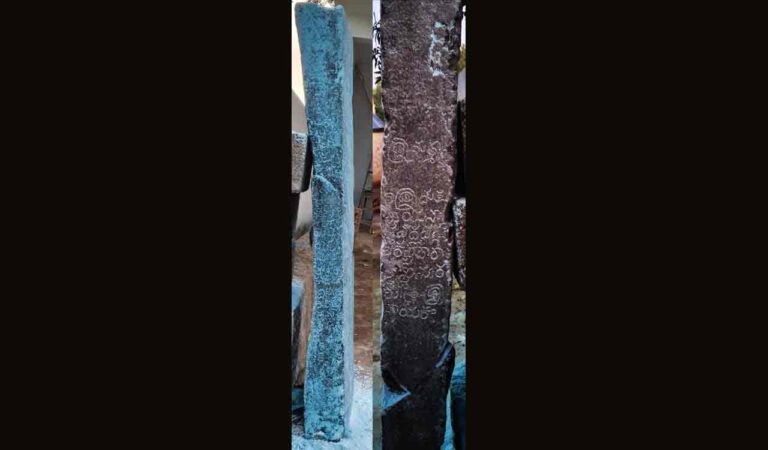
Hyderabad: An undeciphered inscription in a Shiva temple in Kothakota in Wanaparthy district, has identified and documented by Kotha Telangana Charitra Brundam research members Byrozu Chandrashekhar, Dr. Byrozu Shyam Sunder, Hanumanagari Vema Reddy, and Pandrapraggada Rama Rao.
Inside, the temple has a Shiva Linga with a Kakatiya-style flat top along with a Nandi carved in the Chalukya style, Ganapati rendered in Chalukya style with two arms and an image of Hanuman with a tuft of hair in Bhakta Anjaneya posture, characteristic of the 16th-century style.
The inscribed pillar in the temple courtyard is fractured diagonally across its middle section. The script visible on it is 12th-century Telugannada (transitional Telugu-Kannada), and the language is Kannada.
The phrase “Tribhuvanamalla Deva” appears on the pillar, confirming that this epigraph belongs to the reign of the Kalyana Chalukya emperor Vikramaditya VI (Tribhuvanamalla Deva).
Sriramoju Haragopal, President of Kotha Telangana Charitra Brundam, deciphered and interpreted the text, providing details of the inscription.
According to him, the first face records that during the reign of the jewel of the Satyashraya family and ornament of the Chalukyas, Tribhuvanamalladeva Vikramaditya VI, Kalabolaviranolaba Malladesaraddi washed the feet of Kadiraja, an ascetic/priest and donated 3 mattars of wetland in Singanagadanakolalu. This inscription can be definitively dated to May 22, 1118 CE.
The text on the second face is worn and eroded but the name of “Rameshwara Pandita” and a mention of solar eclipse can be identified.
The third face indicates that a chieftain named Sri Nayaka made a land grant through the ritual libation of water after ceremonially washing someone’s feet.
This content is published by Telangana Today and has not been created or edited by Hello Headlines. View original