SDG Goals In Education: Big Challenge Before India
The Sustainable Development Goals (SDGs), adopted by the United
Nations in 2015, represent a global commitment to build a more
equitable, prosperous, and sustainable world by 2030. Among the
seventeen goals, SDG 4 (Quality Education) and SDG 8 (Decent Work
and Economic Growth) are closely interconnected. Quality education
creates skilled and responsible citizens, while decent employment
transforms educational achievements into economic prosperity. For a
country like India, with the world's largest youth population, the
successful realization of these two goals will determine not only national
development but also global progress.
As the world enters the final phase of the 2030 Agenda, an important
question arises: Where does India stand today? The answer is
encouraging in many respects, but it also highlights several areas
requiring urgent attention.
Progress Towards SDG 4: Quality Education:
SDG 4 aims to "ensure inclusive and equitable quality education and
promote lifelong learning opportunities for all." No doubt, India has made
good strides in expanding access to education over the last decade.
The implementation of the National Education Policy NEP 2020 has
provided a comprehensive roadmap for educational transformation. The
policy emphasizes holistic learning, multidisciplinary education, digital
technologies, vocational education, foundational literacy, targets for
bringing dropouts back into the system, and flexibility in higher
education. These reforms align closely with the objectives of SDG 4.
India has achieved significant improvements in school enrolment.
According to recent government data, more than twenty-four crore
students are enrolled in schools. Dropout rates at the elementary level
have declined considerably, while transition rates between different
stages of schooling have improved. Higher education enrolment has
also increased substantially, rising from about 3.4 crore students in
2014-15 to nearly 4.5 crore in 2023-24, with the Gross Enrolment Ratio
(GER) reaching around 30%.
Infrastructure in schools has also witnessed impressive improvement. A
large majority of schools now have electricity, drinking water, sanitation
facilities, and trained teachers. Internet connectivity and availability of
computers have expanded significantly, although considerable regional
disparities remain.
Teacher training has improved as well. More than 90% of primary school
teachers now possess the required professional qualifications,
contributing to better classroom practices. Gender parity has also
improved, particularly in higher education, where female participation
has increased steadily.
Persistent Challenges in Education:
Despite these achievements, India still faces several obstacles before
SDG 4 can be fully realized.
The most significant concern is “learning outcomes.” Increased
enrolment does not necessarily translate into quality learning. National
and international assessments continue to show that many students
struggle with foundational reading, writing, and mathematical skills.
Learning losses resulting from the COVID-19 pandemic have further
widened educational inequalities.
Regional disparities remain substantial. Educational outcomes vary
considerably across states, districts, and between rural and urban areas.
Children from disadvantaged socio-economic backgrounds, tribal
communities, migrant families, and children with disabilities continue to
face barriers to quality education.
The digital divide presents another challenge. Although digital education
has expanded rapidly, access to reliable internet, computers, and digital
devices remains uneven, especially in rural India. Technology can bridge
educational gaps only when equitable access is ensured.
Higher education also faces issues relating to quality, employability,
research output, faculty development, and international competitiveness.
While enrolment has increased, ensuring excellence remains an ongoing
challenge. Further, gross enrolment ratio (GER) remains low compared
to many other countries of the world.
Progress Towards SDG 8: Decent Work and Economic Growth:
SDG 8 seeks to promote sustained economic growth, productive
employment, entrepreneurship, innovation, and decent work for all.
India's economy has demonstrated remarkable resilience and continues
to rank among the fastest-growing major economies. Now India ranks
sixth largest economy in the world. Economic reforms, digital
transformation, startup promotion, infrastructure development, and
manufacturing initiatives have generated new opportunities across
sectors.
The Startup India initiative, Digital India, Skill India Mission, Make in
India, and PM Vishwakarma Scheme have collectively strengthened
entrepreneurship and skill development. India has emerged as one of
the world's largest startup ecosystems, generating employment
opportunities in technology, healthcare, fintech, education, logistics, and
renewable energy.
The labour market has shown improvement in several indicators.
Financial inclusion has expanded dramatically through Jan Dhan
accounts, digital payments, and broader banking access.
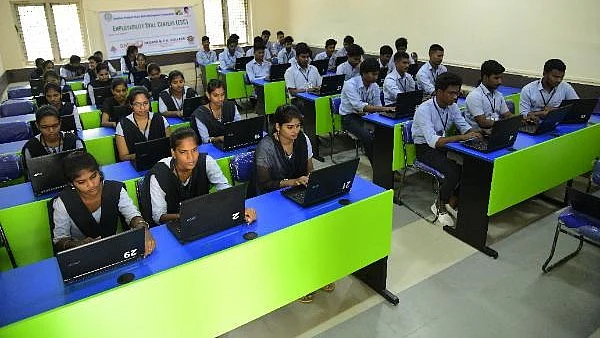
Skill development has become a national priority. Numerous vocational
education and apprenticeship programmes aim to prepare young people
for emerging industries, particularly those driven by artificial intelligence,
automation, green technologies, and digital services.
Challenges Before SDG 8:
Despite strong economic growth, employment generation remains one of
India's biggest developmental challenges.
A significant proportion of India's workforce continues to be employed in
the informal sector, where wages, social security, healthcare, and job
protection remain inadequate. Many workers continue to experience
underemployment rather than productive employment.
Graduate unemployment/underemployment and skill mismatch remain
major concerns. Thousands of educated young people complete
degrees every year but often lack industry-relevant competencies.
Employers frequently report shortages of job-ready graduates despite
large numbers of degree holders. The proportion of NEET (neither in
education, employment, nor training) is significant, showing a concerning
trend.
Women's labour force participation, although improving, remains below
global averages. Greater inclusion of women in formal employment
would substantially strengthen India's economic growth.
Rapid technological advancement also presents new challenges.
Artificial intelligence and automation are transforming labour markets,
requiring continuous reskilling and lifelong learning. Educational
institutions must therefore move beyond traditional teaching and prepare
learners with critical thinking, creativity, communication, adaptability, and
digital competencies.
The Strong Link Between SDG 4 and SDG 8:
SDG 4 and SDG 8 cannot be viewed independently. High-quality
education is meaningful only when it leads to productive employment,
innovation, entrepreneurship, and responsible citizenship.
The National Education Policy rightly emphasizes multidisciplinary
learning, experiential education, on-the-job training, internships,
vocational exposure, entrepreneurship, and industry collaboration.
However, stronger partnerships between higher education institutions
and industry remain essential. Curriculum revision must become more
dynamic, ensuring graduates possess both technical expertise and
essential soft skills.
Faculty members also need continuous professional development so
that they can effectively integrate digital technologies, artificial
intelligence, research, innovation, and problem-solving into teaching.
The Road Ahead:
India has undoubtedly made impressive progress towards achieving
SDG 4 and SDG 8. Educational access has expanded significantly,
infrastructure has improved, gender gaps are narrowing, and economic
opportunities have grown. Yet the journey from “access to excellence,”
and from “employment to meaningful employment,” remains incomplete.
Over the next five years, India's priorities should include improving
learning outcomes, reducing regional inequalities, strengthening teacher
education, expanding digital inclusion, increasing investment in
research, enhancing employability, promoting lifelong learning, and
creating sustainable, high-quality jobs.
The success of SDG 4 and SDG 8 will ultimately depend not merely on
government policies but on the collective efforts of educational
institutions, industry, civil society, teachers, and learners themselves.
However, government’s investment must also go up from the current
state.
As India moves towards becoming a developed nation under the vision
of Viksit Bharat 2047, achieving quality education and decent
employment for every citizen is not merely an “international
commitment”, it is also a “national necessity”. If India succeeds in
transforming its demographic advantage into human capital through
education and productive employment, it will not only achieve the
Sustainable Development Goals but also emerge as a global leader in
inclusive and sustainable development. It is time, policymakers,
decision-makers at all levels and citizens should move forward in
complete unison. There lies the future of India.
This content is published by Free Press Journal and has not been created or edited by Hello Headlines. View original