Beyond the cloud: Why businesses are turning to on-device AI
AI tools have made it easier for businesses to analyze documents, generate content, and automate tasks. But how much do companies know about where the data they enter into these tools goes?
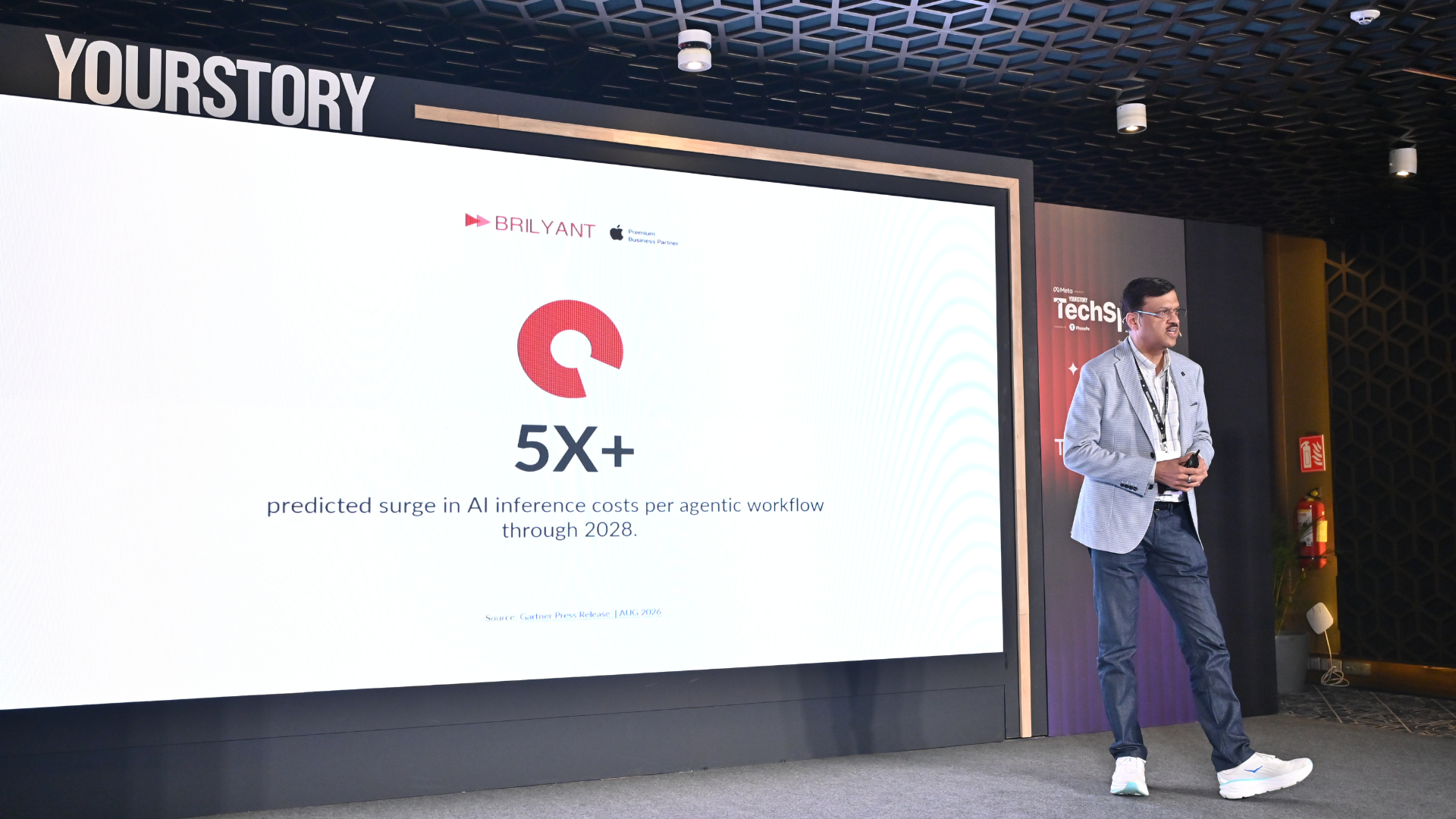
At TechSparks 2026, Akash Saxenaa, CEO of Brilyant, discussed why businesses should consider moving routine AI workloads from the cloud to local devices. He argued that on-device AI can help organizations manage costs, protect data, and reduce their dependence on internet connectivity.
The costs of taking AI to the cloud
The economics of AI are changing. While the cost of individual tokens may be falling, Saxenaa pointed out that inference costs could rise as businesses deploy more AI agents and consume more tokens. Citing Gartner, he referred to predictions that inference costs could increase more than fivefold.
Cost is only one concern. When employees use cloud-based AI tools, sensitive business information may leave the organization’s own environment. This raises questions about data privacy, intellectual property protection, and compliance with data protection requirements.
Saxenaa cited India's Digital Personal Data Protection (DPDP) Act as another reason for businesses to review their AI infrastructure.
“If you look at 83% of Indian enterprises, they have not yet begun comprehensive DPDP implementations, or they are not even aware. What is the cost? Rs 250 crore. Now, if you are a large company, 5,000 employees, that’s a budget line. But if you are an SMB, that's a company,” he said.
For smaller businesses, in particular, the financial consequences of non-compliance could be significant.
Saxenaa’s recommendation is to bring the model to the data rather than take the data to the model.
Not every task requires a frontier model
Saxenaa compared cloud-based AI tools such as ChatGPT, Gemini, and Claude with on-device AI, where models run locally.
Cloud-based tools can involve recurring input and output token costs, latency, and less direct control over where data is processed. On-device AI, by contrast, can operate without an internet connection and does not incur recurring token charges for local inference.
“Almost 60-70% of your workload can move on to on-device. But the balance 30%, you will have to use large, complex, latest front-end AI models," Saxenaa said.
He stressed that the two approaches are not mutually exclusive. Businesses can use larger cloud-based models for complex tasks while moving suitable everyday workloads to local devices.
On-device AI: From the office to the factory floor
Saxenaa outlined several areas where businesses could use on-device AI, including endpoint security, support operations, internal search, and finance.
“There are these beautiful use cases out there for on-device: you look at endpoint security or support operations. All those things can be done on-device. You look at finance, local rack, internal search, finance, operations. Everything can be done on-device,” he said.
For software development teams, keeping code on local devices can reduce the risk of intellectual property being exposed through cloud-based tools.
In contact centers, on-device AI can support real-time call translation, note-taking, and product recommendations. These functions can operate locally, reducing dependence on network connectivity.
Saxenaa also highlighted devices equipped with neural processing units (NPUs), which allow AI models to run locally. This can help reduce recurring cloud costs while supporting data governance and operational resilience.
During his keynote, Saxenaa presented a case study involving Tech Paramount Solutions to show how on-device AI could be used in an industrial setting.
The company’s TP Smart Sol platform combines visitor and vehicle management, asset management, energy monitoring, surveillance, and workforce management.
With Brilyant's support, Tech Paramount Solutions explored using Apple's Mac mini as an edge-computing device to process video analytics locally, while keeping its platform connected to the cloud for alerts, dashboards, and remote access.
The setup can process live AI video analytics from around 100 on-premise cameras.
Tech Paramount Solutions' co-founder shared that deployment reduced annual security overhead by more than Rs 12 lakh, cut lifetime compute costs by over Rs 11 lakh per Mac mini compared with comparable GPU-based options, and increased factory machine uptime by more than 240 hours a month.
Making on-device AI work at scale
Moving AI workloads to local devices involves more than installing a model. Businesses also need to consider device management, security, governance, and the infrastructure required to support large-scale deployments.
Saxenaa explained how Brilyant works with partners including Apple and Jamf to provide device provisioning, AI setup, and lifecycle management. Leasing and financing options can help businesses spread the upfront cost of devices over time.
For organizations managing hundreds of laptops, Brilyant also offers containerized runtimes and governance measures designed to keep data within controlled environments.
The larger challenge is deciding which AI workloads should run locally, which require cloud-based models, and how to manage data and devices across an organization.
On-device AI will not eliminate the need for the cloud. However, as more capable models become available for local hardware, businesses have more options to balance cost, privacy, and performance.
For Saxenaa, the shift is not about using AI everywhere in the same way, but deciding where workloads should run and where business data should remain.
This content is published by YourStory and has not been created or edited by Hello Headlines. View original