A Premature Birth, 35 Lakh in Medical Bills & Months of Care: How This Bengaluru Baby Pulled Through
There was a time when Gouthami Ravi and Sharan Kulkarni would have given anything to hear their daughter cry.
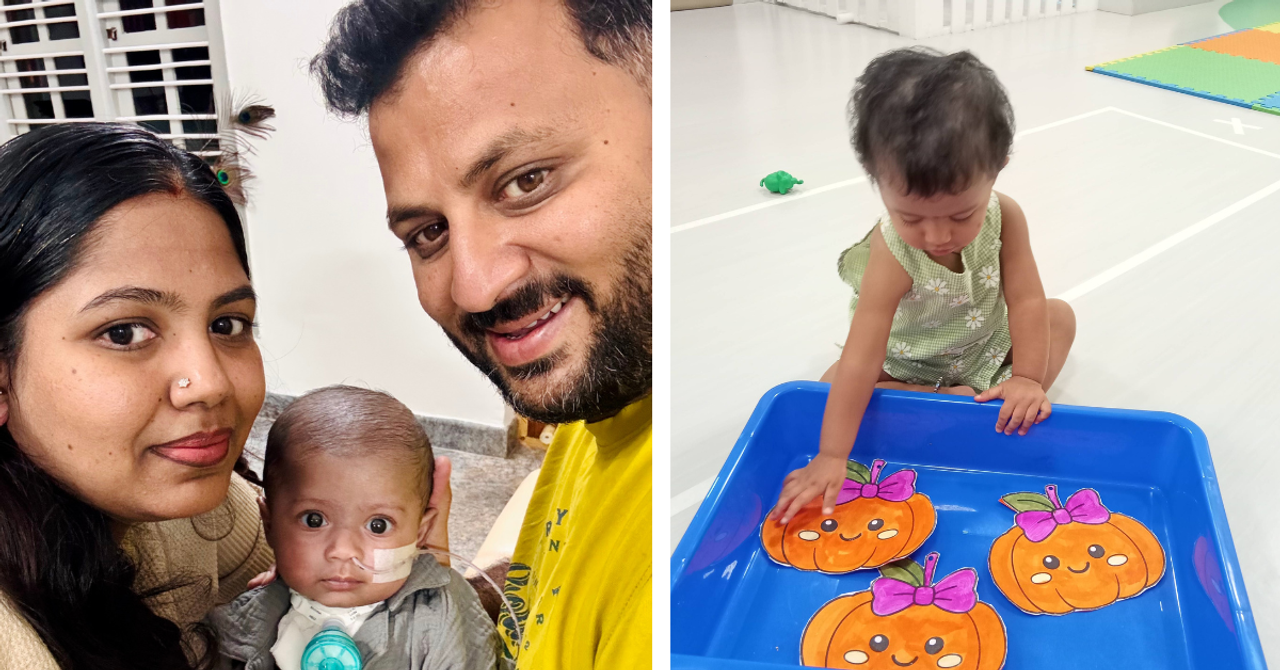
Today, in their Bengaluru home, one-year-old Chikoo fills their days with little sounds, playful movements and the curiosity of a child discovering the world around her. She plays on the bed, makes her presence felt and gives her parents the kind of ordinary moments they once could only hope for.
For months, they had watched over her breathing, learnt to manage medical equipment, and prepared for emergencies. A tracheostomy tube in her throat meant they could no longer hear her cry. Their home had become a medical care unit, and every day revolved around keeping their little girl safe.
On 10 March 2026, after months of treatment, Chikoo’s tracheostomy was finally removed.
Sharan remembers that even before the procedure, he had held on to a belief that his daughter would survive. “We were not in a dilemma that it was 50-50 always. It was always 100%. She’s going to survive,” he says.
That conviction carried the couple through a premature birth, frightening medical emergencies and months of round-the-clock care. But their experience also left them with a desire to help other families facing a similar journey.

When Chikoo needed a tracheostomy at barely a month old, they searched online for Indian parents who had been through the same experience. They found very little that could prepare them for what lay ahead.
“I am so alone in this journey,” Sharan remembers feeling.
Today, Gouthami and Sharan want to make sure other parents facing a similar situation do not have to navigate it without guidance. They are open to speaking directly with families whose children may need a tracheostomy, sharing what they learnt through Chikoo's treatment and helping them understand what to expect.
This includes practical guidance on questions to ask doctors, preparing a home for a child with a tracheostomy, learning tube changes and understanding how to respond to emergencies. They also want to be open about the medical, emotional and financial demands of long-term care, so families have a clearer picture of what lies ahead.
While every child's medical needs are different and decisions must be made with the treating doctors, Gouthami and Sharan hope that sharing their experience can help another family feel less alone and better prepared.
A premature birth, followed by an unexpected crisis
Chikoo was born on 2 September 2025, seven weeks before her expected due date. Weighing just 2.05 kg, she needed breathing support and was moved to a neonatal intensive care unit (NICU) soon after birth. A stomach infection added to her early medical challenges.
After around 15 days of treatment, she was discharged. Her parents brought her home, believing that the difficult beginning was behind them.
“We thought it was the same way,” Gouthami recalls, explaining how they assumed their daughter had recovered as many babies do after a NICU stay.
They began settling into the routines of caring for a newborn: feeding, bathing, and looking after their little girl. Then, about a month into her life, something frightening happened.
During a feed, Chikoo began choking. Her skin turned blue, and she became unresponsive. Gouthami, who knew CPR, tried to help her while the family rushed to the hospital. Chikoo eventually began breathing again, and her oxygen levels appeared normal when they arrived.
The family was sent home, with the episode attributed to a feeding issue.
But when the same thing happened again about a week later, Gouthami and Sharan knew something was wrong. This time, Chikoo’s oxygen levels began falling, and she needed sustained respiratory support.

Further investigations revealed a combination of airway conditions, including laryngomalacia, a laryngeal cleft and tongue-base obstruction. Together, these were affecting her ability to coordinate feeding and breathing safely.
The couple had entered a world of medical terminology, hospital admissions and decisions they had never imagined making for their newborn.
The decision that changed everything
As they began navigating unfamiliar diagnoses and difficult treatment decisions, the family relied on the guidance of their medical team. Gouthami and Sharan are grateful to Dr Sudheer K A, Dr Srikanta J T, Dr Antony George and Dr Priyanka Potti, Dr Vikas Satwik and Dr Sneha Lingappa, and Dr Shwetha Anand Baratikke from the pulmonary, paediatric, and gynaecology departments.
The family credits the doctors involved in Chikoo’s care for helping them navigate a period filled with uncertainty and decisions they had never expected to make.

As Chikoo continued to need breathing support, doctors recommended a tracheostomy, a procedure in which an opening is made in the neck to provide an airway through a tube.
For a baby barely a month old, it was an overwhelming prospect.
The first attempt was unsuccessful. The family had already been through the fear of watching their daughter struggle to breathe and the weight of agreeing to a major procedure. Now, they had to find the strength to try again.
The second tracheostomy, performed in October 2025, was successful. But the procedure was only the beginning of another demanding phase.
Chikoo needed time to recover and gradually come off the ventilator and oxygen support. Her parents spent weeks waiting outside the NICU, looking for updates and hoping that each day would bring progress.
“Emotionally, we were too down,” Gouthami says, describing what the family went through.

They were also thinking about Chikoo’s future. Gouthami wanted to understand whether her daughter would be able to develop and live as other children did. The family sought medical assessments, including checks on her neurological responses, and held on to the reassurance that these results offered.
For Sharan, the answer was to keep believing in his daughter, even when the outcome was uncertain.
“I never asked God for anything else,” he says, describing how he imagined a future in which Chikoo would grow up and experience life beyond the hospital.
That belief did not make the difficult days disappear. It gave them something to hold on to as they navigated one decision at a time.
When home became a medical care unit
After months of hospital care, Chikoo was eventually able to return home with her tracheostomy in place. But bringing her home did not mean returning to normal life.
The family had to prepare their house for her medical needs, arranging equipment such as a suction machine, a pulse oximeter and a feeding pump. They also changed their daily routines to reduce potential irritants in the air.

For months, they avoided lighting incense and made special arrangements for cooking. Nurses cared for Chikoo in shifts, with a dedicated space arranged for them at home.
Yet Gouthami and Sharan knew that professional help could not always be immediately available. They therefore underwent practical training to learn how to care for the tracheostomy and respond to emergencies.
“We had a booklet given. We had to read through that, do the Google research and go back the next day and explain what it is about,” Gouthami recalls.
The training lasted around 20 days. They learnt the procedures, familiarised themselves with the equipment and prepared themselves to manage situations that could arise at home.
Learning to care for Chikoo at home also meant learning to trust their own hands while knowing when to seek medical help. The couple remains grateful to the medical team for guiding them through the practical aspects of her care and helping them prepare for emergencies.
Their home nurses, Amina Ajusha and Aditya Sivadas, were also part of the support system that helped the family manage Chikoo’s daily needs.
Every 15 days, the family travelled back to the hospital for a tracheostomy tube change, carrying the equipment Chikoo depended on. They also had to learn how to perform the change themselves under medical supervision, knowing that they might need to act in an emergency.

Work had to find its place around these responsibilities. Gouthami was able to draw on maternity leave, while Sharan reorganised his business so that much of his work could be managed from home. His team supported him, allowing him to attend to his daughter while keeping the business running.
The couple also leaned heavily on their families.
“The need for having parents at home is extremely important,” Sharan says. “Even today, without them, we cannot stay at home even one day.”
Gouthami credits her employer, SAP, for supporting her through this period.
“SAP stood by me like family. The medical insurance and mental-health support gave me the confidence to make financial decisions for my daughter’s care. I am endlessly thankful to my company for being there for me when I needed that support the most,” she says.
The financial demands of Chikoo's treatment were considerable. From her hospital care and medical procedures to the home-care arrangements she needed until her tracheostomy was removed, the family spent approximately Rs 35 lakh. Insurance covered only a part of the total expense, leaving them to manage the remaining costs alongside the demands of her care.
The day they heard her voice again
For months, Chikoo's parents had been unable to hear her cry with the tracheostomy in place.
Before the tube could be removed, she underwent a series of carefully monitored steps, including a speech-valve trial and a capping trial to assess her ability to breathe through her nose and mouth.

The process required patience. Chikoo did not immediately tolerate every step, and there were moments when the family had to wait longer than expected. Rather than rushing, they followed the medical team's guidance and gave her the time she needed.
Then came a moment they had been waiting for.
“When we were cleaning the tracheostomy, she started crying, and we could hear her voice,” Sharan recalls.
It was a sound that meant far more than words could express. The family and the nurses who had cared for Chikoo were moved to tears.
After the trials and necessary medical assessments, her tracheostomy was permanently removed on 10 March 2026.
Sharan remembers that no words could describe the moment. They went to the doctor and thanked the medical team.
Looking back, he says, “It is not about being right here. It is about taking the next step.”

Today, watching Chikoo play, vocalise, and grow, they can see how far she has come. She now goes to daycare, where she spends her days surrounded by bright toys, new little friends and plenty of activity. While a few developmental milestones are still catching up, her parents describe her as curious, energetic, and full of life.
The medical equipment and routines that once dominated their lives no longer define every moment of their daughter's day.
If you are a parent looking to connect with Gouthami and Sharan, you can reach out to The Better India team for their contact details or connect with them directly through their Instagram accounts.
All images courtesy of Gouthami and Sharan.This content is published by The Better India and has not been created or edited by Hello Headlines. View original