Rewind: Fighting the drought—the reality of Telangana’s agricultural crisis
By Dr Ramesh Chennamaneni
In June 2026, based on climate models and meteorological alerts, national and international organisations, including the Indo-German Project Group, explicitly warned that a developing El Niño would trigger an acute agricultural crisis in Telangana. Predictions pointed to an extremely weak monsoon onset, severe precipitation collapses in August and September, intense downpours instead of steady rain, and prolonged heatwaves. Crucially, drought in the upstream catchment areas of Karnataka and Maharashtra has now halted inflows into key reservoirs like Srisailam and Nagarjunasagar, threatening both irrigation and drinking water supplies.
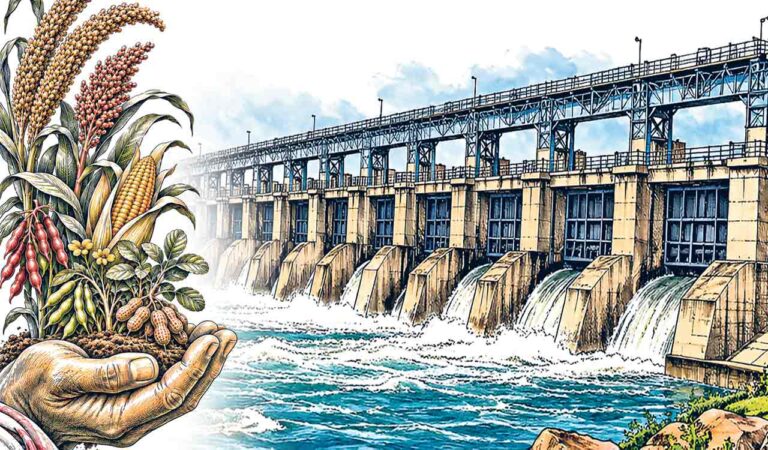
While the Kaleshwaram Lift Irrigation Project (KLIP) was designed to act as a structural shield against such deficits by pumping Godavari floodwaters into interconnected reservoirs like Mallanna Sagar, severe delays in essential repairs have left the network unable to mitigate these dry spells or replenish plunging water tables. Today, Telangana’s rural economy directly confronts these forecast realities.
Though the State government has responded by seeking central assistance, prioritising domestic water supply, and utilising digital platforms such as Rythu Nestham and Rythu Vedikas to promote crop diversification, these measures require critical scrutiny. Reliance on top-down, voluntary persuasion fails because it transfers the entire economic risk onto farmers without structural safety nets. To build genuine confidence, the state must move past empty directives and implement a legally backed, risk-insulated framework alongside a community-driven production strategy.
Failure of Persuasion
State-sponsored advisories and awareness seminars fail in the fields because they operate within a severe policy asymmetry. Asking farmers to switch crops without structural guarantees shifts all the financial and operational risks onto individual cultivators. Paddy remains the default choice for rural communities because a highly functional, predictable ecosystem of a Minimum Support Price (MSP) and assured state procurement supports it.
Telling farmers to cultivate oilseeds or pulses without providing upfront, soil-specific inputs or price guarantees forces them into volatile open markets where private traders can manipulate prices. Consequently, Rythu Vedikas are currently being used as platforms for top-down advisories rather than delivery mechanisms for localised economic support. True climate resilience requires the state to absorb the financial risk of transition through a Mandal-Wise Decentralised Alternative Production Package (MDAPP).
Agro-ecological Mapping
The implementation of MDAPP moves away from blanket, state-wide agricultural directives. Instead, it establishes a strict micro-regional framework that pairs localised soil taxonomy with real-time groundwater aquifer data to determine specific crop mandates. The Department of Agriculture, in coordination with the National Bureau of Soil Survey and Land Use Planning and the Ground Water Department, must classify all 621 mandals, prioritising the 365 officially declared drought-hit regions, into precise production zones.
- Zone A comprises deep black cotton soils (Regur) with over-exploited groundwater, predominantly in specific mandals of Adilabad, Nalgonda, and parts of Khammam. Despite their high soil water-retention capacity, these areas must impose a total ban on Yasangi paddy. This should be replaced with long-staple cotton intercropped with pigeon pea (red gram/Kandi) or Bengal gram (Sanagalu).
- Zone B consists of red sandy loams (Chalka) with critically low or dry water tables across vulnerable mandals in Mahabubnagar, Medak, and Rangareddy. The low moisture availability in these areas necessitates a shift to groundnut (Pallilu), castor (Amudalu), pearl millet (Bajra), and finger millet (Ragi), which thrive on minimal soil nutrient profiles.
- Finally, Zone C maps alluvial and medium loamy soils under major canal networks facing severe water-volume deficits in Nizamabad, Karimnagar, and Warangal. These regions must eliminate flood irrigation and shift towards safflower (Kusumalu), mustard, and green gram (Pesalu).
The physical delivery mechanism will involve upgrading soil health cards into digital MDAPP Smart Passbooks. Every landholding will be tagged with a mandatory crop code determined by its designated zone. If a farmer attempts to register paddy cultivation in a restricted zone through the state portal, the system blocks the registration while simultaneously unlocking alternative input-subsidy modules.
Financial Model
The primary barrier to crop diversification is the immediate liquidity crunch faced by small and marginal farmers when changing their cultivation patterns. MDAPP structurally alters the state’s direct benefit transfer (DBT) system to remove this friction by replacing flat-rate investment support with a dynamic, two-tier financial assistance framework where the total MDAPP payout will comprise the base Rythu Bharosa support plus a conditional Green Transition Bonus (GTB).
An additional, legally ring-fenced amount of Rs 3,000 per acre per season (GTB) will be released exclusively to farmers who completely shift from paddy to the mandated alternative crop grid assigned for their respective mandals. To prevent farmers from falling back on private moneylenders during the critical pre-sowing period, the payout timeline will be heavily front-loaded.
During the pre-sowing phase, 15 days before sowing, 60 per cent of the combined seasonal payout (Base Support plus an upfront Rs 1,800 per acre from the GTB) will be deposited directly into the farmer’s linked bank account. This will provide immediate cash for purchasing specialised seed and preparing the land. The remaining 40 per cent of the financial assistance will be released during the post-verification phase, 30 days after sowing, following crop verification through automated remote-sensing or physical confirmation by the local Agriculture Extension Officer.
Rythu Vedika Material Banks
Under MDAPP, the State’s more than 2,600 Rythu Vedikas will be upgraded from simple meeting spaces into responsive, localised logistics hubs delivering automated seed supplies and water technology. Through automated zero-cost seed banks, farmers will no longer need to purchase expensive alternative seeds from open markets and wait for subsequent reimbursement. Upon crop registration, each farmer will receive a digital, SMS-based seed voucher unique to their landholding, which can be redeemed directly at the local Rythu Vedika for 100 per cent subsidised, high-yielding, drought-resistant varieties developed by Professor Jayashankar Telangana State Agriculture University (PJTSAU).
Simultaneously, under the Micro-Irrigation Direct-Delivery (MIDD), alternative crops will be paired with precision irrigation facilities. Every farmer registered under MDAPP for an alternative crop will automatically qualify for an immediate 90 per cent subsidy on drip or sprinkler irrigation kits. Pre-vetted technical teams will be dispatched directly from the Rythu Vedika to install the hardware within 7 days of seed delivery, ensuring the systems are operational before the first watering cycle.
Buyback Guarantee
The final anchor of MDAPP eliminates market price volatility. Farmers will not grow pulses, millets, or oilseeds if they risk selling their harvest below production costs to private traders. The state must establish a dedicated, legally backed statutory body: the Telangana Alternative Crop Procurement Board (TACPB). Operating in coordination with MARKFED and HACA, the TACPB will have a clear mandate to absorb 100 per cent of the marketable volume of alternative crops through an incentivised pricing model.
Under the 120 per cent MSP Procurement Accord, the TACPB will be legally bound to purchase 100 per cent of the Fair Average Quality (FAQ) alternative crops brought to procurement centres at 120 per cent of the central MSP. The additional 20 per cent state-funded bonus will compensate for the lower physical yield typical of pulses and millets compared with paddy, thereby stabilising farmers’ gross seasonal revenue.
Through decentralised weighbridges, the physical yards surrounding the Rythu Vedikas will be converted into active procurement centres during harvest. By bypassing middlemen and commission agents, transactions will be recorded digitally, and the entire purchase amount will be credited directly to farmers’ linked bank accounts through DBT within 72 hours.
Community-led Adaptation
While MDAPP establishes the structural safety net, true climate adaptation requires a decentralised, community-led production model. By mobilising Farmer Producer Organisations (FPOs) and Primary Agricultural Credit Societies (PACS), rural communities can collectively transition into self-sustaining hubs for short-duration vegetables and dry-land crops to combat market inflation.
The need for community-led vegetable cultivation is driven by an ongoing crisis in consumer markets. As witnessed during recent, unprecedented price spikes in fine rice (Sanna Beeyyam), severe water scarcity can rapidly trigger inflation. When water-intensive paddy crops fail or are restricted, market supply crashes and food prices surge. Vegetables are equally vulnerable to these exact climate shocks.
By enabling FPOs and PACS to systematically cultivate short-duration, low-water-consuming vegetables such as cluster beans, green chillies, okra, and leafy greens, farmers can strengthen their own nutritional security and protect their households from soaring food prices. At the same time, commercial surpluses can be channelled into urban markets to capture premium retail prices.
To ensure farmers receive the full financial benefit of high vegetable prices, the traditional, exploitative supply chain dominated by commission agents must be entirely bypassed. PACS and FPOs will pool small, contiguous landholdings within vulnerable mandals to create dedicated vegetable production clusters equipped with shared precision drip systems.
The Department of Marketing must reserve dedicated, rent-free stalls and loading bays exclusively for registered FPOs and PACS at all major Rythu Bazars. FPOs will organise daily collective transportation to move aggregated vegetable yields from village Rythu Vedikas directly to urban Rythu Bazars overnight. This will ensure fresh deliveries and immediate, middleman-free cash flows back to rural communities.
Progress through long-term strategies
• Watershed management and enhanced dryland agriculture
Villages such as Kothapally and Gottigarpalli in Sangareddy district, Bendalapadu in erstwhile Khammam district, and Ramachandrapuram, Gambhiraopet, and Thimmapur in erstwhile Karimnagar district have successfully demonstrated that dryland agriculture can be highly profitable and sustainable, even in drought-prone zones, through effective watershed management.
By adopting the ‘Four Waters Concept’ (conserving rainwater, soil moisture, groundwater and traditional water resources) and leveraging community-driven public participation, these villages have significantly improved groundwater levels through the construction of check dams and contour trenches. Integrating the conservation of traditional water bodies with low-water alternative crop rotation practices has enabled these villages to secure stable yields despite severe deficit rainfall. Scaling these decentralised, community-backed success models across various districts offers a sustainable solution to future droughts.
• Climate resilience through digital technology
The Indo-German pilot project “Accelerating Climate-Resilient Agriculture in Telangana (ACRAT)”, implemented in the Vemulawada and Konaraopet regions of Rajanna Sircilla district, has delivered exceptional results in demonstrating how to build climate resilience and adaptive capacity against climate change.
Operating through Farmer Producer Organisations (FPOs) in pilot villages like Mangallapalli, Ramayyapeta, and Nagaram, artificial intelligence (AI) and digital tools such as ‘Weather X’ and ‘Trap Snap’ were deployed directly onto agricultural fields. This digital network empowered farmers to anticipate sudden weather shifts and adopt smart irrigation alongside solar precision agriculture. Within just two years, input costs plummeted, crops were insulated from extreme weather damage, and farmers achieved economic self-reliance. This climate resilience model—which earned international acclaim from scientists and peers at the Agri Technika 2025 expo in Hannover, Germany—can be systematically integrated into Telangana’s overarching agricultural development strategy.
The Way Forward
The Government of Telangana must shift from traditional, reactive drought relief measures toward proactive, climate-preventative strategies. To achieve this, the state administration must move beyond impractical rhetoric and boldly embrace the structural responsibilities inherent in agricultural transformation. In this context, the state government must accord the highest priority to the following:
- Statutory implementation of MDAPP and Green Bonus
Orders must be issued immediately to restructure ‘Rythu Bharosa’ funds into two tranches, including an upfront ‘Green Transition Bonus’ of Rs 3,000 per acre to incentivise climate-smart agriculture and provide financial security to farmers shifting away from water-intensive paddy.
- Restructuring Rythu Vedikas into digital hubs
Local Rythu Vedikas must be transformed from passive meeting halls into proactive ‘Farmer Material Banks’ that directly distribute climate-resilient seeds free of cost and provide micro-irrigation kits. Drawing on the success of the Sircilla-based Indo-German ‘ACRAT’ project, these centres must collaborate with FPOs to expand digital networks and deploy AI tools such as ‘Weather X’ and ‘Trap Snap’ to the grassroots level to systematically fortify climate resilience. - Establishment of Procurement Board
To aggressively encourage alternative crop cultivation, a 100 per cent procurement guarantee must be institutionalised at an incentive price of 120 per cent over the market rate; a dedicated Special Procurement Fund must be earmarked to insulate farmers from market fluctuations during extreme weather disruptions. - Cooperative vegetable corridor
The Marketing Department must allocate Free Commercial Space in all urban Rythu Bazars exclusively for FPOs and Primary Agricultural Credit Societies (PACS) to facilitate direct vegetable marketing and eliminate predatory intermediaries. - Expediting KLIP repairs and stabilising water resources
To secure permanent protection against future droughts, emergency repairs to KLIP and its interconnected reservoirs must be undertaken on a war footing to restore floodwater diversion and enable large-scale groundwater recharge. Simultaneously, decentralised public-participatory watershed management models — keeping Mission Kakatiya tanks as nucleus — must be expanded statewide to harmonise traditional water conservation practices with low-water-consuming crop alternatives.
(The author is a former legislator & former Advisor for agriculture)
This content is published by Telangana Today and has not been created or edited by Hello Headlines. View original