Yatra’s ‘MICE’ Problem
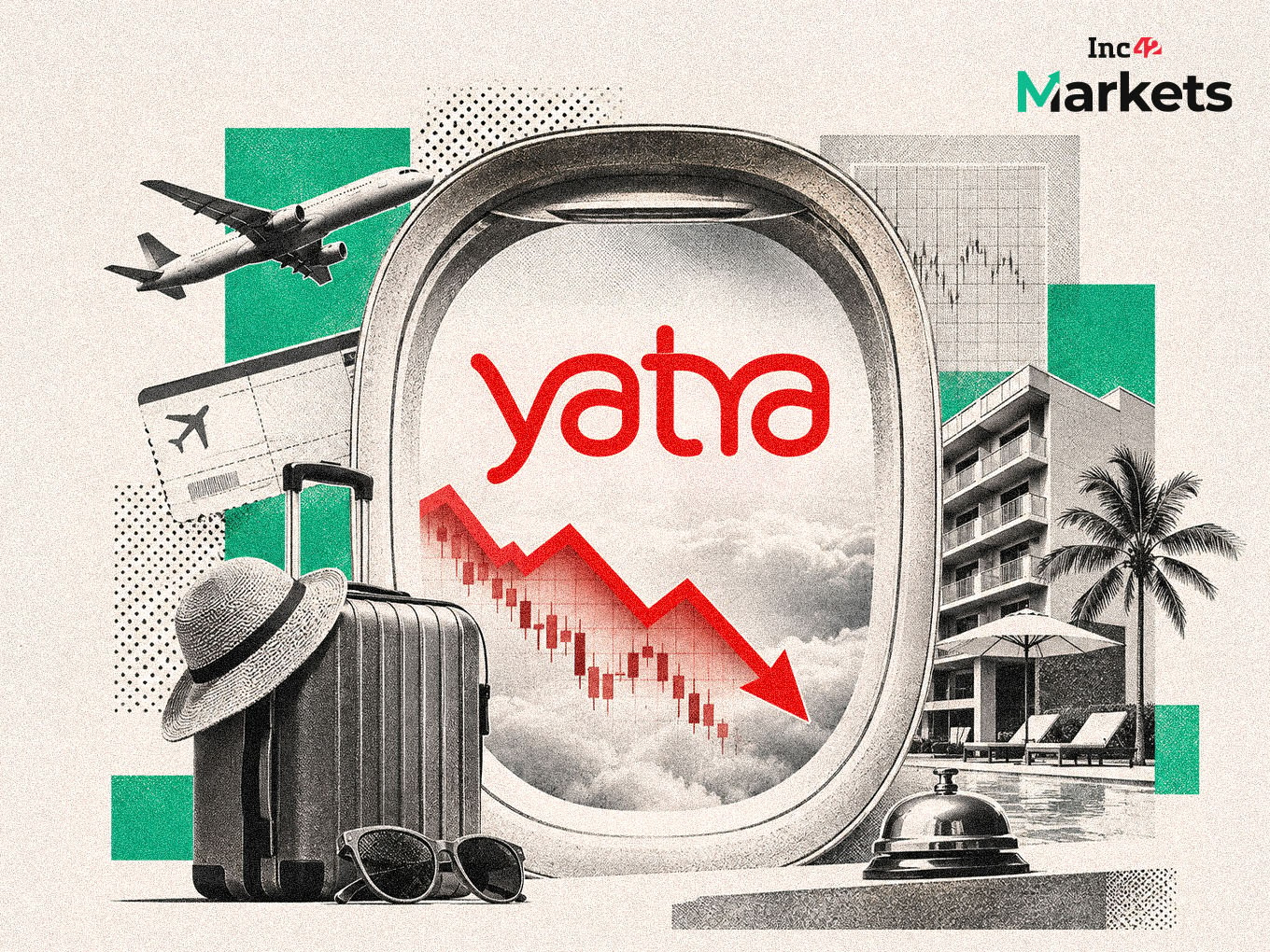
Bookings grew, but revenue shrank and profit disappeared. That was the paradox of Yatra in the September quarter, when India’s travel tech sector was expected to capture the momentum leading into the festive and holiday travel season.
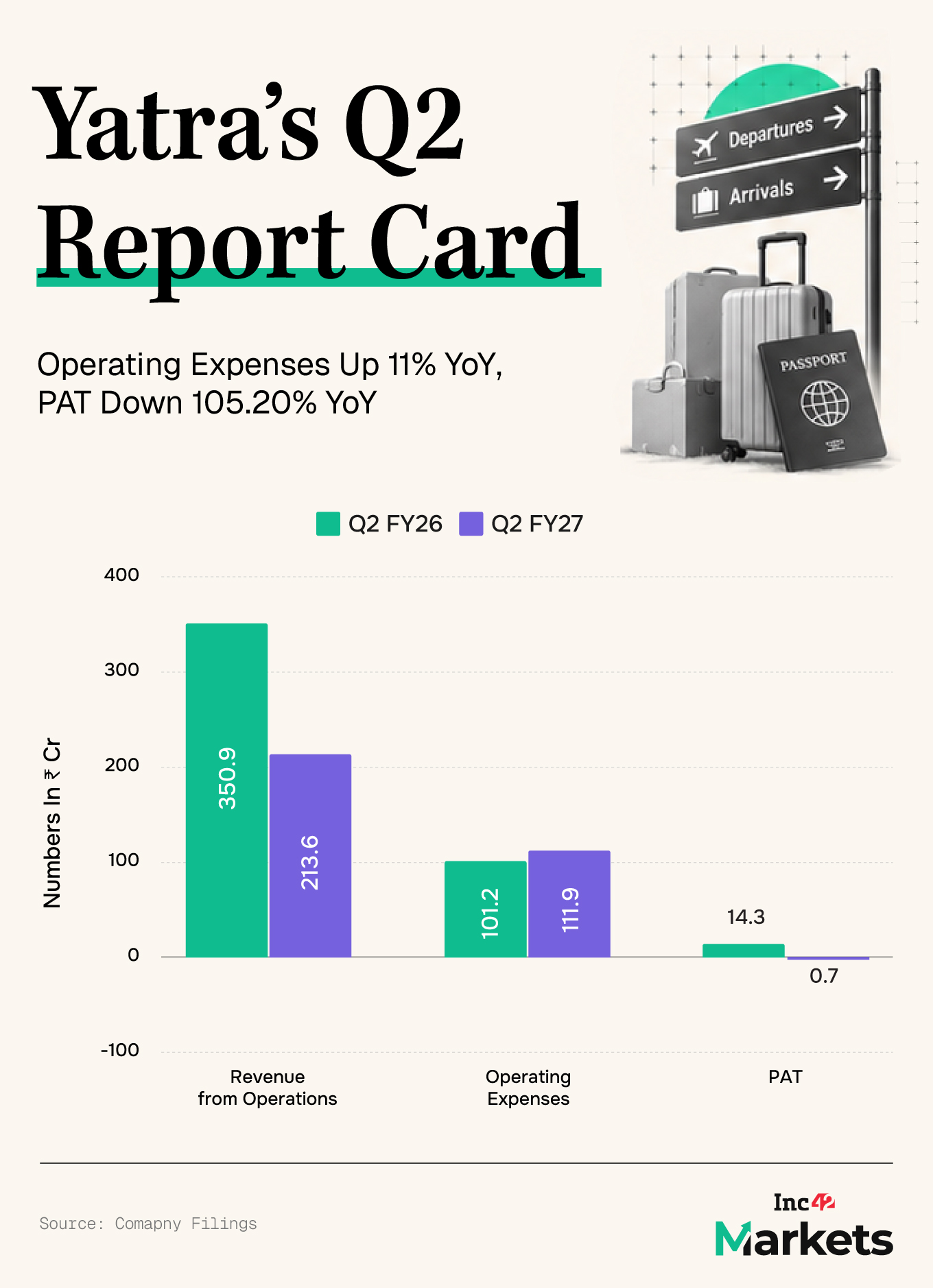
The listed travel tech company reported a consolidated net loss of ₹78.4 Lakh in Q2 FY27, against a net profit of ₹14.3 Cr in the year-ago period.
Revenue from operations declined 39.1% year-on-year (YoY) to ₹213.6 Cr, reflecting a slowdown in its ‘Meetings, Incentives, Conferences and Exhibitions’ (MICE) business, which has historically contributed meaningfully to its corporate travel operations.
Yatra’s results have come at a precarious time. Its US-listed parent, Yatra Online, has received a notice from the Nasdaq for failing to maintain the exchange’s minimum $1 closing bid-price requirement.
Separately, the Indian-listed entity’s shares have remained under pressure due to factors like earnings growth, business visibility and the ability to convert booking growth into profitability.
Interestingly, Yatra’s gross bookings rose 6% YoY to ₹2,165.5 Cr during the quarter, leaving the OTA grappling with a peculiar paradox: rising booking volumes but shrinking revenue and profitability.
So, why is Yatra struggling to make more money despite a growth in bookings? And is the MICE slowdown the only problem or is there more?
MICE Crushes Revenue Growth
At first glance, Yatra’s 39% revenue decline appears steep, particularly when compared with the growth reported by some of its online travel peers. Yatra attributed the revenue decline primarily to lower revenue from MICE, which is recognised on a gross basis.
For context, ixigo reported a 13% YoY increase in revenue from operations to ₹320.96 Cr in Q2 FY27, while its gross transaction value (GTV) grew 22%. Similarly, MakeMyTrip reported 11.2% revenue growth in constant currency to $232.5 Mn, with gross bookings rising 20.9%.
Yatra’s gross bookings, by comparison, grew only by 5.6% YoY to ₹2,165.5 Cr. Profitability also remained a concern. Adjusted EBITDA declined 41.2% YoY to ₹15 Cr, while the company reported a small net loss of ₹78 Lakh.
Pressure was visible across its business segments. Gross bookings from air ticketing business rose 15% to ₹1,700.6 Cr, while air gross margin rose 29% to ₹75.7 Cr and air ticketing adjusted margin improved by 20.8%. While standalone hotel gross bookings grew 20%, the losses in the hotels and packages business continued to drag down the gains from air ticketing.
The company’s H1 FY27 operating cash flow turned negative at ₹14.7 Cr, primarily because of a ₹48.8 Cr working capital deployment.
This is worth tracking alongside its reported profitability, particularly as the company continues to invest in technology and expand its corporate customer base. Yatra had cash, cash equivalents and term deposits of approximately ₹218 Cr at the end of September 2026.
Unlike consumer-facing travel platforms that rely heavily on consumer air ticketing, and hotels and holiday bookings, Yatra has a sizeable corporate travel business. It is also one of India’s largest managed corporate travel providers, with MICE driving these bookings. This should provide a relatively stable source of bookings compared to discretionary leisure travel.
During Q2 FY27, the company added 54 corporate customers, with an annual billable potential of ₹203.5 Cr. Corporate bookings grew 18% YoY and 10% sequentially, while 54% of existing corporate clients increased their spending.
Personal travel bookings by employees of corporate clients also increased 36% YoY, pointing to opportunities for cross-selling within its existing customer base. This is significant because corporate travel relationships can generate repeat bookings and provide access to a wider employee base.
Nasdaq’s Compliance Pressure
The earnings pressure is not the only issue confronting Yatra’s investors. On November 10, the US-listed parent of Yatra Online Ltd received a notification from Nasdaq’s listing qualifications department after its ordinary shares failed to maintain the minimum $1 closing bid price for the required period.
According to the notice, the company’s shares did not meet the minimum bid-price requirement between September 29 and November 9, 2026, under Nasdaq listing rules.
The company has been given 180 calendar days, i.e. until May 10, 2027, to get back in compliance. To do so, its shares must close at $1 or higher for at least 10 consecutive business days, or longer (generally up to 20 consecutive business days). This can be further extended by 180 days if Yatra fails to meet the compliance requirements, subject to other listing-related requirements.
But Yatra does run the risk of getting delisted in May next year if it fails on any of Nasdaq’s criteria.
A reverse stock split is among the options the company could consider to restore compliance. However, Yatra has cautioned that there is no assurance it will regain compliance or qualify for an additional period.
“The notice concerns the US-listed parent and should not be confused with a separate delisting warning for Yatra Online Ltd’s shares on the BSE and NSE. Nevertheless, the development adds to the pressure surrounding the broader Yatra group. Investors will take full context into the picture as its performance on the Indian stock market has also been very weak,” an analyst tracking travel stocks said.
Travel Stocks Tumble
Yatra’s stock performance is also part of a broader correction across India’s listed travel and travel tech companies. Most consumer-facing travel platforms have struggled to sustain their valuations in 2026.
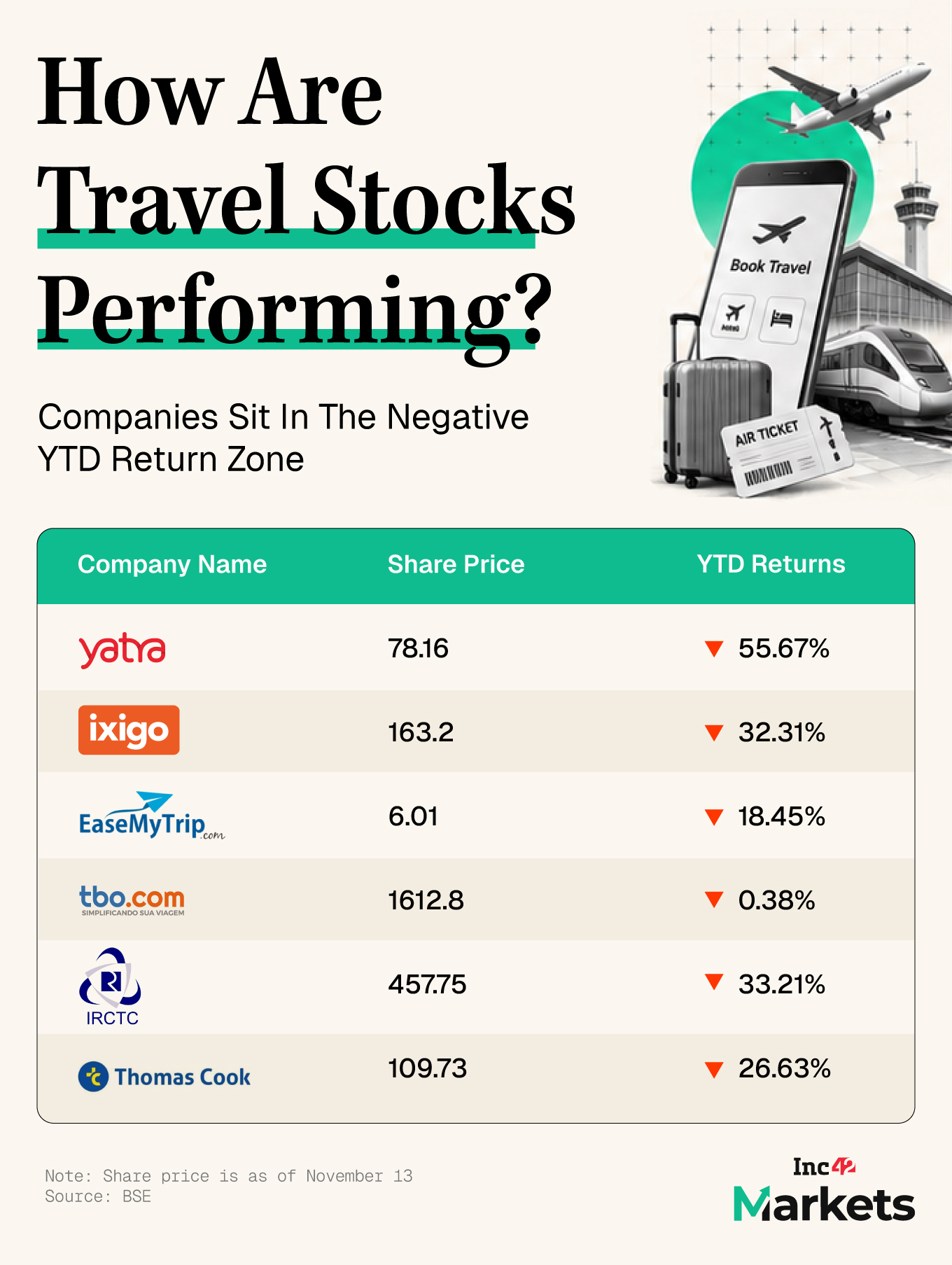
As of November 13, 2026, Yatra Online’s shares had declined approximately 56% year-to-date (YTD), making it one of the worst performers among listed travel tech companies. Its shares closed at ₹77.64 on the BSE on November 13, against a 52-week high of ₹201.85.
Le Travenues Technology, the parent of Ixigo, had fallen approximately 34% YTD, while Easy Trip Planners was down around 24%. Both companies have faced pressure on profitability and valuation concerns.
The correction extends to larger travel stocks as well. IRCTC has declined approximately 35% YTD, while Thomas Cook India is down around 25-29%, despite these businesses having considerable differences.
“The broader correction suggests that investors are becoming more selective about travel-related stocks. While India’s travel market continues to benefit from rising discretionary spending and online booking adoption, companies are being evaluated on their ability to sustain margins, improve monetisation and generate consistent earnings,” the analyst quoted above said.
What Could Fix Yatra
For Yatra, the next few quarters will be important in establishing whether the Q2 weakness was largely a temporary MICE-related disruption or indicative of more persistent pressure on its corporate travel business.
But there were some early signs of improvement in the MICE business which could bode well for the third quarter. For example, bookings recovered 37% sequentially as corporates began rescheduling programmes that had been deferred or scaled down. This, however, is yet to translate into a meaningful improvement in earnings.
Yatra is also betting on SME and mid-market customers, technology-led automation and expense management solutions to expand its addressable market.
However, investors will want to see these initiatives translate into better topline and operating leverage on the corporate travel and events front to shore up margins. The company will also need to demonstrate that it can manage corporate travel demand volatility with each passing season. For now, Yatra has a MICE problem but not a lot of solutions.
MARKETS WATCH: NEW ISSUES, POST-IPO JOURNEY & MORE
Wakefit Posts A Flat Q2 PAT: The listed mattress brand reported a nearly flat YoY net profit of ₹15.9 Cr in Q2 FY27, down 32% sequentially, as rising commodity prices, geopolitical disruptions and a challenging operating environment weighed on profitability.
Razorpay’s IPO: The fintech major has received SEBI’s observations on its draft IPO papers, clearing the way for Razorpay to proceed ahead with its proposed ₹5,000-6,000 Cr public issue. It is targeting a Q1 2027 listing at a valuation of ₹47,000 Cr.
SoftBank Dumps Meesho: The Japanese multinational investment holding company offloaded 7.6 Cr Meesho shares worth ₹1,885.2 Cr. Fidelity, Societe Generale, Morgan Stanley and domestic mutual funds picked up the stake.
Ola Electric’s Q2 Revenue Fall: The two-wheeler EV maker narrowed its net loss to ₹362 Cr in Q2 FY27, but operating revenue declined 39% YoY to ₹421 Cr amid continued pressure on its top line and sequential profitability.
[Edited by Shishir Parasher]
The post Yatra’s ‘MICE’ Problem appeared first on Inc42 Media.
This content is published by Inc42 and has not been created or edited by Hello Headlines. View original