Ola Electric hands the keys to dealers. What led to this shift in gears?
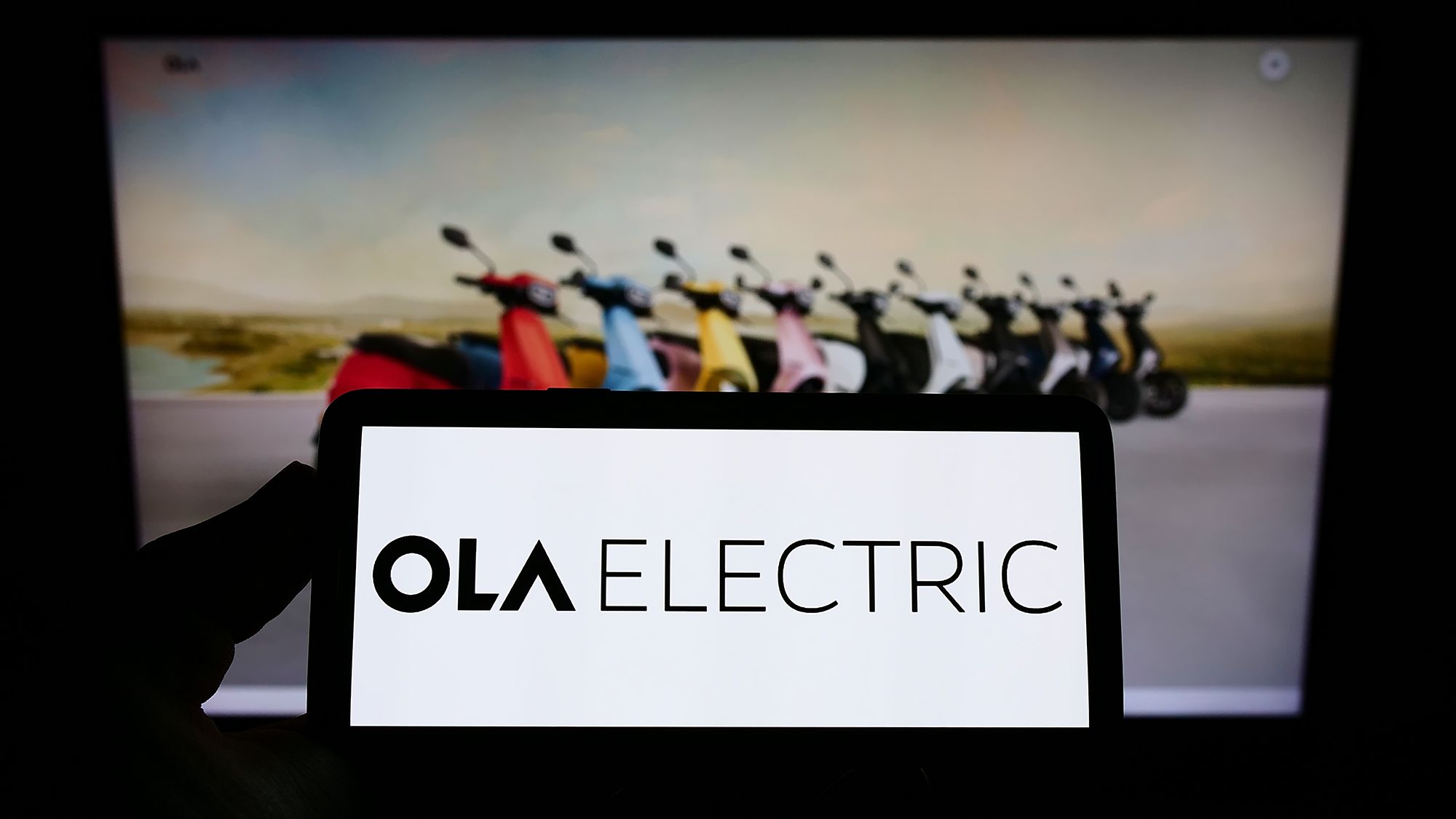
On November 1, Ola Electric stopped taking orders at its own outlets. Most of them will be shut by December, as Ola moves away from the direct-to-consumer model that defined the company and turns to a dealer-led business.
Ola has recorded this in its investor presentation filed with the NSE and BSE on November 12 under Regulation 30 of the SEBI Listing Regulations. The document covers the unaudited standalone and consolidated results for the second quarter and half-year ended September 30, 2026.
In its Q2 FY27 shareholders' letter, dated November 12, the company calls the move towards a dealer-led model a "reset". What prompted this 'reset'?
The numbers tell part of the story. Consolidated revenue from operations was Rs 828 crore in Q1 FY26. It fell to Rs 690 crore in Q2, then Rs 470 crore in the next quarter, and bottomed out at Rs 265 crore in Q4 FY26.
Interestingly, the electric two-wheeler market has been growing in recent times. In Q2 FY27, industry volumes reached 5,99,317 units, up 82.7% year on year, and EV penetration in the two-wheeler market touched 11.2%. However, Ola's Q2 revenue fell 39% to Rs 421 crore in FY27.
The service record behind the reset
The shareholders' letter says little about why the direct model had to go, but public records give an indication.
The problems began with service. Between September 2023 and August 2024, the maker of electric two-wheelers received 10,644 complaints through the National Consumer Helpline. Of these, 3,389 concerned service delays and 1,899 were about delayed deliveries, according to media reports.
On October 7, 2024 the Central Consumer Protection Authority (CCPA) issued a show-cause notice giving the company 15 days to respond, and the complaints it cited included charges during the free service period, refusals or delays in warranty work, and unsatisfactory repairs.
Ola's response was that 99.1% of the complaints had been resolved to the customer's complete satisfaction. But the regulator reportedly found that 80% of those claimed resolutions had not been implemented, and the CCPA widened its inquiry.
Founder Bhavish Aggarwal promised the backlog would clear soon, and said the company would double its own service network to 1,000 centres by December 2024. Around the same time, a public spat erupted between Aggarwal and the comedian Kunal Kamra, who had taken up the customers' service complaints.
Subsequently, the company-owned store network ran into another problem. In March 2025, Bloomberg reported that only about 100 of Ola's roughly 3,400 showrooms displayed the trade certificate that the Motor Vehicles Act requires. Ola called the report misplaced and prejudiced.
Transport officials raided at least 26 stores in Maharashtra and six in Madhya Pradesh and impounded 60 scooters. Maharashtra's transport minister later said that of 432 showrooms inspected in April 2025, only 47 held valid certificates, and that the other 385 were shut.
The shareholders' letter does not connect any of this to the move towards a dealer network.
A new front end, built in eight weeks
The first set of dealer outlets became operational on September 4, on Janmashtami. By Diwali, on November 8, Ola says it had appointed 255 dealer partners operating 319 sales stores. The company is planning about 450 stores by December 2026 and 700 by March 2027.
Volumes through the new channel have climbed quickly. Wholesale orders were 3,955 vehicles in September and 13,505 in October. Ola expects 16,000 in November and 20,000 in December. Production is meant to keep pace, from 9,235 vehicles in August and 14,092 in October to about 25,000 in December.
The case Ola makes for dealers is financial as much as commercial. Under the old model, the company carried the stores, the stock, and the working capital. Now, it says, dealers pay for vehicles when they order and hold the inventory in their own showrooms.
Auto borrowings have fallen from Rs 2,422 crore in December 2024 to Rs 337 crore in September 2026, helped by a QIP and rights issue, and the company expects the auto business to generate free cash flow in the near term.
Operating expenses are meant to fall by a further Rs 50 crore as the company-owned showrooms close.
What the letter does not hide
The letter is candid in places. Inventory in the dealer channel built up through October and November, and registrations were a little slower in October. Ola puts channel inventory at about 15 days, and under a week in the earliest stores. It says that in markets where dealers opened early and have settled in, its market share is now well above pre-transition levels, though the company doe not give any figure.
There is also a supply problem. About 5,000 vehicles with paid orders in September were delayed by a week, running into October, because chargers were unavailable. The company says it is facing a paid order backlog and the constraint is its supply chain, not its plant, which it says can build well above the current output.
Hence the letter's headline claim: demand is no longer the constraint, supply is. The claim deserves attention. Wholesale figures count vehicles sent to dealers, not vehicles sold to riders, and the letter admits slower registrations in October.
The margin trade
Dealers do not come free. Ola says gross margin, which held at about 29.9% in Q2, will dip a little in Q3 and Q4 because of the dealer rollout, while operating margin should improve meaningfully. Excluding PLI incentives, Q2 gross margin was 26.5%. Gross margin per unit was roughly Rs 35,000, against an average selling price of about Rs 1,21,000, down from about Rs 1,68,000 in FY23.
The losses remain large. Operating EBITDA was a loss of Rs 218 crore in Q2FY27, wider than Rs 165 crore in Q1, and the loss after tax was Rs 362 crore. Consolidated free cash flow was negative Rs 371 crore, with the auto segment accounting for Rs 134 crore of that and the cell business most of the rest. Total borrowings are down from Rs 3,132 crore to Rs 1,819 crore.
The product roadmap
Going forward, Ola is betting on two things to win customers back: a cheaper scooter and its own batteries.
The cheaper scooter is the S1Z, which is expected to be delivered to customers by March 2027. It uses a battery type that Ola says costs less to build. The company plans to fit the same battery to its existing models. It also says that, as dealers open, demand will shift towards its premium scooters and motorcycles.
The batteries come from Ola’s own factory, which has reached its first 6 gigawatt-hours of capacity ahead of schedule. The government has extended a production incentive for the plant to 2031, and Ola expects the payments to kick in from January to March.
According to the company, making its own batteries costs the same as buying them, if about 70% of those made pass quality checks, and 10 to 15% less if 85% of them pass checks.
What to watch out for
A company not only owns its product but also owns every complaint that comes with it. While dealers will now share that responsibility, Ola cannot simply wish away all issues with a reset. It has to address the structural challenges that led to the bottlenecks and delays.
The success of the transition hinges on three major factors.
The first is sell-through: whether registrations keep pace with wholesale dispatches as the dealer network grows from 319 stores to 700. The second is supply: whether production really reaches 25,000 a month, and whether suppliers and chargers keep up with it. The third test is margin: whether the cost savings from closing company stores outweigh the gross margin given up to dealers.
Ola has moved quickly, and the early numbers seem to be favourable. But they are the company's own, and they cover only a few weeks. The real proof will come in the Q3 results.
(Disclaimer: Shradha Sharma, Founder and CEO of YourStory, is an independent director at Ola Electric.)
Edited by Swetha Kannan
This content is published by YourStory and has not been created or edited by Hello Headlines. View original