From funding with own college fees to 1,000+ beds: how oho Living won Tier-2
Anyone who has moved to a new city for college or a first job knows the feeling. You arrive with a suitcase and an address you can barely find, and the room you are handed is bare. Nobody tells you where to buy groceries or whom to call when the geyser breaks. You figure it out alone.
In cities like Ranchi, Patna and Jaipur, the choice was usually between expensive premium housing and bare rooms with no standard at all. Students and young professionals who wanted a clean, well-run home at a fair price had nowhere to go, and landlords and young tenants rarely trusted each other.
oho Living was built to fill that gap. It now runs 1,032 beds across six cities, with one promise: to be the friend in the city for everyone who moves to one.
From listings to homes
Ritu Raj had tried to solve this once before. In college, he built GoForRooms, a website that helped students find a place to stay. It could point someone to a room, but it could not promise what living there would be like.
So when he started oho Living, paying for it with his college fees, the team chose to run the homes themselves. It began with a single property in Ranchi, run the way a friend would run it, and grew one property and one city at a time.
The model is simple. oho Living signs an agreement with a property owner, as a lease, a revenue share or a franchise, and takes full responsibility for the resident. The owner no longer manages tenants, and the resident no longer deals with an unpredictable landlord.
The founders
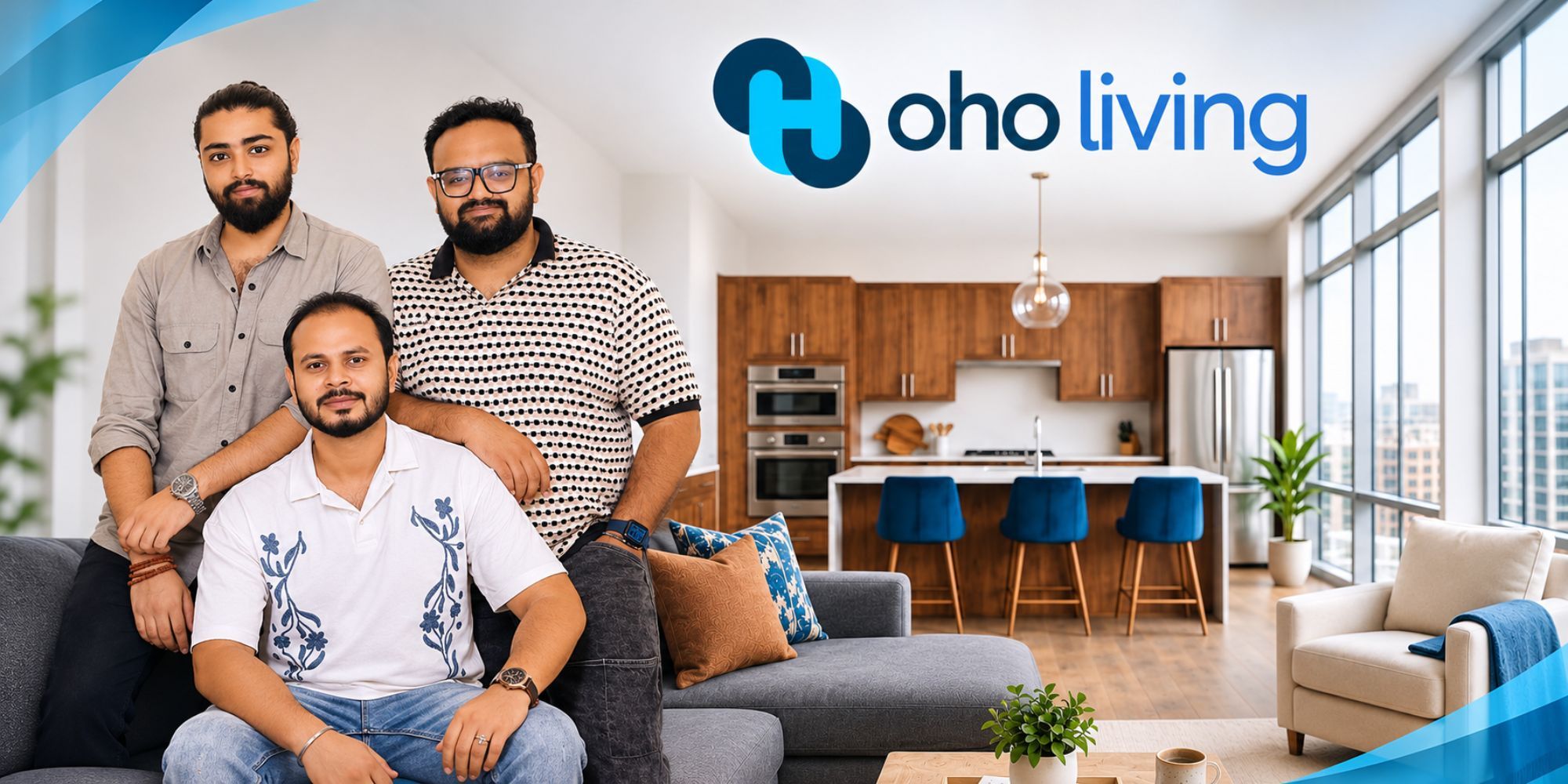
Ritu, now Co-founder and CBO, leads sales and growth. Saurabh Kumar, Co-founder and CEO, owns strategy, brand and fundraising; at 25, he already has more than a decade of startup-building behind him, including a social media community of over 13 million followers. Prakhar Minocha, Co-founder and COO, runs the homes and the teams behind them, drawing on more than nine years in real estate, including a villa rental business and a hostel on Airbnb.
The simplest idea in the room
In 2021, Jharkhand Angels gathered startups from across the state at one event. Most were pitching food delivery, e-commerce, job platforms, even VR. oho Living was solving the plainest problem in the room: helping people find a good place to live.
Then the founders said they wanted to serve 1 crore people, starting from Ranchi. Most of the room laughed. One investor laughed too, then caught himself asking: why not?
The worst year
The early years were a grind. Founders in their early twenties had to convince landlords and institutions to take them seriously, and running homes meant something broke almost every day. The team answered with structure, writing SOPs and playbooks while the company was still small.
That did not prevent 2023, the founders' lowest point. The business had split into two parts, and they could not see the next step. Jharkhand Angels stepped in as an adviser and helped restructure the company.
The bet due diligence said no to
By December 2024, oho Living was steadier, but revenue was still small. Saurabh sat down with the investor and laid out his plan to go big. This time, the vision landed.
Due diligence said no. Jharkhand Angels invested anyway, backing the founders and the Tier-2 thesis over the numbers. The money came in by July 2025.
In the year that followed, monthly revenue rose about 25 times, from roughly ₹2.5 lakh to around ₹50 lakh. Homes went from average to genuinely good, the premium Signature brand launched, a sixth city was added, and EBITDA began to look predictable.
As the investor put it, everyone now calls Tier-2 India the big bet. These founders saw it years earlier.
A Community Manager, not a property manager
For the founders, a resident's experience does not end at the door of their room. Community forms when people feel safe and seen, so every home has a Community Manager instead of a property manager.
Three brands serve three kinds of newcomer: Signature for premium full buildings, Urban for working professionals, and LiveliHood for students, run with education partners including Motion, PhysicsWallah and Allen. Matured properties run at around 95% occupancy.
Growing on partners' money
oho Living's recent growth has come without spending its own capital on property. In Patna, coaching institutes fund student residences and send the students, while oho Living runs them; 512 beds there earned about ₹27 lakh a month from day one. In Jaipur, landlords pay for the fit-out and oho Living pays a fixed rent. In Agra, landlords furnish the flats and share the revenue.
The five deals signed this quarter, including a franchise in progress with Bhubaneswar's Shaswat Group, added 658 beds and ₹57.3 lakh in monthly revenue capacity.
What comes next
The company plans to reach 2,134 beds by March 2027, led by Patna, Jaipur and Bhubaneswar. At 80% occupancy, that would mean about ₹1.49 crore in monthly revenue. Urban is set to become the largest brand as more young professionals move to Tier-2 cities for work.
Beyond that, Vision 2030 is 100,000 beds across every state in India, with a website that lets anyone find a home and move in within 10 minutes.
And the number that made a room laugh in 2021 has not shrunk. Saurabh still talks about serving 1 crore people.
oho Living did not start perfect. In the founders' words, it started honest: a real problem, a small team and a commitment to figure it out along the way. For anyone arriving in a new city with a suitcase and an address they can barely find, that is the point.
This content is published by YourStory and has not been created or edited by Hello Headlines. View original