In This Assam Village, a Forest Spider Is Fried in Mustard Oil & Served as a Seasonal Delicacy. Here’s Why
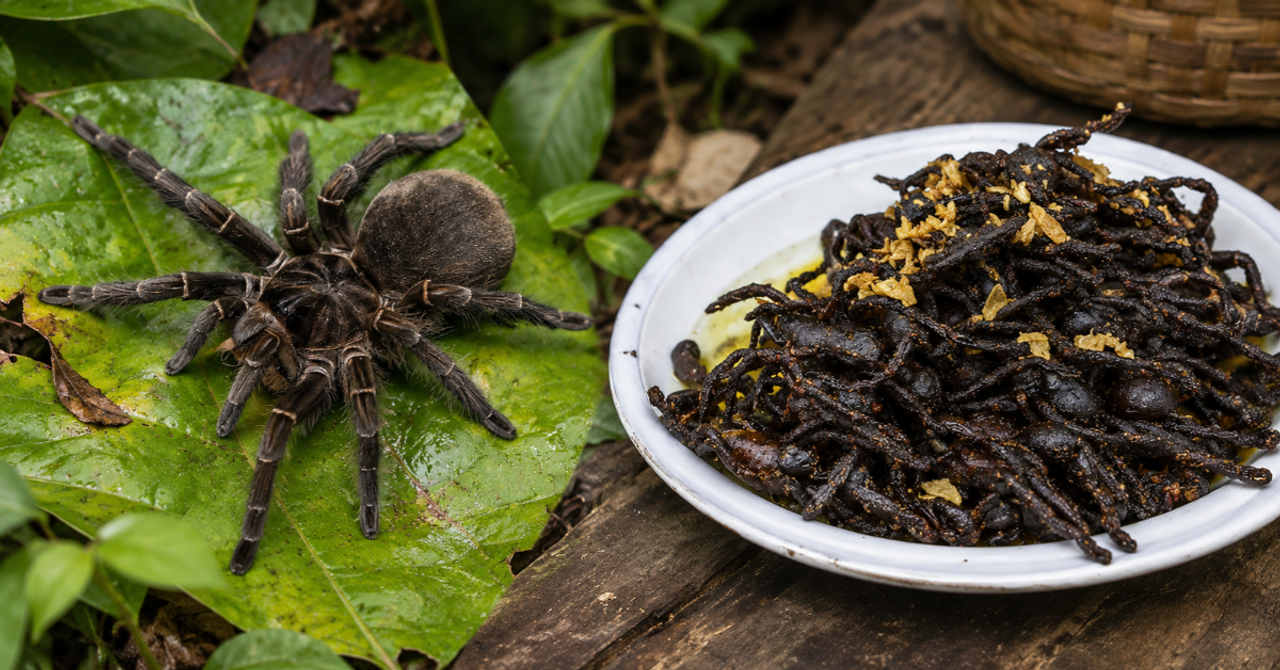
In the forest-fringe villages of Assam's Kamrup (Rural) district, the arrival of the pre-monsoon season brings with it a food tradition that begins beneath the ground.
Between April and June, members of the indigenous Rabha community venture into areas adjoining sal forests to collect a large, dark, hairy spider from its burrow.
Known locally as Bhaluk Makara, the Indian Black Earth Tiger Spider is not considered a threat or an unusual forest encounter. It is a seasonal food, gathered when the community observes it to be most abundant.
The practice has now been documented scientifically for the first time.
A study titled First Record on the Traditional Consumption of the Indian Black Earth Tiger Spider (Lyrognathus crotalus Pocock, 1895) Among the Rabha Tribe from Northeast India, published in the Proceedings of the Zoological Society on August 18, 2026, records how the Rabha community collects, prepares and consumes this endemic tarantula.
Authored by Jyotiprakash Boro, Kuldeep Bora, Chandramita Boro and Samir Terdalkar, the research brings attention to a little-documented aspect of indigenous food knowledge in Northeast India: the seasonal consumption of spiders.
From forest burrows to the kitchen
The Indian Black Earth Tiger Spider (Lyrognathus crotalus) belongs to the tarantula family Theraphosidae and is native to Northeast India.
Its local name, Bhaluk Makara, refers to its bear-like appearance, with its relatively large, black body covered in dense hair.
Researchers recorded the practice in and around Mouman village in Kamrup (Rural), Assam, where the spiders are found in forest-fringe habitats dominated by sal trees (Shorea robusta).
For the study, the researchers conducted fieldwork between April and June 2025, interviewing 34 members of the Rabha community, including elderly residents and people who regularly collect the spiders.
Their accounts helped establish when the spiders are gathered, how they are located and the methods used to prepare them.
Collection is concentrated in April and May, when villagers report that the spiders are seasonally abundant. It generally takes place over three to four days a month during the peak period, although people occasionally collect them outside these months depending on availability.

A single collection trip can yield approximately 20 to 30 spiders.
The process begins with locating their underground burrows along forest edges. Collectors either carefully dig into the ground or insert a wooden stick into a burrow to encourage the spider to emerge.
The burrows are part of the species' natural habitat. Once collected, the spiders are taken for preparation soon afterwards.
They are washed and repeatedly soaked in hot water for several minutes before being fried in mustard oil for approximately seven to 10 minutes. Salt and garlic powder are added for flavour. The cooked spider is consumed with its body and is traditionally accompanied by locally prepared rice beer.
The preparation method, according to the researchers, has been transmitted across generations. For the Rabha community, it forms part of a seasonal food practice associated with the availability of a particular forest-dwelling species.
A wider tradition of eating spiders in Northeast India
The Rabha community's practice is part of a broader, though relatively under-researched, tradition of consuming arthropods among indigenous communities in Northeast India.
A separate 2026 paper, Edible Spiders: An Unconventional Source of Nutrition and Therapeutic Agents, published in Frontiers in Sustainable Food Systems on March 9, documents the consumption of two orb-weaver spiders, Nephila pilipes and Trichonephila clavata, among indigenous communities in Nagaland.
Locally known as siyankyü in the Lotha Naga language, these spiders are valued for their plump abdomens.

The study, by Lobeno Mozhui, Kekhesino Sale and L. N. Kakati, draws on interviews with 33 people possessing traditional knowledge of spider consumption.
Unlike the Rabha preparation, the Nagaland tradition involves removing the spiders' heads and legs before washing and soaking them in hot water.
They are cooked with oil, salt and locally used ingredients such as ginger, chilli, bamboo shoot and sumac. Respondents described the cooked abdomen as having a creamy, nutty flavour, and the spiders are consumed as a meat substitute.
The two studies document different species and culinary practices, but both highlight how knowledge of edible spiders is preserved through oral traditions.
What documenting the tradition means for conservation
While the Rabha community considers the spider a nutritious seasonal food, its nutritional composition has not yet been established through laboratory analysis.
The Assam study does not provide measured protein, mineral or micronutrient values. It also records no reported medicinal or therapeutic use among the respondents.
The researchers identify another important gap: the ecological impact of harvesting remains unclear.
Some community members perceive the local spider population as stable, based on their observations over several decades. However, these accounts have not been independently verified through population surveys.
The number of spiders collected annually, their reproductive patterns and the effects of repeated harvesting on local populations require further investigation.
This distinction is important because documenting a traditional food practice is only one part of understanding its relationship with the surrounding ecosystem. Without information on population size, distribution and breeding patterns, it is difficult to determine whether existing harvesting levels are sustainable.
Further research into the species' ecology, population dynamics, nutritional composition and conservation status could help establish a baseline.
But for now, the study places a previously undocumented food tradition on the scientific record.
Recording how the spider is found, harvested and prepared offers a starting point for understanding both the cultural knowledge behind the practice and the ecological questions that still need answers.
Sources:
‘First Record on the Traditional Consumption of the Indian Black Earth Tiger Spider (Lyrognathus crotalus Pocock, 1895) Among the Rabha Tribe from Northeast India’: By Jyotiprakash Boro, Kuldeep Bora, Chandramita Boro and Samir Terdalkar, Published on 18 August 2026
‘Edible spiders: an unconventional source of nutrition and therapeutic agents’: By Lobeno Mozhui, Kekhesino Sale, L. N. Kakati, Published on 9 March 2026
‘For the Rabhas of Assam, this giant spider is a seasonal delicacy’: By Roopak Goswami, Published on 24 August 2026
This content is published by The Better India and has not been created or edited by Hello Headlines. View original