Editorial: Countering China’s dominance
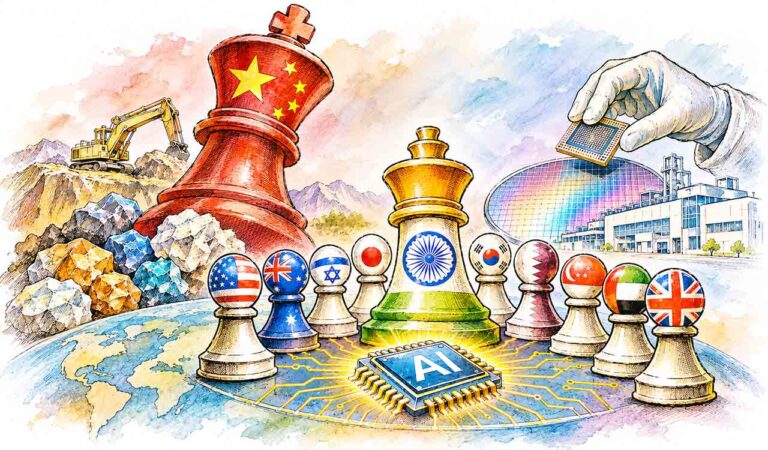
It is an undeniable fact that China continues to wield an outsized influence over the global supply chains for critical minerals and artificial intelligence. Efforts are ongoing to counter this dominance and ensure fair competition in an area that impacts virtually every sphere of human activity. The ‘San Francisco Declaration’ is the latest initiative in this direction. Ten countries — India, the United States, Australia, Israel, Japan, South Korea, Qatar, Singapore, the UAE, and the United Kingdom — have signed the multilateral agreement to ensure that no country can secure the AI ecosystem alone and that AI development must span multiple jurisdictions and industries, requiring coordinated action among trusted partners. The San Francisco Declaration on the Secure Foundations of Enduring Prosperity is linked to the broader US-sponsored Pax Silica initiative, which seeks to secure the global technology and AI ecosystem. The agreement aims to reduce reliance on concentrated markets, counter economic and supply chain pressure from China, address non-market overcapacity, and prevent hostile actors from acquiring sensitive technologies that could grant military or intelligence advantages. For India, the declaration presents both strategic opportunities and new responsibilities. India’s inclusion signals that it is being viewed as an important participant in the global AI ecosystem rather than merely a technology consumer. This elevates India’s standing among major technology and strategic powers of the Indo-Pacific. China currently dominates global critical mineral supply chains, accounting for around 60 per cent of mining, 90 per cent of processing and separation, and 94 per cent of permanent magnet manufacturing.
China has extended the temporary suspension of export controls on rare earth elements, lithium-ion batteries, and graphite anode materials until January 10, 2027. There is a growing convergence among global economies on the need for joint efforts to “de-risk” critical technologies by linking AI governance with resilient supply chains and long-term economic security partnerships. To achieve this, it is essential to break China’s semiconductor chokehold and build alternatives to strengthen economic security. Becoming a member of Pax Silica will open up avenues for India to significantly accelerate its semiconductor and AI ambitions. The Pax Silica declaration lays out a shared vision of economic and technology cooperation across supply chains — from raw materials to semiconductors and AI infrastructure — and a commitment to mutual prosperity and security. Resilient semiconductor supply chains are critical in a world that has witnessed the weaponisation of supply chains. Of late, China has tightened controls on rare earth exports, requiring government clearance before the minerals can be shipped abroad. Its dominance in production and processing gives Beijing considerable leverage in trade talks. India can benefit from stronger partnerships, diversified supply chains, investment, and access to advanced technologies. Collaboration with trusted partners can also reduce excessive dependence on others and strengthen economic resilience. The signatories to the San Francisco Declaration have agreed to share a list of high-priority technologies and critical infrastructure to guard against theft, illicit transfers, and undue foreign control.
This content is published by Telangana Today and has not been created or edited by Hello Headlines. View original