
How Optimizely Hack Exposed 178 Websites To Crypto, Card Theft

In another major cybersecurity incident, malicious code injected into websites through digital experience platform (DXP) Optimizely exposed visitors to potential theft of cryptocurrency, payment card details and browser data.
The attack affected 178 organisations, including Zoom, BBC, CNN, Salesforce, GitLab, IKEA, HSBC, Equifax and Ledger, after attackers compromised customer projects on Optimizely Web and used the platform’s content delivery network (CDN) to distribute malware.
The injected JavaScript also had capabilities to deliver two iOS exploit kits, Coruna and DarkSword, potentially exposing visitors using vulnerable Apple devices to further attacks.
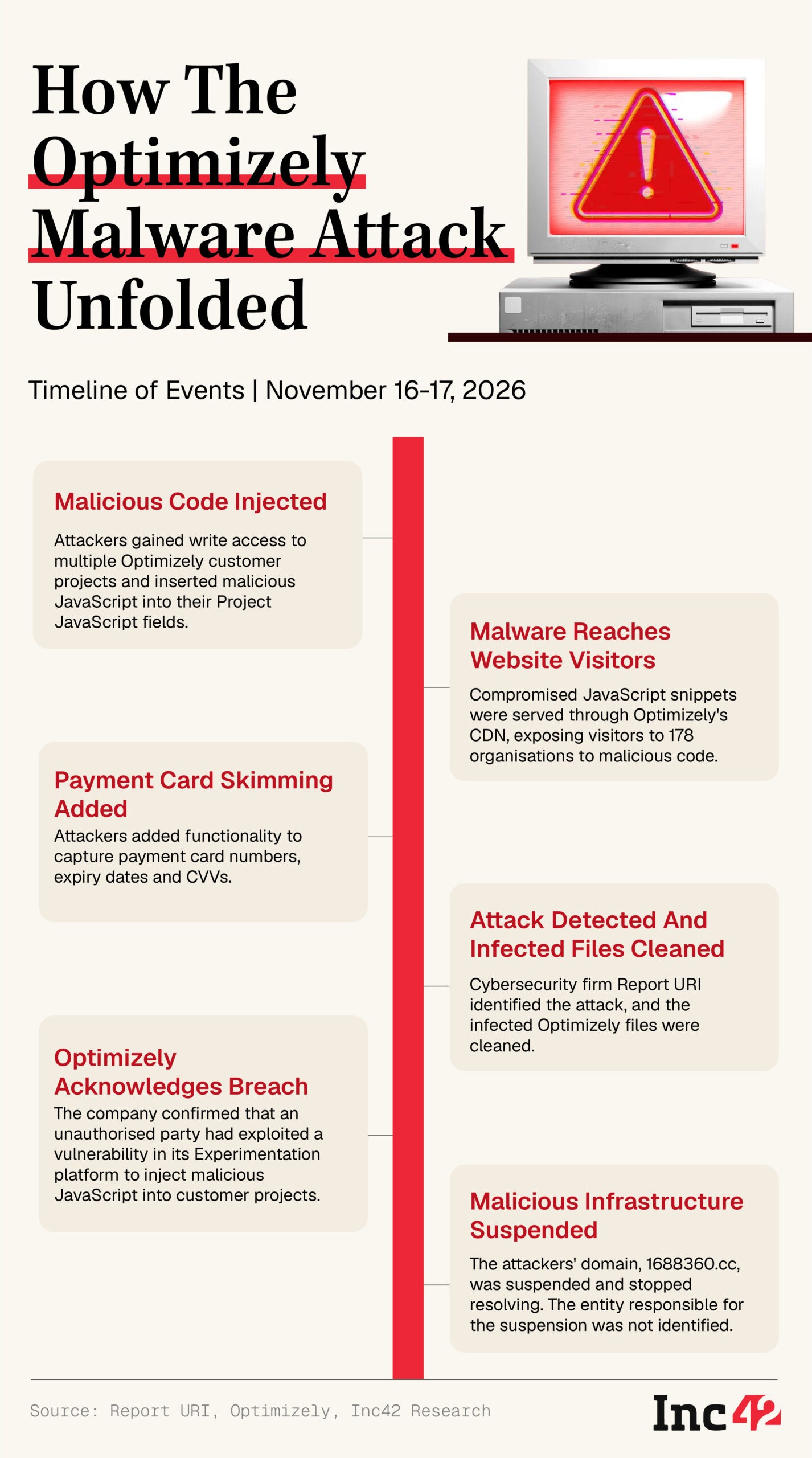
The attack was detected on November 16 by cybersecurity firm Report URI, which found 188 compromised JavaScript snippets linked to 178 organisations across 20 sectors, including banking, technology, retail, media, healthcare and telecommunications. The findings emerged from an analysis of 1,611 distinct Optimizely snippets.
The malware could replace cryptocurrency wallet addresses with those controlled by attackers, capture payment card details, steal browser cookies and take screenshots of visitors’ webpages.
The attackers had received around $7,040 in cryptocurrency by November 16. Report URI revised this figure to approximately $7,151 in an update published on November 17.
In response to an Inc42 query, Optimizely said it identified the incident on November 16, 2026, after an unauthorised party exploited a vulnerability in Optimizely Experimentation to inject malicious JavaScript into some customer projects.
The company said it had contained the incident and fully remediated the vulnerability.
As part of its response, Optimizely blocked access to the vulnerable path, deployed a fix and removed the injected code from affected projects. It also ended active sessions, revoked tokens and reset access for affected user accounts.
“We have also implemented additional protections to prevent malicious code from being delivered through Cloudflare. While the incident has been fully remediated, we are working with third-party experts on a comprehensive investigation. We have notified and are supporting all affected customers,” the company said.
The Mechanics Of The Optimizely Attack
Optimizely Web allows businesses to experiment with different versions of their websites, personalise visitor experiences and analyse how users interact with their pages.
To use the platform, customers integrate a JavaScript snippet hosted on Optimizely’s CDN into their websites. The snippet also includes an optional field called Project JavaScript, which allows customers to add custom code that runs on their webpages.
According to Report URI, attackers exploited access to customer projects to inject malicious JavaScript into these fields.
As a result, visitors did not need to click suspicious links or visit unfamiliar websites to encounter the malware. Their browsers automatically loaded the compromised code when they accessed affected websites.
Three variations of the injected code were traced. The first loaded a malicious script directly from an external domain, while the second concealed the domain using Base64 encoding. The third contained the entire malicious payload and could execute it through a function called eval if access to the external domain was blocked.
The compromised code was also found in Zoom’s Optimizely snippet, which instructed visitors’ browsers to load another JavaScript file from the malicious domain.
However, how the attackers gained access to multiple customer projects remains unclear. Possible explanations include a compromise of Optimizely’s systems or the use of stolen credentials that allowed attackers to access customer accounts.
What Could The Malware Do?
The injected JavaScript, identified as track.js, was capable of carrying out multiple forms of malicious activity. Depending on the visitor’s device and activity on a webpage, it could target financial information, collect browsing data or attempt to exploit Apple devices.
Replacing cryptocurrency wallet addresses: One of the malware’s key capabilities was to interfere with cryptocurrency transactions.
For instance, a visitor could copy a wallet address displayed on a website, only for the malware to replace it with an address controlled by the attackers before the user pasted it into their wallet.
The script could scan webpages for cryptocurrency wallet addresses and substitute them with the attackers’ addresses. It supported several cryptocurrencies and networks, including Bitcoin, Ethereum, Solana, Tron, Toncoin, Litecoin, Bitcoin Cash and Dogecoin.
Stealing payment card details: The malware could also function as a payment card skimmer, capturing information entered by visitors into website forms.
It monitored form submissions and outgoing network requests to identify payment card details, including card numbers, expiry dates and CVVs. The captured information could then be transmitted to an external server controlled by the attackers.
However, the malware had a limitation. It could not access card details entered into hosted payment iframes operated by providers such as Stripe and Adyen. Details entered directly into a website’s own payment fields were potentially exposed.
Stealing cookies and screenshots: The malware could also collect information associated with visitors’ browsing sessions.
When it detected cryptocurrency addresses alongside wallet-related or payment-related terms, it could transmit information such as the webpage URL, non-HttpOnly cookies, original wallet addresses and a screenshot of the webpage to the attackers’ server.
Delivering iOS exploit kits: The malware could also target visitors using Apple devices, particularly iPhones and iPads, by delivering two iOS exploit kits called Coruna and DarkSword.
These exploit kits are designed to exploit vulnerabilities in Apple’s operating system. The script first checked the iOS version running on a visitor’s device before attempting to load the relevant exploit chain.
The exploit kits were delivered through hidden iframes and external domains controlled by the attackers.
Devices running iOS 18.7.3 and later, as well as iOS 26.3 and later, were patched against the relevant vulnerabilities, based on comments found in the exploit kit.
Edited by Akshit Pushkarna
The post How Optimizely Hack Exposed 178 Websites To Crypto, Card Theft appeared first on Inc42 Media.
This content is published by Inc42 and has not been created or edited by Hello Headlines. View original