In a year of AI, why ‘human’ is Cambridge Dictionary’s word of 2026
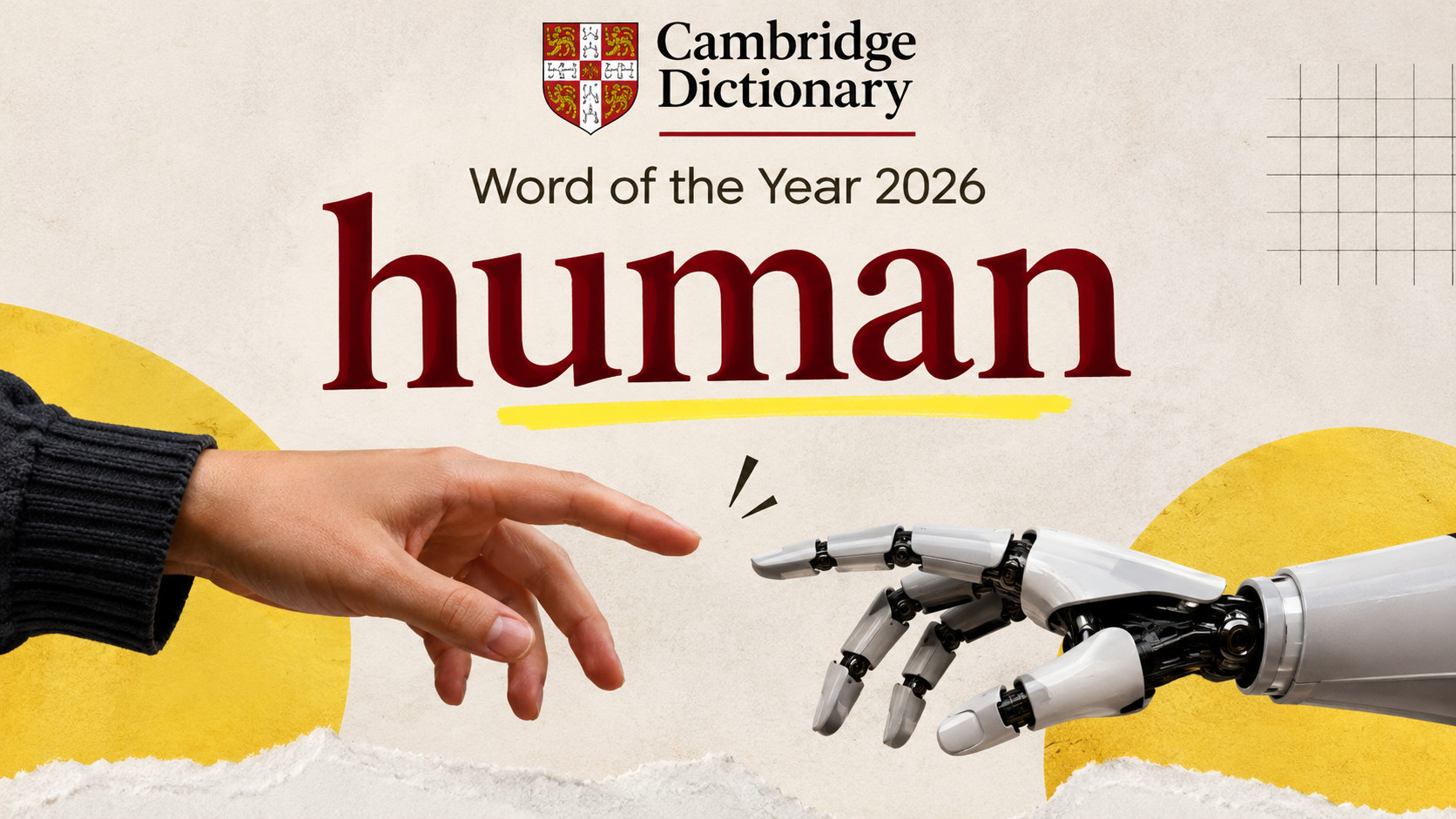
Hyderabad: For a few years now, Cambridge Dictionary’s Word of the Year has described our uneasy relationship with artificial intelligence (AI).
In 2023, it picked “hallucinate” for the confident falsehoods that chatbots produce. Last year, it was “parasocial”, partly because people were forming one-sided bonds with AI companions. This year, the lexicographers have gone back to basics.
The word of 2026 is “human.”
The dictionary defines the adjective as “having the qualities, faults and feelings that people have, as opposed to gods, animals or machines.” What caught its editors’ attention, though, was less the word itself than the company it now keeps. They point to “human-written,” “human-generated” and “human-made.” These reassure us that a machine wasn’t involved.
“Artificial intelligence has been a growing presence in society for years now, but this year it seemed to be everywhere,” said Colin McIntosh, the dictionary’s chief editor. He said 2026 had brought a renewed appreciation of the human element in what we consume, a shift he calls the “human premium.”
When the machine passes
There is a reason the word needs defending.
In a study published this year in the Proceedings of the National Academy of Sciences, the University of California, San Diego researchers Cameron Jones and Benjamin Bergen ran the classic three-way Turing test. An interrogator chats with a person and a machine at the same time, then decides which is which.
When GPT-4.5 was told to adopt a human-like persona, it was picked as the human 73 per cent of the time. That was more often than the real people it was up against.
The headlines tended to skip one key detail – what the prompt should be. Without instructions to play a persona, GPT-4.5’s success rate fell to 36 per cent. The machine passes for human, in other words, when a human tells it how.
The label flips
Cambridge also points to a reversal in how companies talk about their work. Businesses that once added disclaimers when they used AI now advertise when something has been made by people.
Music is where the shift has been loudest. In March, the UK government dropped its plan to let AI companies train on copyrighted work unless the rights-holders opted out. It backed down after a campaign by artists, including Kate Bush and Elton John, who called the proposal “thievery on a high scale.” In the government’s own consultation, only 3 per cent of the roughly 11,500 respondents had supported its preferred option.
A month later, the Los Angeles label Jazz Is Dead and the advertising agency TBWA\Chiat\Day LA launched Played By Humans. The free tool lets musicians certify their tracks as human-made and lets listeners check what they are hearing. Its makers say the idea isn’t to oppose AI but to make clear who made what.
Maxxing the analogue
The pushback has its own vocabulary. Cambridge credits the investor Christian Angermayer with “humanmaxxing,” the pursuit of peak performance and a longer life through fitness trackers and supplements. But there is an irony there: becoming more human with the help of more technology.
“Friction-maxxing” goes the other way. It means deliberately making daily life a little less convenient to loosen the hold of screens. Cambridge first flagged the term in January. It cited the writer Kathryn Jezer-Morton’s argument that people need to build up their tolerance for inconvenience.
The shortlist tells a similar story. “Analogue” has stretched to cover screen-free pastimes such as knitting, reading a book or playing vinyl records. “Agent” now also means an AI system that can carry out complex tasks without a human in control. “Wholesome” and “chic” complete the list.
That “agent” and “human” share a shortlist may be the most telling detail of all. One word describes what the machines are becoming. The other describes what people want to hold on to.
(With PTI inputs)
Get the latest updates in Hyderabad City News, Technology, Entertainment, Sports, Politics and Top Stories on WhatsApp & Telegram by subscribing to our channels. You can also download our app for Android and iOS.
This content is published by The Siasat Daily and has not been created or edited by Hello Headlines. View original