The Lights We Leave On Could Be Taking Away the Darkness Kerala’s Forests Need. Here’s How to Help
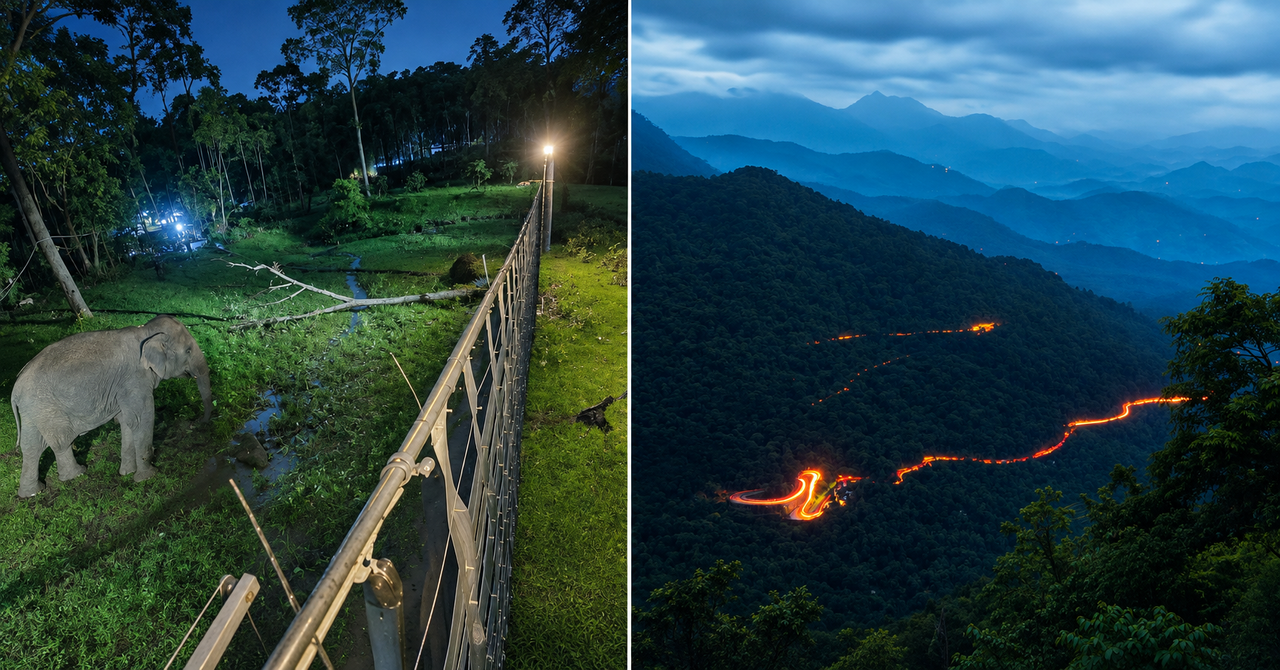
A road outside a forest stays lit after sunset. So does a nearby place of worship or a cluster of shops where people gather. Those lights help people go about their lives. But their glow can travel beyond the places they are meant to illuminate.
For wildlife living in Kerala’s Western Ghats, that raises an important question: how much of the night inside protected forests is still naturally dark?
A team of four researchers has begun answering it. Their study, published in Biological Conservation in October 2026, mapped artificial light in and around 21 protected areas in Kerala and examined the roads, buildings and other human activities associated with it.
Their findings reveal a conservation concern that is easy to overlook: even where forests have protected boundaries, light from surrounding areas can still reach them.
What's causing the forests to light up?
Using satellite data from 2024, researchers S. Haripriya, M.S. Arjun, S. Gopakumar and Vijayan Divya measured night-time light across national parks and wildlife sanctuaries.
They then compared those measurements with maps showing nearby roads, places of worship, buildings and centres of human activity.
The difference between forests was striking.
Periyar Tiger Reserve's western division recorded the highest average and peak levels of satellite-measured light among the 21 areas, with a mean radiance of 0.369 and a maximum of 24.0.

Within protected areas, the strongest statistical link was with the density of places of worship. In the surrounding landscape, road networks and places where people gather or work were more important predictors.
That distinction matters. Light affecting a forest may be associated with several kinds of human activity, and managing it requires knowing where to look.
But light does not always arrive as a visible beam. It can scatter through the atmosphere and brighten the night sky over places some distance away. Researchers call this skyglow.
The team examined areas extending up to 30 km beyond forest boundaries. Their modelling suggested that the wider surrounding landscape, particularly the 10–30 km zone, could contribute substantially to skyglow.
This means lighting decisions made several kilometres away may influence how dark a protected forest remains at night.
Why does darkness matter to wildlife?
The Western Ghats are home to many species found nowhere else, including animals active after dark. Natural cycles of light and darkness help wildlife navigate, find food and follow daily rhythms.
Research elsewhere has shown that artificial lighting can alter animal behaviour. However, the Kerala study did not directly observe animals or measure how they were affected.
That distinction is important.
The researchers have identified where artificial light is present and which features of the surrounding landscape are associated with it. Understanding what those light levels mean for different species will require further research.
Lead author S. Haripriya has also expressed an interest in investigating these ecological effects in future.
Could simple lighting changes help protect these forests?
For forest departments and local authorities, the study offers something immediately useful: a way to identify areas where lighting deserves closer attention.
A brightly lit road near a forest edge could be assessed for lamps that shine upwards or sideways. Places of worship and tourism facilities could review whether lights need to remain on at full strength throughout the night.
Shielded fixtures, lower-intensity lighting and switching off unnecessary lights during periods of low activity are among the options worth considering, while keeping public safety in mind.

These are possible next steps rather than changes already implemented because of the study.
The findings could, however, help forest officials, local communities and those responsible for public lighting decide where action would be most useful.
For years, protecting forests has meant paying attention to what happens within their boundaries. This research offers a reason to look beyond those boundaries, too.
And sometimes, protecting a forest's natural environment may begin with something as simple as reconsidering where, when and how we use light.
Sources:
‘Spatial assessment of artificial light at night in and around protected areas of the Kerala Western Ghats’: By S. Haripriya, M.S. Arjun, S. Gopakumar and Vijayan Divya
‘From illumination expansion to ecological response: artificial light at night and detectability of forest vegetation responses across India’: By Dibyendu Dutta, Published on 31 October 2026
‘New study examines effect of artificial light at night in protected areas’: By Arathi Menon, Published on 5 November 2026
This content is published by The Better India and has not been created or edited by Hello Headlines. View original