Anthropic IPO Rekindles Debate Over India’s AI Ambitions

Anthropic’s record-breaking IPO has triggered a debate among Indian business leaders on the country’s ability to build globally competitive AI companies.
Despite rising AI investments in India, the gap in capital, research capabilities and technical talent highlights the challenges facing homegrown AI companies.
Indian AI startups raised $676 Mn across 57 deals in H1 2026, over 4X the year-ago period, but building a global AI giant will require deeper pools of capital, sustained R&D and stronger technical talent.
Anthropic’s stock market debut has offered a glimpse of the extraordinary investor appetite for AI. The Claude parent priced its shares at $83 for the IPO, above its price range of $70-78. The IPO, which values the company at around $1.5 Tn, was oversubscribed by over 10X.
The listing is a landmark moment for the AI industry and gave public market investors an opportunity to back one of the companies at the centre of the AI race.
For scale, Anthropic’s $1.5 Tn IPO valuation is equivalent to nearly 37% of India’s projected nominal GDP of $4.06 Tn for FY27, as per the IMF’s October estimates.
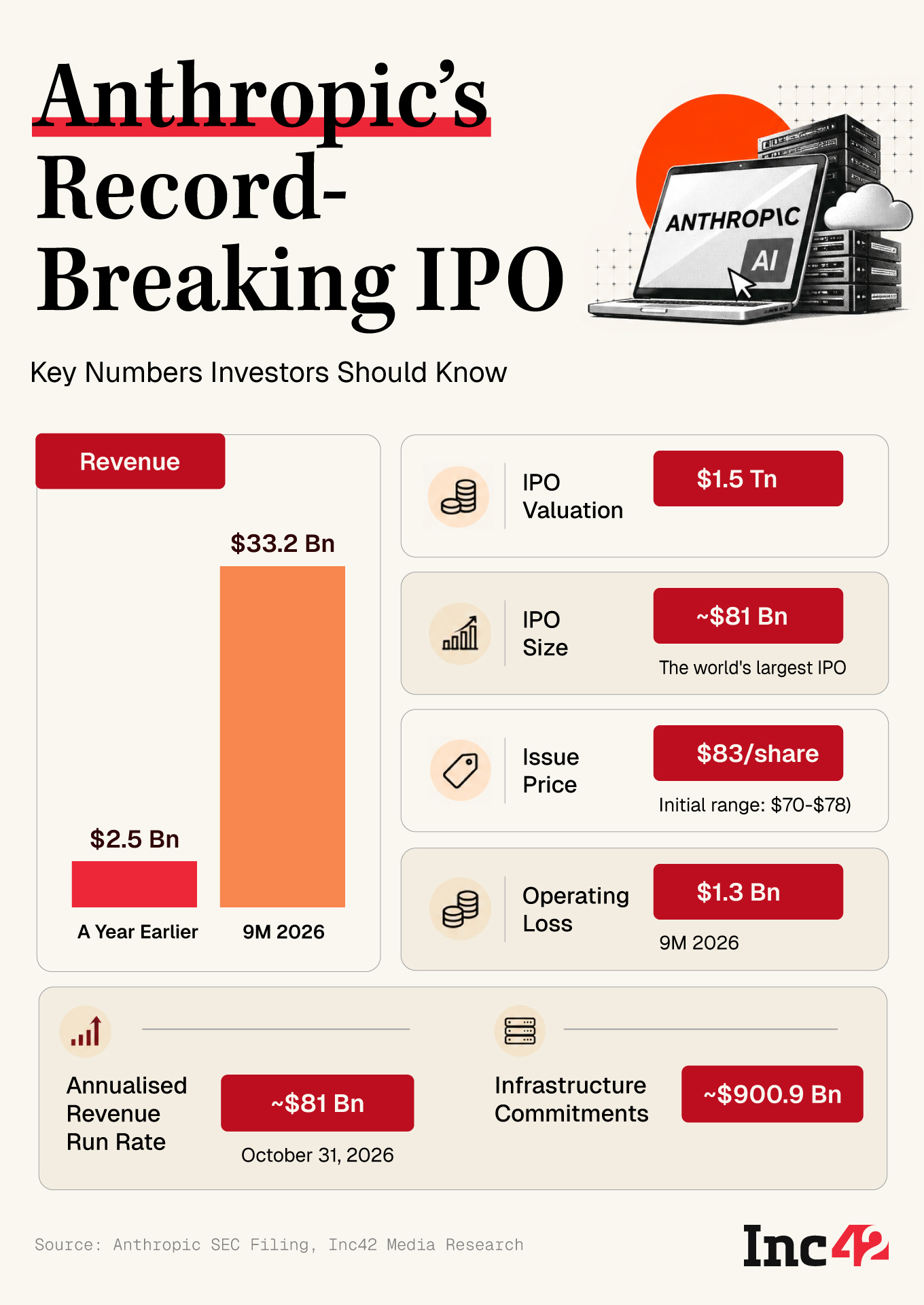
However, the significance of this IPO extends beyond Wall Street. In India, it has sparked a debate about the country’s ability to build globally competitive AI companies.
The conversation gained momentum after veteran banker and Kotak Mahindra Bank founder Uday Kotak compared Anthropic’s valuation with the combined market capitalisation of India’s top 10 companies. In a post on X, he questioned whether Indian businesses were undervalued or whether the country needed to catch up with the new tech economy.
“Anthropic, an AI company known for Claude, listed at a valuation of $1.5 Tn. It did not exist until about 5 years ago. This is more than the combined market cap of the top 10 Indian companies. Are we undervalued, or do we need to catch up in the new world? Or both?” Kotak wrote.
The debate that unfolded after this comparison saw Adani Group CFO Jugeshinder Robbie Singh label the Anthropic IPO as a “textbook category error in asset pricing”. In a post on X titled “Cross-Regime Category Error: Why Legacy Bankers Can’t Price Synthetic GDP”, Singh argued that India’s largest companies and frontier AI businesses operate in fundamentally different economic regimes.
“India’s blue chips are neither undervalued nor ‘behind’ — they are yield vehicles monetising the physical human economy,” he wrote, arguing that frontier AI companies are being valued for their potential to create “synthetic GDP” through autonomous AI agents and digital workforces.
Ex-Infosys CFO Mohandas Pai questioned the premise of comparing the two. “Every disruption creates new companies with huge valuations. It is the nature of markets. Comparing is silly,” he wrote.
Pai argued that the more pertinent question the IPO raises for India is what exactly is needed for an Indian company to recreate an Anthropic-like scale.
This reflects a broader question prevalent in the Indian startup ecosystem: whether the country can move beyond valuing existing businesses to fostering innovation and funding deeptech companies that may take years to build.
The question gains more significance as funding for Indian AI startups gathers pace despite lagging significantly behind global levels.
More Money Flows, But The Gap Remains
AI emerged as the defining theme in the Indian startup ecosystem in Q3 2026, with startups in the segment raising a record $438 Mn, up 265% YoY, across 35 deals. This took the sector’s total funding in the first nine months of 2026 to more than $1.1 Bn.
The surge stands out against a relatively subdued funding environment. Indian startups collectively raised $2.2 Bn across 210 deals in Q3, up just 5% YoY, while the deal count fell 13%.
However, the increase in AI funding has also brought valuations under scrutiny. Inc42’s Indian Investor Ranking & Sentiment Survey, based on responses from more than 85 institutional investors, found that 63% of investors see some degree of froth in Indian AI startup valuations. About half expect a correction within the next 18 months.
Pranav Obhrai, founding and managing partner at Atrium Ventures, said rising AI valuations are part of a global trend, particularly in the US. He added that vertical AI applications offer a clearer path to building defensible businesses through distribution.
“Distribution becomes the moat, especially in India, where technology alone offers limited protection against global competition,” he said.
Vertical AI applications across BFSI, healthcare, defence and agriculture emerged as the top choice in Inc42’s survey, with 39% of investors expecting them to capture the most value over the next five years. AI hardware and semiconductors followed at 23%, while AI-led IT and business services accounted for 18%.
The findings suggested that investors were increasingly prioritising commercially viable AI applications over capital-intensive foundational technology. Whether the funding momentum continues will depend on sustainable revenue, defensible businesses and valuations that can withstand a potential correction.
What Will It Take To Build India’s Next AI Giant?
Capital alone, however, will not be enough. Building deeptech companies capable of locking horns with giants like Anthropic also requires research talent, technical expertise and the infrastructure to train and run increasingly sophisticated models.
An analysis by General Catalyst’s Utkarsh Bajpai of companies valued at over $5 Bn highlighted the role of technical talent in value creation. Researchers lead 16% of these companies but account for 31% of their combined $170 Bn valuation. Nearly 80% of the founders have technical backgrounds.
For Indian startups, this means moving beyond products that merely package existing foundation models. As access to these models becomes easier, differentiation will increasingly hinge on proprietary technology, domain expertise and solutions to specific problems.
“Gone are the days when you could just build wrappers on top of foundational models. You have to build vertically focused products that solve real problems with an AI-first approach,” Mehta said.
The opportunity extends beyond large language models to AI applications, enterprise software, robotics and other deeptech segments. But building globally competitive businesses in these areas requires patient capital and sustained investment in research, talent and infrastructure, often years before commercial returns materialise.
India’s challenge, therefore, is to move from participating in the AI market to building technology that competes globally. Rising funding signals investor interest, but translating it into durable businesses will require stronger research capabilities, technical talent and a willingness to back ambitious ideas for the long term.
Edited by Akshit Pushkarna
The post Anthropic IPO Rekindles Debate Over India’s AI Ambitions appeared first on Inc42 Media.
This content is published by Inc42 and has not been created or edited by Hello Headlines. View original