79 Years of Accession: How Kashmir’s Status Changed
Kashmir, Observer, Jammu, Srinagar, Latest Kashmir News, Kashmir News, Kashmir Latest News
By Farooq Ahmad Khan
On October 27, 1947, Indian troops landed at Srinagar as tribal raiders advanced into Jammu and Kashmir.
A day earlier, according to the date on the Instrument of Accession, Maharaja Hari Singh had signed the document joining his state to India.
Lord Mountbatten accepted it on October 27, amid a military emergency that left little time for political deliberation.
Seventy-nine years later, the landing remains a defining moment in the history of Jammu and Kashmir, but its meaning cannot be separated from what followed.
Accession on specified subjects gave way to a special constitutional arrangement, which was progressively narrowed before its removal in 2019.
The former state then lost its statehood, and today, its restoration has become a central political demand.
The distance between these stages tells a larger story about the relationship between constitutional authority and popular consent.
When British paramountcy ended in August 1947, princely states had to decide their future relationship with India or Pakistan. Religion, which had influenced the partition of British India, did not automatically determine the destination of princely states. Their rulers executed the instruments of accession, although geography, economic ties and popular wishes remained important political considerations.
Hari Singh initially sought time. His state bordered both new Dominions, and independence appeared to him a possible alternative. Standstill arrangements were intended to preserve existing services while he considered the choices before him.
Events soon overtook that calculation. Rebellion in Poonch, communal violence and the upheaval of Partition placed mounting pressure on the state. Muslims, Hindus and Sikhs suffered in the violence, a history that becomes distorted whenever the experiences of one community erase those of another.
The tribal invasion beginning on October 22 transformed the crisis. Raiders advancing towards Srinagar committed atrocities as the Maharaja struggled to contain their advance. He sought military assistance from India, which made accession the basis for intervention.
The Instrument authorised Indian jurisdiction over defence, external affairs and communications, along with related matters. It did not immediately transfer unrestricted authority over the state’s internal affairs to the Dominion government. Clause 7 withheld a commitment to accept a future Indian Constitution, while Clause 8 preserved the ruler’s authority except where the Instrument affected it.
Accession and complete constitutional integration were therefore separate stages. Their subsequent convergence was a political process, rather than an outcome fully settled by the document signed in October 1947.
Mountbatten’s acceptance letter added another element. It envisaged a reference to the people once order had been restored and the invaders removed. The Instrument itself contained no plebiscite clause, but the accompanying correspondence and subsequent government statements established an assurance that would remain central to Kashmir’s political history.
The proposal survived the immediate crisis.
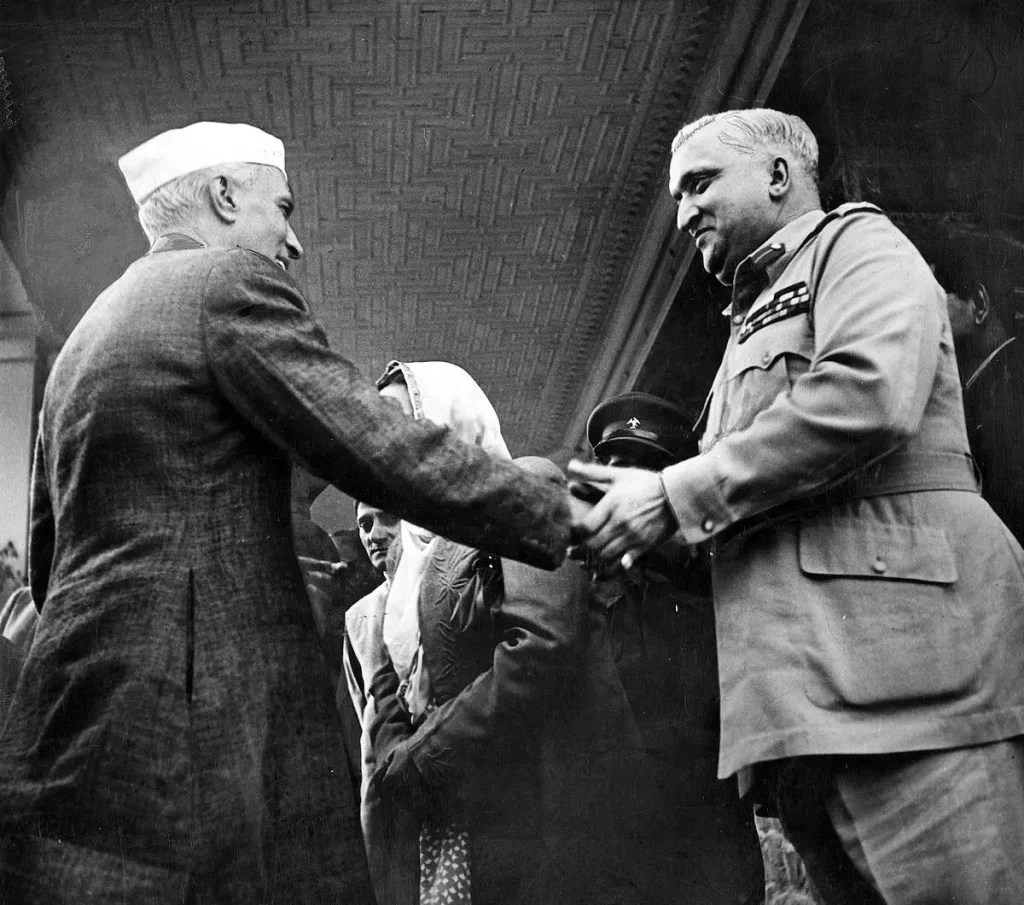
In August 1953, Prime Minister Jawaharlal Nehru and Pakistan’s Prime Minister Mohammad Ali were still discussing arrangements for a plebiscite, including a provisional timetable for appointing an administrator. Their governments disagreed over demilitarisation, troop levels, local armed formations and the conditions needed for an impartial vote.
India argued that Pakistan had failed to meet the necessary withdrawal requirements. Pakistan questioned whether a vote conducted under an India-aligned administration could be fair.
These disputes obstructed the process, but they do not fully explain India’s subsequent retreat from the proposal.
A decisive shift came in 1954, when Nehru argued that American military assistance to Pakistan had altered the security situation. By 1956, he was also invoking Kashmir’s constitutional development and the dangers of migration and renewed upheaval. An undertaking once presented as conditional on the restoration of order had become a course India increasingly rejected.
Article 370 belonged to a related but distinct question. A plebiscite concerned the state’s political affiliation. Article 370 governed its constitutional relationship with India.
When Gopalaswami Ayyangar introduced the provision in the Constituent Assembly on October 17, 1949, he referred to unsettled conditions, United Nations involvement and the commitment to ascertain popular wishes. He also explained the proposed role of Jammu and Kashmir’s own Constituent Assembly in determining its constitution and the extent of Union jurisdiction.
The provision established a framework involving consultation and concurrence, with the original clause (3) contemplating a recommendation from the state’s Constituent Assembly for a presidential notification.
The Delhi Agreement of 1952 and the Presidential Order of 1954 developed this arrangement. The 1954 order introduced Article 35A, which protected legislative provisions concerning specified rights of permanent residents.
Over subsequent decades, presidential orders extended more provisions of the Indian Constitution to Jammu and Kashmir. Article 370, initially part of a distinct constitutional arrangement, also became an instrument through which that arrangement was progressively narrowed.
By 2019, the autonomy operating under it was substantially reduced.
India increasingly relied on the state’s Constituent Assembly having affirmed accession. The United Nations, however, did not accept that development as a substitute for the envisaged plebiscite. Security Council Resolution 122, adopted in January 1957, maintained that distinction.
Domestic constitutional integration and an internationally proposed settlement remained separate questions.
The decisions of August 5 and 6, 2019, brought the constitutional arrangement to an end. Presidential orders applied the Indian Constitution in its entirety, ending Article 35A’s operation.
The Jammu and Kashmir Reorganisation Act separately divided the former state into the Union Territories of Jammu and Kashmir and Ladakh.
The Union government defended these measures through arguments about integration, equal rights, security and development. Critics questioned both their substance and their adoption while Jammu and Kashmir lacked an elected Assembly.
Beneath the legal dispute lay a political question: how much consent should accompany a decision that changes the constitutional status of an entire region?
China’s opposition introduced another dimension, particularly concerning Ladakh and disputed territory along the India-China boundary.
Beijing controls Aksai Chin, which India claims. India also rejects China’s 1963 boundary agreement with Pakistan concerning the Shaksgam region. Beijing’s territorial interests and partnership with Pakistan help explain its position, which should not be mistaken for a straightforward defence of Kashmiri autonomy.
In December 2023, India’s Supreme Court upheld the abrogation of Article 370. It held that presidential power under clause (3) survived the dissolution of the state’s Constituent Assembly, while rejecting an interpretive substitution attempted through Article 367.
The Court upheld Ladakh’s separation but left open the broader question of converting Jammu and Kashmir into a Union Territory, given New Delhi’s assurance that statehood would be restored. It directed elections and restoration of statehood at the earliest.
An elected government returned in 2024, with Omar Abdullah taking oath as chief minister on October 16. But a government in a Union Territory lacks the constitutional authority available to a state government.
Police and public order remain outside the Assembly’s legislative competence. The Assembly has renewed its demand for statehood, but restoration remains pending as this anniversary arrives.
The difference is important. Restoring statehood would not automatically revive Article 370 or Article 35A, nor would it restore the former state’s territorial configuration.
The present demand concerns the status of Jammu and Kashmir within the Indian Union, even as older disputes and political grievances remain unresolved.
The end of a constitutional arrangement does not, by itself, settle the history that preceded it. A domestic judicial judgment can determine the legal position within India, but it cannot alone reconcile competing territorial claims or resolve the political disagreements that have persisted for decades.
Recognising those disagreements also does not mean that the earlier plebiscite proposal is now agreed upon or being implemented.
Jammu and Kashmir entered the Union through an Instrument that specified the subjects over which India would exercise jurisdiction. Its subsequent constitutional history brought far-reaching integration, diminishing autonomy and, finally, the loss of statehood.
The region now seeks the restoration of a status it once possessed.
Legal authority can establish the powers of a government. Political trust depends on how those powers are exercised, how assurances are treated and whether people have a genuine voice in decisions concerning their future.
The history that began in October 1947 remains unfinished in this respect. Its next chapter will be judged by whether constitutional decisions produce a political relationship that people can accept as their own.
— The author is an advocate and a former civil servant. He can be reached at advofarooqahmadkhan@gmail.com.
The post 79 Years of Accession: How Kashmir’s Status Changed appeared first on Kashmir Observer.
This content is published by Kashmir Observer and has not been created or edited by Hello Headlines. View original