He Failed 88 Times to Make an Edible Spoon. Now, It’s Finding Its Way to Dining Tables
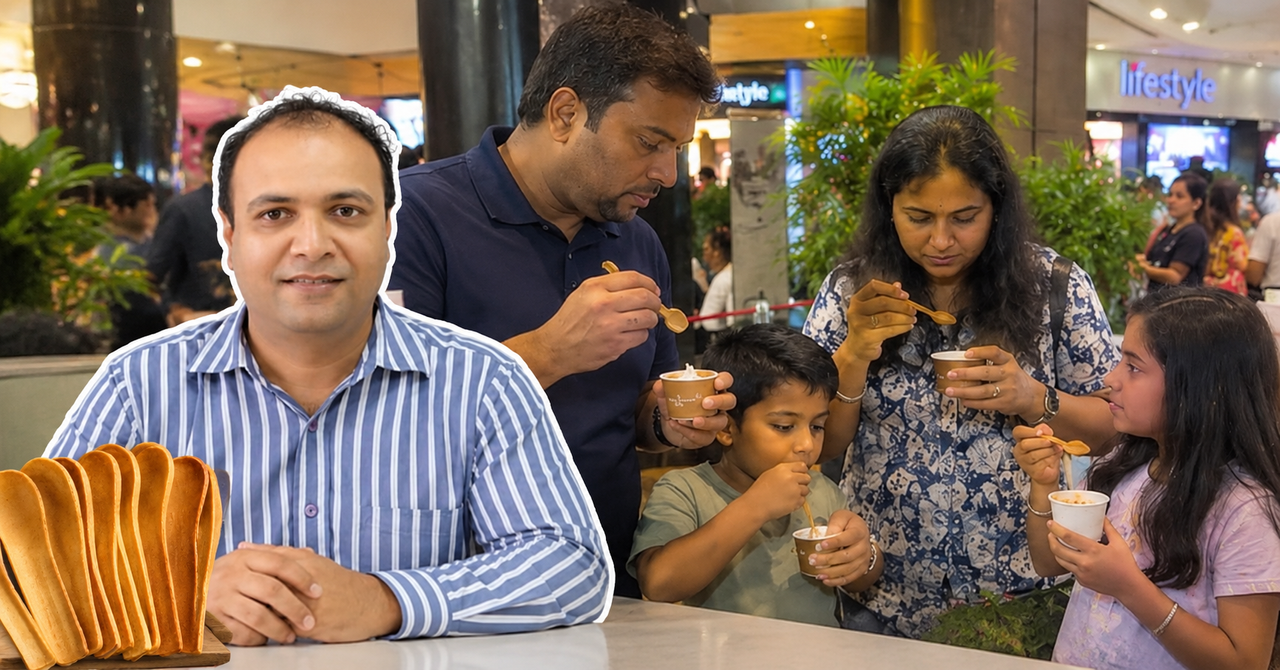
At a Ganpati gathering in Mumbai, lunch was over and everyone was waiting for dessert. The thalis had been cleared, conversations had moved on, and there was only one thing left to do: bring out the kheer.
Except this time, there was something unusual in the cutlery.
Niki Rai, who had organised the gathering, asked her guests to hold on to their spoons instead of throwing them away. A few eyebrows went up. She had already told everyone that these were edible, but people were still understandably unsure.
Then came dessert. “Now this is your biscuit,” Rai told the children, handing them their dessert with the spoon.
The reaction was almost immediate. The children started biting into the spoons, treating them less like cutlery and more like a crunchy snack. The adults were more hesitant, watching first to see if it really worked. Soon, however, others wanted a taste too.
“It was quite a spectacle, but it was worth it,” Rai recalls.
The spoons had been made by Mumbai-based startup Edybites, which is trying to tackle a very ordinary problem: what happens to a disposable spoon after the few minutes it spends helping us finish a meal?
Its answer is simple enough to eat. Founded by Rupesh K Sanghvi in 2022, Edybites makes edible spoons using a millet and flour-based formulation. The idea is that the spoon can become part of the meal rather than another piece of waste to be thrown away. If it is not eaten, the product is designed to naturally decompose.

But turning that simple idea into a spoon that could hold its own through a meal was another story. It had to be sturdy enough to carry food, pleasant enough to eat and practical enough to make at a price people would accept.
The idea began with a spoon and a piece of khakra
For Sanghvi, the thought first came during the COVID-19 lockdown.
With fewer services and errands available, everyday household work suddenly meant doing much more oneself. One day, after preparing a meal and looking at a sink full of utensils, he found himself eating with his fingers because there was no clean spoon left.
That brought back a familiar Gujarati food memory: khakra.
“If we can finish our last meal of dal khichdi with a combination of khakra,” he thought, could something similar be made in the form of a spoon?
The thought stayed with him. It also connected with something Sanghvi had observed during his more than 17 years in the aviation and travel industry. Having worked in sales and business development with airlines including Malaysia Airlines, Flydubai, Malindo Air and Kuwait Airways, he had seen how much disposable material moved through a flight.
Once a flight landed, used food packaging and cutlery had to be discarded. Some meal components could not be reused because of safety and airline policies, even when they had not been consumed.

For Sanghvi, that raised a broader question: could at least one small part of the meal be made differently?
He initially imagined the spoon being used with yoghurt, pastries, desserts or dishes such as dal khichdi and sambar rice on flights. Aviation remains one of the sectors he is interested in, alongside hospitals, institutional catering and events.
The larger idea, however, is not simply to tell people to use less plastic. It is to make the alternative convenient enough that people actually use it.
Making a spoon that does not fall apart
That turned out to be the difficult part.
Sanghvi says he failed 88 times while developing the spoon. Each version had to be tested for its shape, size, weight, and sturdiness. It needed to be strong enough to hold food, but not so hard that eating it became uncomfortable.
The formulation uses a combination of sorghum, corn flour, and wheat flour, along with other ingredients. Sanghvi says the precise recipe is proprietary, but the millet and flour-based formulation is central to giving the spoon its structure.
Too much flour, and the spoon could become soggy quickly. Too much firmness, and it could become difficult to bite.
The team also experimented with flavours. Chocolate emerged as one of the main variants, particularly because it pairs naturally with vanilla ice cream.

That makes dessert one of the easiest places to introduce the concept. A person may be more willing to eat a spoon after finishing a bowl of ice cream than rethink every piece of cutlery used during an entire meal.
There is also a practical reason Edybites has focused on spoons rather than trying to replace every disposable food item at once. Sanghvi says other edible products, such as cups, can face challenges when they are expected to hold liquids for longer periods. With tea or coffee, for instance, the material can soften or affect the eating experience.
The spoon offers a smaller, more manageable starting point.
The product has a shelf life of about three months without refrigeration, with the team working towards extending it further. It is made under a contractual manufacturing arrangement, with attention to hygiene and the heating process required to form the spoon. The finished spoons are individually covered and packed in boxes designed to minimise breakage during transportation.
The product also requires the relevant food safety certification, including an FSSAI licence.
When the spoon reached a real dining table
For Niki Rai, the real test came not in a product demonstration but at a family gathering.
Rai, a learning and development professional and executive coach, had first heard about the product through a friend. She was curious but wanted to try it herself before recommending it to others.
When she eventually used Edybites spoons at a Ganpati gathering, she served them alongside a regular thali and asked guests to try them with the sabzi. Later, she brought them out again with kheer.
The children needed little convincing. “For kids, it was like a biscuit,” she says.
For adults, the experience was more about getting used to the idea. Rai says the spoon felt similar to a regular spoon and was comfortable to use, although its smaller size meant it could not hold a large quantity of food. She found it particularly suited to desserts, while children could use it for foods such as porridge too.

What stood out most to her was not just that the spoon was edible, but that it did not feel like a compromise.
For Rai, taste was important. She also liked that the ingredients included grains such as jowar and wheat, along with fenugreek, rather than making the spoon feel like an entirely separate object that happened to be sustainable.
Once the children started eating theirs, curiosity took over.
The parents who had initially been apprehensive began joining in. Soon, Rai says, people were asking for extra spoons.
Since then, she has continued recommending the product at events and gatherings, including while travelling.
Making the sustainable choice practical
There is, however, a catch.
An Edybites spoon currently costs around Rs 7-8, according to Sanghvi. That is considerably more than a conventional disposable spoon, making price one of the biggest hurdles to getting people to make the switch.
After all, when a plastic spoon costs a fraction of that, convincing someone to pay more for something they will eat or discard after one meal is not easy.
Sanghvi has seen this play out in the conversations around the product.
“However rich you are, at one point you would think, just to have a spoon, why should I pay seven rupees?” he says.
That is why Edybites has not tried to rush into the mass market. Since November last year, when the startup began seeing stronger market traction, it has sold or distributed more than 5,100 spoons. For now, Sanghvi is taking a gradual route, exploring events, institutional catering, hospitals and airlines, along with markets where customers may be more willing to pay for sustainable alternatives.

There is another irony to solve, too.
The spoon is edible, but it still needs to reach the customer intact. That means packaging it carefully against moisture and breakage. Sanghvi says the team is experimenting with paper-based packaging and ways to reduce plastic without compromising the product.
For a startup trying to eliminate one disposable item, using plastic to protect that alternative is hardly an ideal solution. It is a problem the team is still working through.
What happens when a spoon becomes part of the meal?
Perhaps the most interesting thing about Edybites is that its sustainability pitch does not end with the word “biodegradable”.
It asks people to rethink what they consider waste in the first place.
A conventional spoon has a very short life. It may spend a few minutes carrying a bite of food before being separated from the meal and sent to a bin. Edybites is trying to stretch that experience a little further: what if the spoon itself became the final bite?
At scale, that could add up.
Based on an estimated 2.5-3 grams of plastic in a conventional disposable spoon, Edybites estimates that every one lakh edible spoons could potentially displace around 250-300 kg of single-use plastic. At 10 lakh spoons, that works out to roughly 2.5-3 tonnes of potential plastic displacement.
These are estimates of what could be displaced if the edible spoons replace plastic ones at that scale, rather than plastic waste already avoided by the startup.
For Sanghvi, however, the number is only one part of the larger picture.
He is particularly interested in what happens when children encounter such alternatives early. His hope is that edible or biodegradable options could eventually find their way into school canteens, hospitals, senior-care facilities and other places where disposable cutlery is used every day.
And perhaps that is where Rai's Ganpati gathering offers a glimpse of what adoption can look like.

The children simply needed to know they could eat the spoon. Once they did, the idea stopped being a sustainability lesson and became something much more familiar: a biscuit-like treat at the end of a meal.
Rai has continued recommending the spoons at gatherings since that first experience, and her reason is simple.
“We’ve got to be a flag bearer in our own way, no matter how small that change is,” she says.
For now, Edybites is still figuring out how to make that small change cheaper, easier to package, and practical at a much larger scale.
But somewhere between a Mumbai kitchen, 88 failed attempts and a group of children happily chomping through their spoons after dessert, the idea has found its most convincing test yet.
The spoon did not end up in the bin, it ended up being dessert.
All images courtesy of Edybites team
This content is published by The Better India and has not been created or edited by Hello Headlines. View original