India’s Inference Test, Scaler Founder’s New AI Bet & More

Inside The Business Of Inference Platforms
Sarvam is entering its commercial era with Token Factory. By serving global AI models on local GPUs with Rupee billing, Sarvam is now chasing usage-driven revenues. But critics are flaying the unicorn’s new AI inference stack for questionable economics and hosting Chinese models.
Sovereignty Debate: Token Factory lets developers toggle between Sarvam 105B and open-weight models from DeepSeek, Kimi and Gemma 4 31B via a single API. Its inclusion of Chinese models sparked scrutiny after critics questioned whether subsidised GPUs under IndiaAI Mission were powering Token Factory. Sarvam clarified that it is using its own hardware for the service, but questions surrounding its unit economics remain.
Utilisation Economics: Running a token factory on its own GPUs means Sarvam carries the cost of idle capacity. As such, utilisation, not volume, will determine whether the service makes money for the AI unicorn. The expiration of promotional rates (₹0.25 per million tokens) by 2026-end will also test whether developers, who arrive for cheap open models, will ultimately stay for Sarvam’s proprietary stack.
Data Risks: Sarvam’s Data policy adds another layer of risk. The AI unicorn offers zero data retention only on request. This means that Token Factory, by default, will use user data to fine-tune its models unless clients explicitly disable the feature. For enterprises handling sensitive or proprietary information, this could be a dealbreaker.
A Crowded Realm: Sarvam is not alone in building India’s inference layer. Construction giant L&T is scaling its Vyoma.AI token factory, E2E Networks is expanding via Jarvislabs and Utho Cloud is planning a 2027 entry. Mirror Security is carving out a niche in encrypted-inference, while global giants like OpenAI and Anthropics are also localising workloads. Amid this heavily contested landscape, price, speed and reliability could become the main differentiators.
As India rides the AI inference wave, can Sarvam’s Token Factory stay ahead of the curve and build a globally competitive inference powerhouse? Let’s find out…
From The Editor’s Desk
 Scaler Founder’s New AI Bet
- Anshuman Singh has launched a new startup called Arcfront. The new AI venture studies how professionals solve problems and then turns this data into training material for AI models. He is building the venture with ex-Google executive Naman Bhalla.
- Singh claims that Arcfront already caters to four frontier AI labs, without disclosing their names. Separately, angel investor Gokul Rajaram said that the new startup generated $80 Mn in revenue in September 2026.
- Arcfront joins a growing list of startups building training datasets, testing tools and simulated work environments for AI developers. As per Inc42 data, the homegrown AI ecosystem is projected to become a $126 Bn opportunity by 2030.
 Celcius Eyes ₹100 Cr
- The cold-chain logistics provider is in advanced talks to raise nearly $10.8 Mn in its Pre-Series C funding round from existing backers IvyCap Ventures, Omnivore, and Eurazeo. The round is expected to materialise by mid-2027.
- The potential fundraise, which is expected to comprise both equity and debt, will likely go towards strengthening its tech infrastructure, scaling its business and expanding its presence across India.
- Founded in 2020, Celcius operates a digital platform that connects shippers with transporters and cold storage providers. It operates over 50 distribution hubs. The startup has raised $52 Mn in funding to date.
 Hackers Breach MoEngage
- The SaaS startup has said that cyberattackers unauthorisedly accessed a limited part of its cloud infrastructure via a compromised third-party vendor account. It claims to have contained the incident in late-October and has strengthened its security measures.
- The aftermath saw some of its clients facing difficulties in accessing the platform for nearly seven days. However, MoEngage denied any disruption in its services. It also claimed that less than 1% of its customer accounts were impacted.
- The incident comes amid growing concerns around AI-assisted cyberattacks. In the past week alone, data breaches at State Bank of India, CoinDCX and Optimizely have raised concerns over the resilience of global tech infrastructure amid the growing threat of AI.
 Muted Week For Startup Stocks
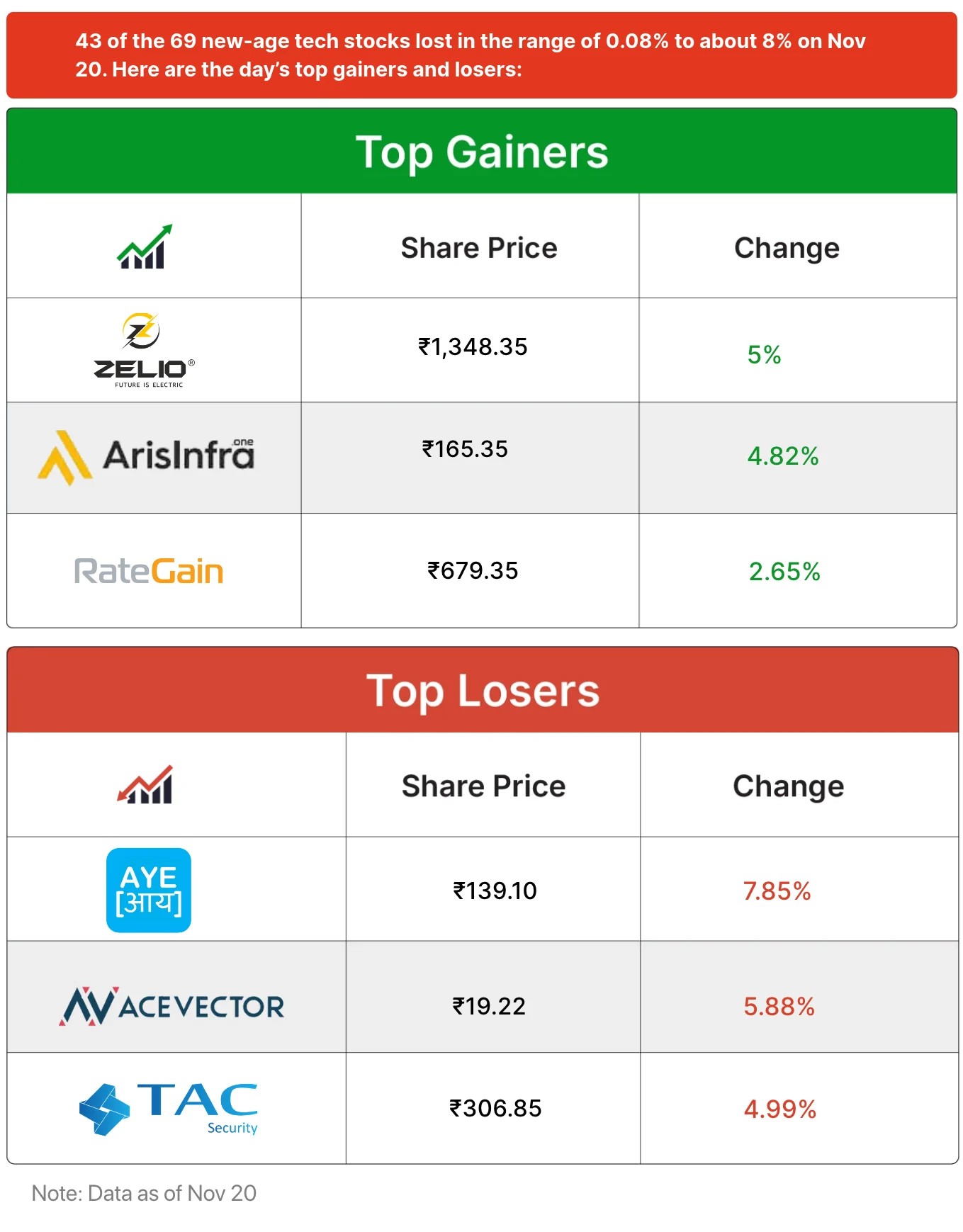
- Of the 69 new-age tech stocks under Inc42’s coverage, only 22 ended last week with gains. The remaining 47 startup stocks ended the week in the red. Zappfresh and TAC Infosec shed the most, while Zelio and Veefin emerged as the biggest gainers.
- The combined market capitalisation of the 69 new-age tech stocks remained nearly flat at $176.9 Bn at the end of the last week, down about $100 Mn from $177 Bn the preceding week.
- Going forward, investors will track crude oil prices, developments in West Asia, upcoming domestic GDP data, and interest rates for market cues next week.
 Fi Money’s FY26 Show
- The fintech startup managed to narrow its consolidated net loss by 25% YoY to ₹153.3 Cr in FY26. The reduction in its loss appears to be a signal of shrinking scale as the startup’s operating revenue declined 21.1% YoY to ₹38.7 Cr in the fiscal under review.
- In line with its top line, the fintech startup’s total expenses for the fiscal also fell 22.8% to ₹207.5 Cr from ₹268.9 Cr a year ago.
- Founded in 2019, Fi Money started off as a neobank that offered savings accounts, loans, investments and wealth products. It later announced a pivot to B2B AI and enterprise tech offerings. The startup has raised $137 Mn to date.
 Weekly Funding Rundown
- Indian startups cumulatively raised $291.3 Mn last week, up 1,056% week-on-week. Deal count also zoomed 144% to 22 compared to just nine deals last week. Dreamteam and Style Union took the biggest cheques home at $53 Mn and $51.8 Mn, respectively.
- AI startups dominated the funding charts last week, raking in $114 Mn across seven deals. Ecommerce emerged as the second-most funded sector as three startups raised a combined $66.8 Mn.
- Early stage funding activity also remained strong as seed-stage startups garnered $25 Mn across two deals. Accel emerged as the most active investor last week, participating in the rounds of Humyn Labs, August AI and others.
Inc42 Markets
Inc42 Startup Spotlight
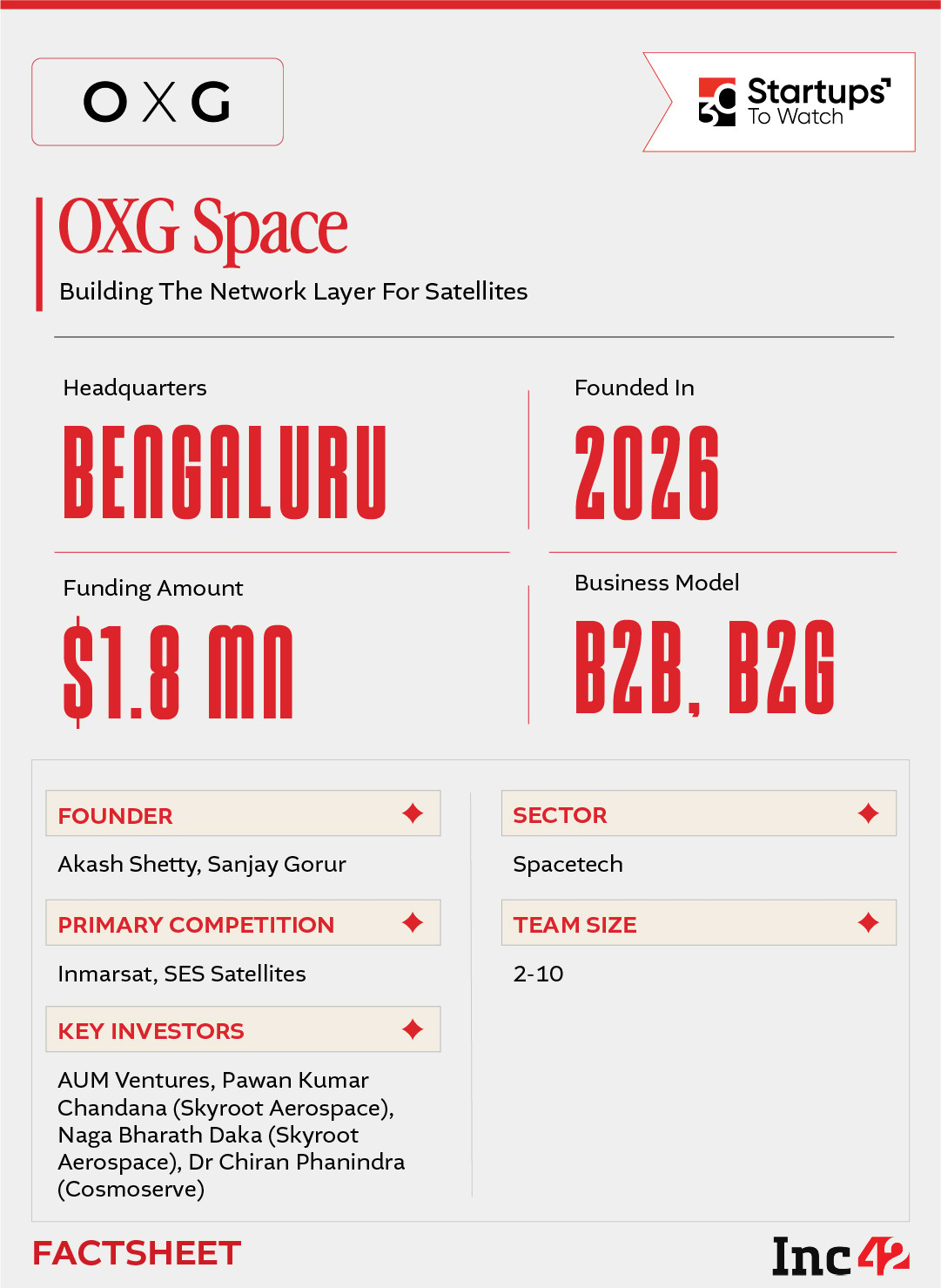
How OXG Space Is Building A Data Highway For Satellites
Satellites can capture images of a crisis within minutes, but their data often takes hours to reach the Earth. This can delay decisions in mission-critical sectors like defence and intelligence. OXG Space is plugging this gap with its orbital network that can relay satellite data in near real time.
5G Towers In Space: Founded earlier this year, OXG is building an orbital network to provide continuous satellite connectivity and in-orbit computing. Its shared orbital nodes are designed to maintain persistent contact with Earth orbit satellites, relay data and fuse inputs from multiple satellites. It is initially targeting a 1 Gbps-class link, with a future roadmap toward 64 Gbps per spacecraft.
By processing data where it is created, it plans to help defence and intelligence operators coordinate optical and radar assets in near-real time.
Aiming For The Skies: Backed by Aum Ventures, the startup now plans to launch Mission Synapse, a 12-month programme to demonstrate its antenna, ground-link and in-orbit computing technologies. The startup’s next challenge will be proving its tech stack and scaling commercial deployments.
Eye On The Prize: As demand for satellite imagery and analytics rises, the global Earth-observation market is projected to become a $7.2 Bn opportunity by 2030. The startup aims to carve a niche in this space with its technology, which combines 5G non-terrestrial network-inspired connectivity with in-orbit computing. So, can OXG Space turn satellite data into real-time intelligence?
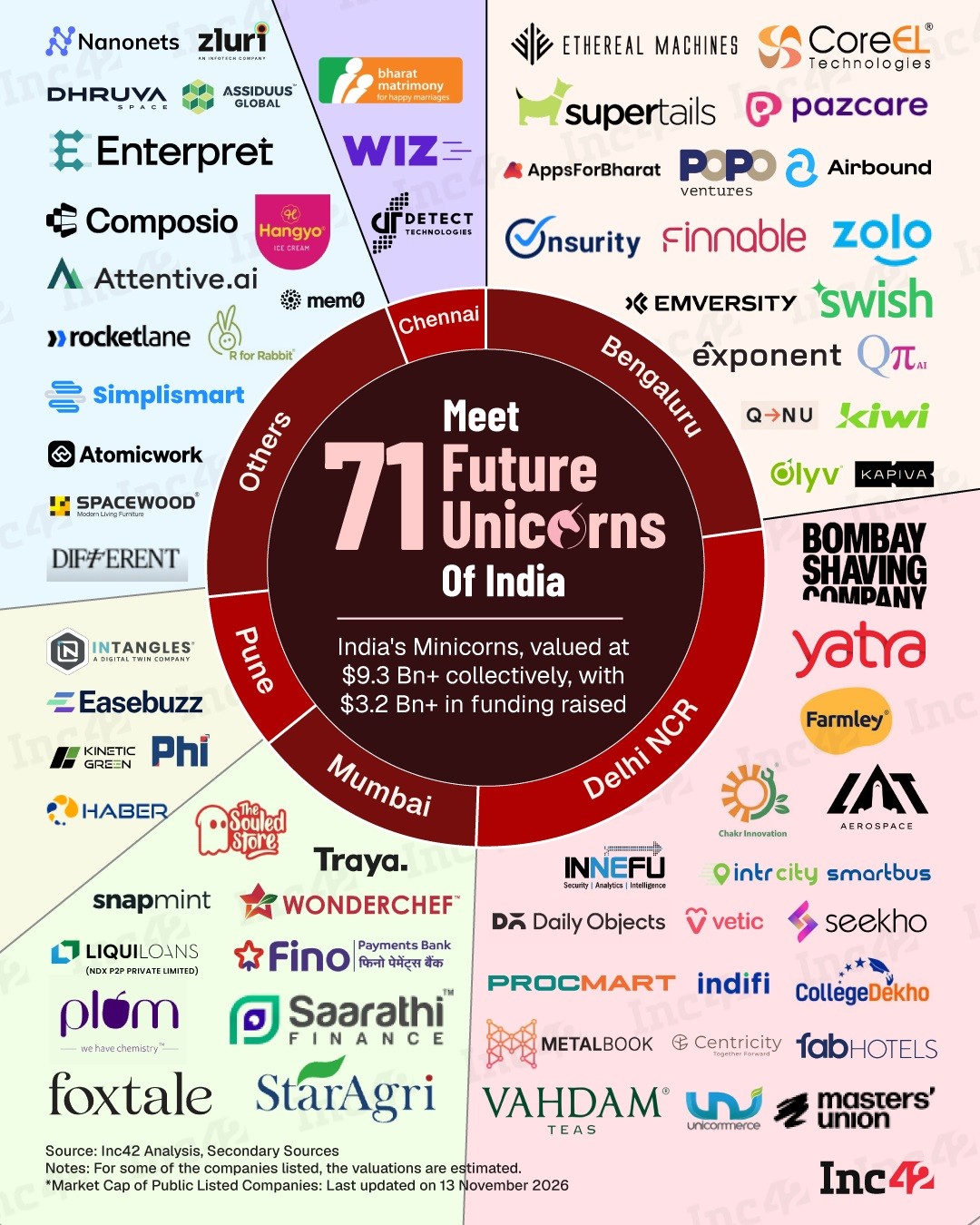
Infographic Of The Day
India’s startup ecosystem isn’t just about unicorns. There’s a whole bunch of startups building big businesses just below that billion-dollar mark. These 71 minicorns are already worth $9.3 Bn+ collectively and have raised $3.2 Bn+ in funding…
The post India’s Inference Test, Scaler Founder’s New AI Bet & More appeared first on Inc42 Media.
This content is published by Inc42 and has not been created or edited by Hello Headlines. View original