Opinion: Beyond newsroom—Dalit, Adivasi women are building India’s digital counter-publics
By Dr Korvi Vinayakala
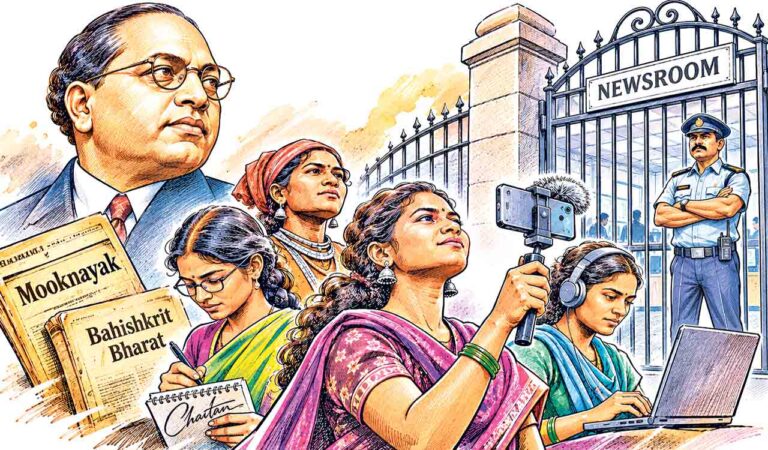
The newsroom gate still stands. Dalit and Adivasi women have simply stopped waiting at it. In 1920, a young BR Ambedkar launched a Marathi fortnightly and called it Mooknayak, the leader of the voiceless. He did so because the newspapers of his day would not print what he had to say. Seven years later came Bahishkrit Bharat. More than a century on, I keep returning to that first title, because the question it posed has not gone away. It has only moved house, from the printing press to the smartphone.
Consider first who still holds the pen. When Oxfam India and Newslaundry examined 121 leadership positions across Indian newspapers, television channels, news websites and magazines in 2022, 106 were held by journalists from the general castes. Not one was held by a Dalit or an Adivasi.
Of the 87 anchors of primetime Hindi and English debate shows they studied, about three in four were upper caste, and none was Dalit, Adivasi or OBC. In English newspapers, no more than five per cent of bylines belonged to Dalit and Adivasi writers. These are not the figures of a profession that has merely forgotten to diversify. They describe a gate, and a well-guarded one.
A Guarded Gate
The violence that this gate filters, meanwhile, continues without pause. The National Crime Records Bureau registered 57,789 crimes against Scheduled Castes in 2023, up from 57,582 the year before and 50,900 in 2021. That is roughly 28.7 cases for every lakh of the Scheduled Caste population, and these are only the cases that found their way into police registers. Anyone who has done fieldwork in rural India knows how many never do. When such stories reach the front page at all, they tend to arrive as spectacle: a body in a field, a protest, a minister’s statement. The Dalit woman appears as an object of pity, seldom as someone who thinks, argues and writes.
An Old Diagnosis
None of this would have surprised the scholars who reshaped the study of caste and gender in the 1990s. Uma Chakravarti gave us the term ‘Brahmanical patriarchy’ in 1993 to describe how caste purity is maintained through the control of women’s sexuality. Gopal Guru argued in 1995 that Dalit women “talk differently”, because they are pressed down at once by caste, by class and by the patriarchy within their own communities. Sharmila Rege showed how the cultural capital needed to enter print and television had been concentrated, for generations, within Savarna networks.
A century ago, Ambedkar’s Mooknayak insisted the voiceless were never actually voiceless; they were simply denied a platform. The platform now exists. The harder question is whether we are prepared to listen
The deeper root lies in Ambedkar’s 1916 paper, Castes in India. There he identified endogamy—marrying only within one’s group—as the engine that produces and protects caste. To keep that engine running, he observed, the social order must regulate women’s bodies, making women the gateways of the caste system. Mainstream Indian feminism, for all its achievements, has too often treated “woman” as a universal category and patriarchy as a single, caste-blind enemy. The Dalit woman’s experience was folded into a story written largely by others.
What Internet Has Changed
This is where new media has made a genuine difference, and it is worth being precise about how. The point is not that technology is liberating in itself. The point is that it removed the editor’s permission slip.
Take Savari, a web portal conceived, run and written entirely by Adivasi, Bahujan and Dalit women. Its essays do not ask to be included in someone else’s conversation; they start their own. Jenny Rowena’s ‘Woman and Community’, Kanika S’ ‘Caste Management through Feminism in India’ and Huma Dar’s ‘Of Power and Privilege: Faultlines in Upper-Caste Indian Feminism’ turn the lens around. Dar, in effect, applies Ambedkar’s theory of endogamy to the conduct of dominant-caste women themselves.
They face patriarchy, yes, but through the marriages they make, they also preserve the wealth, status and lineage of their castes. Read alongside Anu Ramdas’ ‘Feminism is Brahminism’, these writings explain why sisterhood across caste so often breaks down at precisely the moment it is most needed.
Or take Round Table India, a news and opinion portal rooted in Ambedkarite thought. Its contributors have shifted the debate from a paternalistic “Dalit problem” to what is more honestly called an upper-caste problem. Anoop Kumar’s ‘Merit is Constructed via Coaching Centres’ and Vaibhav Kharat’s ‘Merit: A Savarna Tool to Reinforce Caste Hegemony’ dismantle one of our most comfortable myths. What elite institutions call neutral merit is very often social and cultural capital accumulated over generations of endogamous privilege and then presented as individual talent. Many of us who teach in those institutions would do well to read them slowly.
These portals are the direct descendants of the Phules’ schools, of Tarabai Shinde’s fierce critique of gendered double standards and Ambedkar’s journals. The pamphlet has become the blog post; the local press has become the web archive. What has changed is the scale. India crossed roughly 900 million internet users in 2025, according to the IAMAI-Kantar report, and 98 per cent of them now go online in Indian languages. A Dalit woman in a small town no longer needs a city editor to publish. She also has the means to reach the Dalit diaspora and international human rights networks that once sat entirely out of reach.
The New Gatekeepers
I would be failing my own students, however, if I told only the hopeful half of this story. Access remains deeply unequal. The fifth National Family Health Survey found that only 33 per cent of Indian women had ever used the internet, against 57 per cent of men; among rural women, the figure was just 25 per cent. There is little reason to think Dalit and Adivasi women sit above that average. The counter-public is real, but its doors are narrower than the headline numbers suggest.
Those who do get online meet a different kind of gatekeeper. When Equality Labs studied a thousand hate-speech posts on Facebook India in 2019, 13 per cent were casteist, and 93 per cent of the hateful posts it reported were still on the platform afterwards.
Sunaina Arya has rightly warned of a “digital untouchability”: coordinated trolling, algorithms that bury anti-caste writing, and moderation systems that read a sharp critique of caste as a violation of community standards while allowing casteist abuse to stand. There is also a quieter problem. Dominant-caste users increasingly perform anti-caste solidarity on X and Instagram for the social credit it earns, without giving up a single seat on a board, a faculty or an editorial desk.
What Would Actually Help
Three things are both necessary and achievable. Newsrooms should publish their own caste and gender composition every year, as many publish their circulation, and set targets against which they can be held accountable. Platforms that already list caste as a protected category in their policies must enforce it in Indian languages, with Dalit and Adivasi moderators and researchers involved in the work. And universities should treat writing on Savari and Round Table India as serious scholarship, placing it on syllabi beside Chakravarti, Guru and Rege. Subaltern knowledge is not raw material for someone else’s theory. It is theory.
What these portals show is that marginalised communities are not passive recipients of technological modernity. They have seized its tools to write their own histories and to carry an Ambedkarite vision of emancipation into a globalised age. A century ago, Mooknayak insisted that the voiceless were never actually voiceless; they had simply been denied a platform. The platform now exists. The harder question, for the rest of us, is whether we are prepared to listen.
(The author is Head and Assistant Professor, Department of English, Telangana Social Welfare Residential Degree College for Women, Siddipet at Mittapalli)
This content is published by Telangana Today and has not been created or edited by Hello Headlines. View original