Kashmir’s Saffron Fields Cannot Become Dumping Grounds
Kashmir, Observer, Jammu, Srinagar, Latest Kashmir News, Kashmir News, Kashmir Latest News
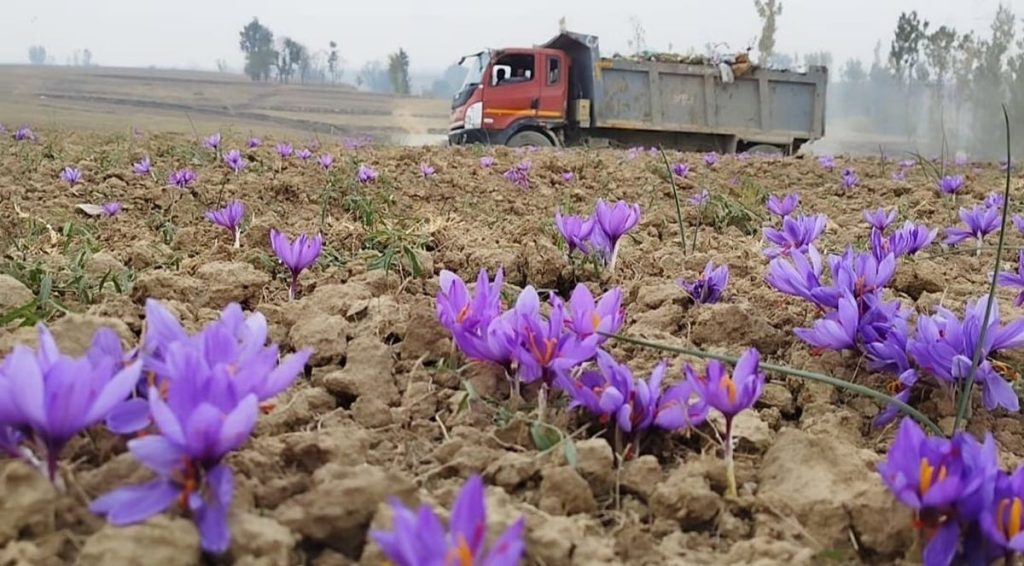
I have watched garbage trucks pass through the saffron fields of Patalbagh and Galandar, near National Highway 44, for almost three years.
October and November are the worst months.
This is when the saffron flowers bloom, but the garbage trucks keep coming. I have written about it, filmed it and shared videos online. Still, nothing has changed.
The dump sits in a small valley between two raised saffron fields. It is Kahcharai land, which means village grazing ground for sheep and cattle.
About five years ago, the Pulwama district administration gave around 67 kanals, or 8.3 acres, to Municipal Committee Pampore to build a waste management plant. That plant was supposed to sort and treat the waste.
What the land got instead was four years of untreated, mixed garbage, tipped straight onto the ground.
Nobody asked the village.
The deputy commissioner made the allotment without speaking to the Halqa Majlis or the Ward Committee, and state land belongs to those bodies, not to the Revenue Department.
Neither body has worked for three years, and the elected government doesn’t seem keen on holding panchayat and urban local body elections.
So the people with the best claim to that grazing ground weren’t there when it was handed away.
Officials like to tell commoners that ignorance of the law is no excuse. Fine, then the same goes for the municipality and the deputy commissioner.
Dumping mixed waste breaks the Solid Waste Management Rules of 2016 and their 2026 update. It breaks the Saffron Act of 2007 too, and this land was never meant for a dump at all.
Who should have caught it?
The Agriculture Department calls itself the guardian of saffron farming in Kashmir. On July 10, 2026, its extension officer in Pampore wrote to the Sub Divisional Agriculture Officer in Tral, asking him to take it up. He could have acted himself.
Meanwhile, rats and rodents have eaten saffron corms on about 2,000 kanals. Growers watched their crop go while a letter moved one desk higher.
The Pollution Control Committee was no faster. Its divisional officer in Pulwama did nothing for four years. I told the Regional Director at least a dozen times. A notice went to the municipality only after I complained to the chairman, Vasu Yadav, and the site stayed open even then.
The Supreme Court has given these committees the power to impose environmental compensation on their own. Four years have gone by and they haven’t charged Pampore’s municipality a single rupee.
I ended up doing a job that officials are paid for.
So I went to the National Green Tribunal, with around 40 saffron growers as co-petitioners. Our case was listed first on 17 November 2026. My lawyer, Saurabh Sharma, showed the bench geotagged photographs and the pollution committee’s own report. He had a three-minute video ready, but the judges had seen enough. Chairperson Justice Prakash Shrivastava and Expert Member Dr Afroz Alam set up a Joint Committee at that first hearing.
The committee has people from SKUAST-K, the Regional Director of the Ministry of Environment, Forest and Climate Change, and a nominee of the pollution committee.
Within eight weeks they must visit Patalbagh, assess the damage to the 2,000 kanals and the land around them, and check whether the dump has the clearances the law demands.
The Deputy Commissioner of Pulwama, the officer who allotted the land, will coordinate the visit.
I am glad the tribunal moved quickly, but the speed bothers me.
Photographs, one report and two judges were enough for a single hearing. Comparatively, four years of local offices gave us a letter passed between desks.
If the evidence was always this clear, the failure sat in the offices closest to the fields.
I could reach a tribunal. Most people who farm that soil can’t, and nobody has told me where they are supposed to go.
SKUAST-K now has a seat on the committee, and it can use that seat well. Its draft Mountain Development Policy says little about protecting saffron land or the karewas where much of the saffron grows.
Illegal digging of soil and sand has stripped those karewas for years, and now garbage stations are going up on them too.
I took a similar case to the tribunal over a dump Municipal Committee Pulwama set up on karewa land in Newa. I have written about a Karewa Protection Authority, and Bijbehera MLA Dr Bashir Veeri has tabled a private member’s bill on the same idea.
The university could suggest how to restore and landscape these fields. I plan to put that to its Vice Chancellor soon.
At the end of the day, a tribunal can order an inspection, but it can’t make a municipality ask a village before it fills the village’s grazing ground with garbage.
Only an elected body can do that, and the grazing ground is still waiting for one.
The post Kashmir’s Saffron Fields Cannot Become Dumping Grounds appeared first on Kashmir Observer.
This content is published by Kashmir Observer and has not been created or edited by Hello Headlines. View original